


 5
5
Welcome to our institutional newsletter, Crypto Long & Short. This week:
- Sylvia To on AI agents choosing denationalized money
- Top headlines institutions should pay attention to by Francisco Rodrigues
- Kamino hits $90M in OnRe liquidity while $KMNO drops 16% in Chart of the Week
Thanks for joining us!
-Alexandra Levis
Expert Insights
Hayek predicted it, Satoshi built it, agents will use it: the stealth denationalization of money
- By Sylvia To, vice president, Bullish Capital Management
While F.A Hayek, Satoshi and AI may seem like three unrelated topics, the next few minutes will reveal exactly how critical this triad is to our financial sovereignty and it will fundamentally change your view on money as we know it.
Crypto’s cypherpunk ethos
Amid flashy distractions of memecoins, speculation and NFTs, Satoshi would want us to remember the true ethos of crypto, that is: privacy, decentralization and censorship resistance. These ideologies did not come from central banks or policy makers. They came from the cypherpunk’s definition that freedom is best defended not by persuasion but by architecture.
As Vitalik Buterin recently articulated in his March 2026 thread on X, this means building “sanctuary technologies” that create “shared digital space with no owner,” enabling “interdependence that cannot be weaponized” and advancing “de-totalization” to prevent total control by any power.
Money should be a product, not a decree
In 1976, Hayek argued that money should not be “legal tender” forced on people by the state. It should be discovered, adopted and discarded through market choice like any other product. His book Denationalisation of Money outlined these characteristics of “good money”:
• Non-state issuance: not decreed, not voted, not bail-out-able.
• Rule-based monetary policy: predictable supply schedule, not discretionary.
• Global choice: adoption is voluntary; anyone can opt in or out.
• Resistance to capture: no central issuer to pressure, no board to replace.
• Settlement without permission: value transfer doesn’t require institutional approval.
Sound familiar? Yes, Bitcoin.
Bitcoin sits in a special category inside that experiment. Not because it’s perfect today, but because it is plausibly the first monetary network to meet Hayek’s central requirement. That is money introduced by some pathway that cannot easily be stopped. As Bitcoin undergoes price discovery, its volatility is the cost of birth and the market deciding what an ungoverned, credibly scarce asset is worth in a world trained for fiat. But even in that turbulent phase, Bitcoin checks a surprising number of Hayek’s boxes.
The trojan horse: stablecoins and the trap inside it
If we’re honest, stablecoins are currently one of crypto’s most successful use cases. They are fast, programmable and easy to price. They move across borders with far less friction than bank wires.
But here’s the uncomfortable truth: stablecoins don’t denationalize money. They digitize the existing national money and extend its reach. Most stablecoins do not compete with the dollar. They import the dollar.
The dollar is a tool of state policy. Pegging to it ties you to its inflation, its surveillance, its sanction regime, its banking chokepoints and its regulatory priorities. Stablecoins may feel like freedom because they move on open networks, but their reference asset is still the same old sovereign instrument.
So while stablecoins can be useful, they also risk becoming the perfect bridge into tighter control. In that sense, stablecoins are not neutral. They are a competitor to decentralized currencies. If bitcoin is denationalization, stablecoins are nationalization with better UI.
The real end user
Here’s where the story gets more interesting and more Hayekian.
Humans are emotional, irrational, politically driven and short-term oriented. Our monetary systems reflect that. We routinely trade long-term stability for short-term relief, then act surprised when crises compound.
But what happens when most of the participants in the economy aren’t humans?
With the meteoric rise of agentic software, and apps increasingly being designed for agents using frameworks like Model Context Protocol (MCP), there is a credible near-term future where autonomous agents purchase services, data, compute, API calls, storage, inference and specialized tools through continuous micropayments.
Agents will care less about branding and narratives and more about properties like:
• machine-readable transaction metadata
• instant, programmable finality
• composability with other systems
• low transaction overhead
• censorship resistance (because uptime is a feature)
• predictable monetary rules (because models optimize against them)
In other words: agents will gravitate toward money that behaves like good infrastructure. A stablecoin is stable because an issuer maintains a peg. An agent might ask: What is the failure mode of the issuer? What is the policy risk? What is the censorship risk? What is the settlement risk under stress? Bitcoin’s value may fluctuate, but its rule set is unusually legible. Its issuance is not negotiated. Its core properties do not depend on a board decision, a regulator’s discretion or the solvency of a nation.
Maybe humans won’t choose the best money because we’re too entangled in politics, habit and fear.
Maybe Hayek’s “new money” was never meant for humans — at least not first.
Maybe the pathway that governments “can’t stop” isn’t a mass political movement.
Maybe it’s AI agents who operate at machine speed, indifferent to national identity, optimizing for reliability, who can be the deciders of the new monetary rails.
When that tipping point arrives, denationalization of money won't feel like a philosophical triumph. It will be an inevitable engineering outcome, propelled not by ideology, but by raw machine necessity.
When that tipping point arrives, denationalization of money won't feel like a philosophical triumph. It will be an inevitable engineering outcome, propelled not by ideology, but by raw machine necessity.
Headlines of the Week
- By Francisco Rodrigues
Traditional finance giants, including the owner of the NYSE, ICE, and Morgan Stanley, have kept on making strategic moves in the crypto space, while regulatory milestones like Kraken securing Fed access signal the industry's path toward mainstream integration.
- NYSE owner invests in crypto exchange OKX at $25 billion valuation: Intercontinental Exchange, the parent company of the New York Stock Exchange, acquired a minority stake in crypto exchange OKX, valuing the firm at $25 billion. ICE will license OKX's spot crypto prices to launch crypto futures, while OKX will offer ICE futures and tokenized equities to its customers.
- Morgan Stanley names Coinbase and BNY as custodians in proposed bitcoin ETF filing: The Wall Street giant updated its S-1 filing for a proposed spot bitcoin ETF, designating BNY as administrator and cash custodian and Coinbase Custody as the crypto custodian.
- Kraken becomes first crypto company to secure Fed master account access: The approval lets Kraken speed up deposits and withdrawals for large traders and institutional clients, but is limited, with Kraken not earning interest on reserves or accessing the Fed's emergency lending.
- Kazakhstan central bank to invest $350 million worth of gold, forex reserves into digital assets: The strategy will focus on shares of high-tech and cryptocurrency infrastructure companies, as well as crypto-linked index funds.
- Billions in crypto are moving in Iran. Analysts can't agree if it's war-time panic or business as usual: When airstrikes hit Iran on Feb. 28, crypto outflows from Nobitex spiked 873%, suggesting a “digital bank run” was ongoing. The reality may be more complex.
Chart of the Week
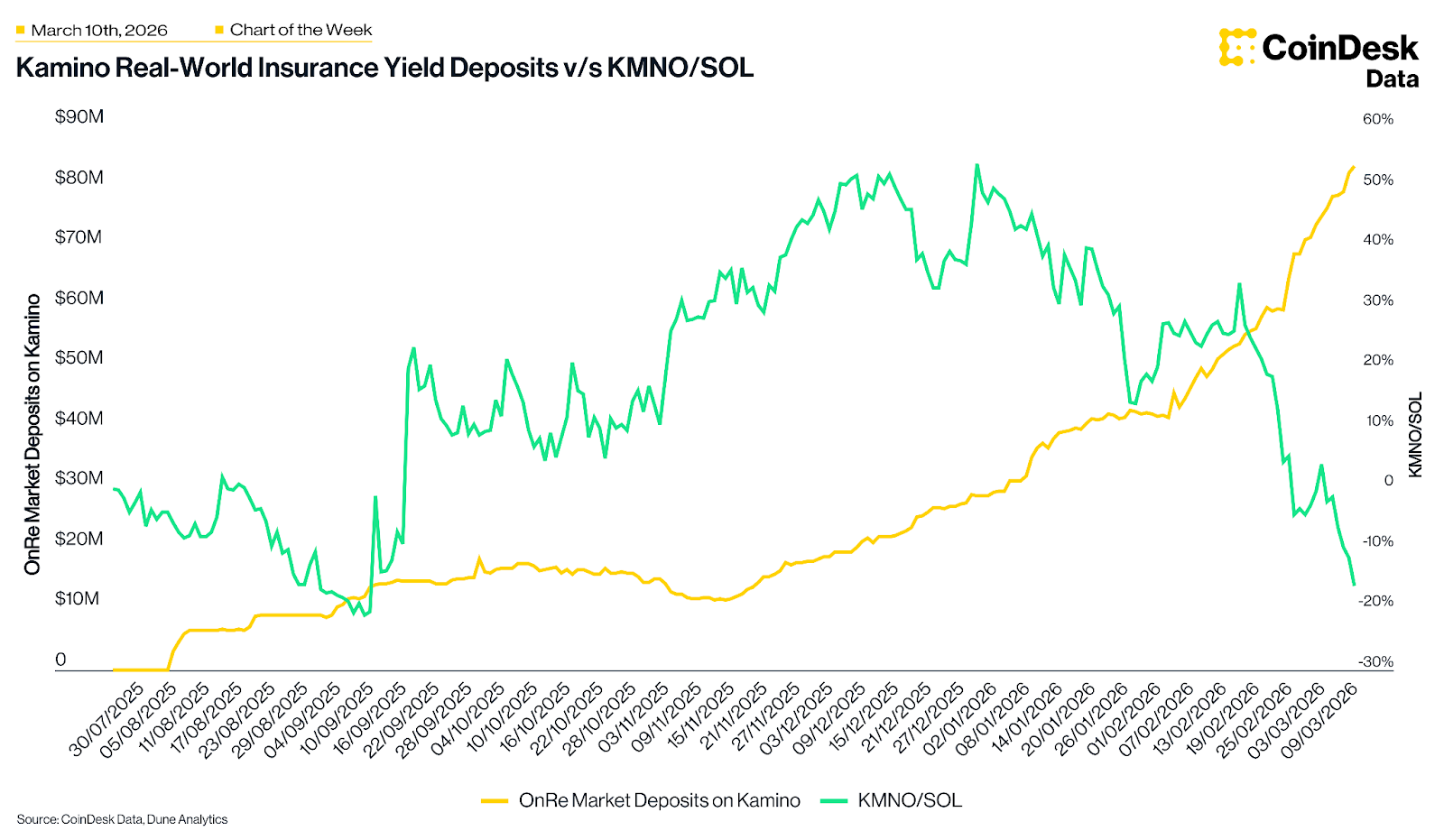
Kamino hits $90M in OnRe liquidity while $KMNO drops 16%
Kamino's OnRe market has increased 80% to nearly $90M in 30 days, cementing its position as the primary liquidity layer for OnRe's on-chain reinsurance protocol. This growth allows users to bet on a $480B+ real-world vertical by using $ONyc- a tokenized insurance asset - as collateral.
However, this fundamental RWA scaling sharply diverges from the native $KMNO token; the $KMNO/SOL pair has dropped 16% over six months, pressured by a broader market downturn and 13M monthly token unlocks (0.13% of total supply).
Listen. Read. Watch. Engage.
- Listen: The third annual Wealth Management Day is back alongside Consensus Miami! Apply today to join this free, exclusive day of education and networking.
- Read: February ETF and ETP review from ETF Express contributed by Joshua de Vos.
- Watch: CoinDesk Data & Indices President David LaValle joins Jennifer Sanasie to discuss why BTC is holding steady despite global volatility.
- Engage: Come see CoinDesk Data & Indices at Exchange Conference. CoinDesk Data & Indices David LaValle and Etienne Hannart will be onsite.
Looking for more? Receive the latest crypto news from coindesk.com and explore our robust Data & Indices offerings by visiting coindesk.com/institutions.
Note: The views expressed in this column are those of the author and do not necessarily reflect those of CoinDesk, Inc., CoinDesk Indices or its owners and affiliates.

 cryptobriefing.com
 1
1
