



 6
6
Ethereum researchers and developers have proposed gradually burning more validator rewards as staking rises.
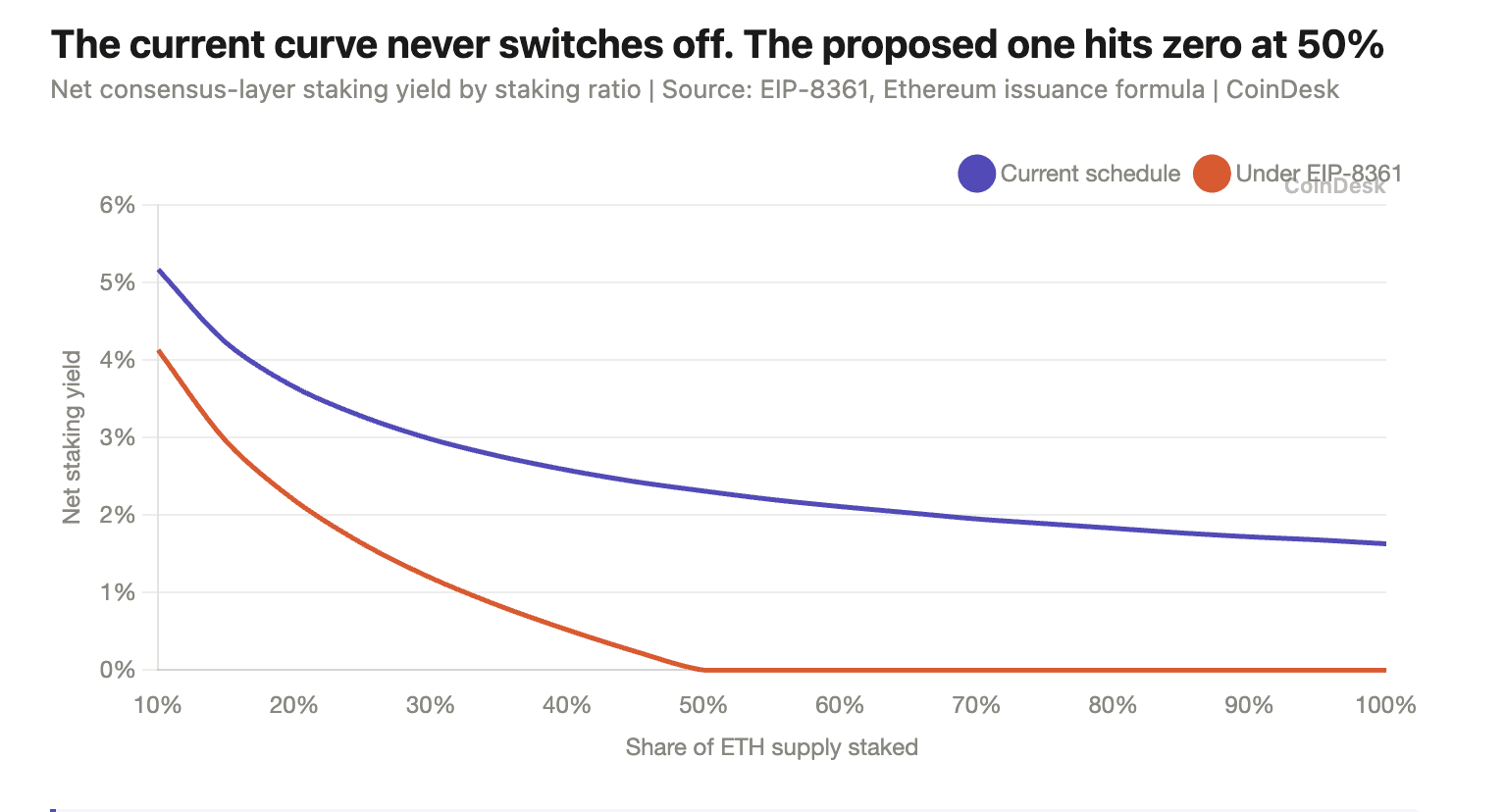
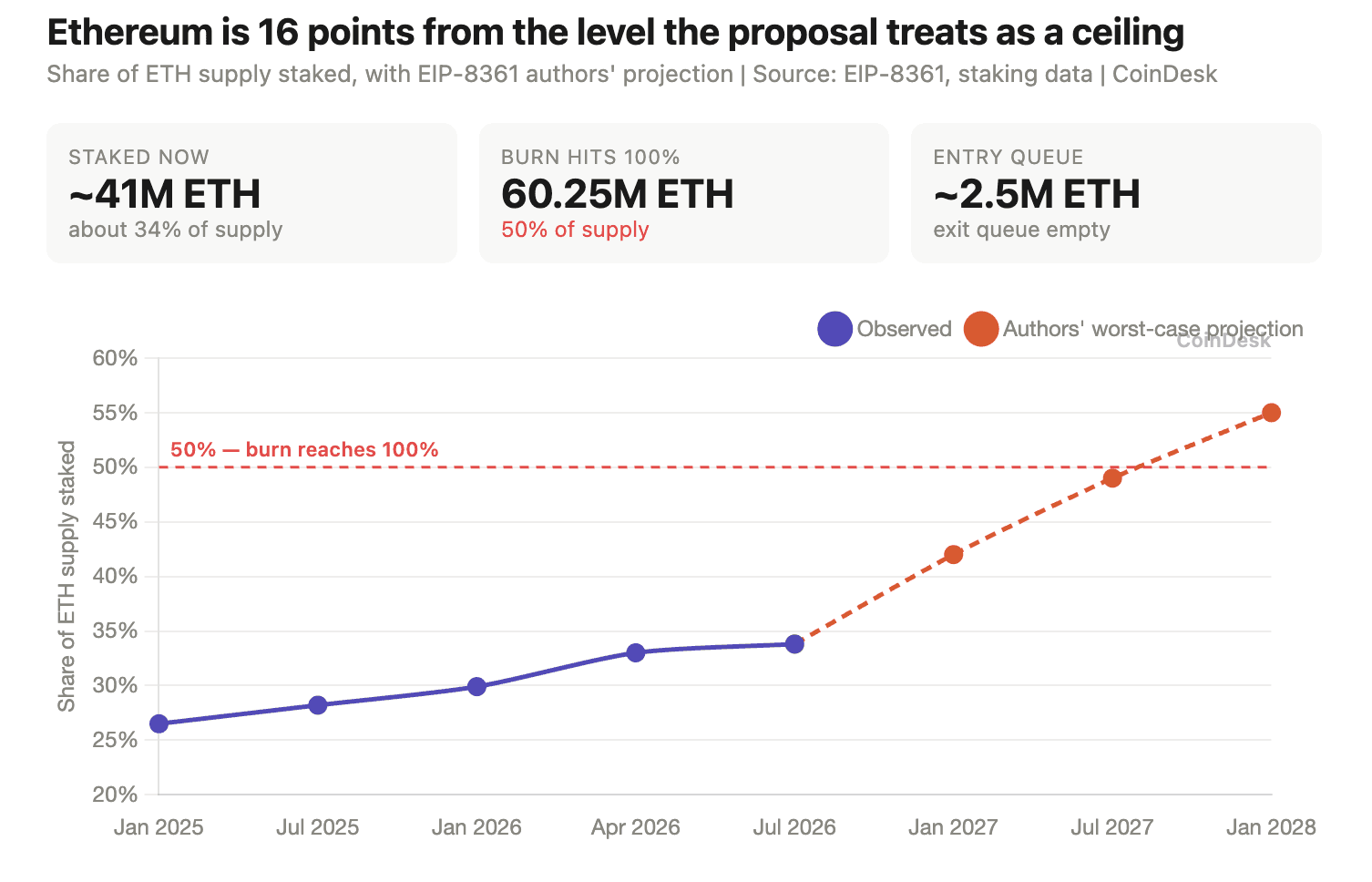
The burn would hit 100% once roughly 60.25 million $ETH (about half the total supply) is staked, driving net issuance to zero and potentially strengthening $ETH’s long-term scarcity and valuation by limiting further dilution of existing holders.
Staking is how Ethereum secures itself. Holders lock up $ETH and run software that validates transactions, and the network pays them for it by creating new $ETH. Those participants are validators, and that newly created $ETH is the reward. Burning means destroying coins permanently rather than paying them out.
Every 6.4 minutes, at the close of what Ethereum calls an epoch, a fraction of each validator's rewards is deducted and destroyed rather than redirected elsewhere, with that fraction rising linearly to 100% as staking approaches the saturation point.
Validators would still be paid the same way for doing the same work, and they keep all the transaction fees and tips they earn from building blocks. Only the newly created $ETH gets burned. The deduction from validator rewards arrives slowly, phasing in over 18 months, with about six months before that while the upgrade ships, so roughly two years to adjust.
Six researchers signed the proposal, including Justin Drake of the Ethereum Foundation. It landed days before the deadline for smaller changes to be considered for Hegotá, Ethereum's next network upgrade.
The problem, as the authors see it, is that staking never stops paying. Even if every $ETH were staked, the yield would still sit near 1.5%, so there is always a reason to add more.
Jérôme de Tychey, one of the proposal's authors, projects more than 70 million $ETH staked by January 2028 if nothing changes. Past a certain level, the proposal states, extra stake makes Ethereum less secure rather than more, because the $ETH ends up held by exchanges and staking providers instead of its owners, while small individual stakers get squeezed out.
About 41 million $ETH is staked today, or close to 34% of supply. Another 2.5 million sits in the queue waiting to be activated, trackers show, a wait of six weeks or more, and nobody is queuing to leave.
Ethereum limits how fast validators can join or leave, so both directions form a line. The cap exists so a large bloc can't enter or exit fast enough to destabilize the network. Entry queue is $ETH waiting to start staking, exit queue is $ETH waiting to stop. Currently about 57,600 $ETH a day can activate.

 bitcoinworld.co.in
 cointelegraph.com

 ambcrypto.com

