



 14
14
Ethereum’s staking success may have created a new problem, at least according to the authors behind newly submitted EIP-8361. The proposal introduces a Tapered Issuance Burn mechanism designed to remove incentives for staking beyond 50% of Ethereum’s total supply, arguing that the network’s current issuance curve encourages unlimited validator growth instead of allowing market forces to determine equilibrium.
Ethereum Staking Debate Intensifies Again
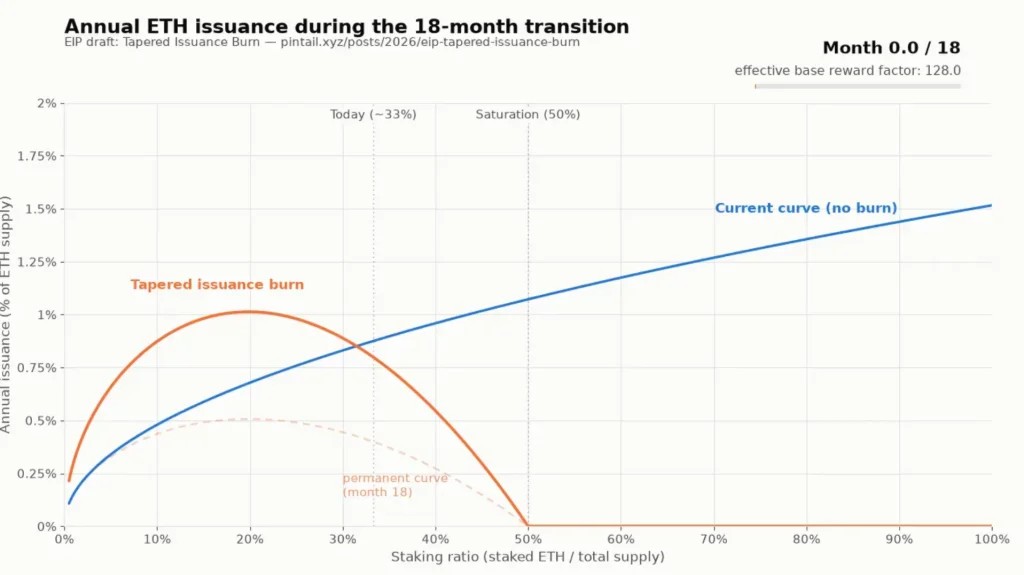
The proposal claims Ethereum crossed a one-third staking ratio in April 2026 and has continued climbing each month. Under the existing issuance model, staking yield reportedly never falls below roughly 1.5% even if the entire $ETH supply were staked.
According to the proposal, the validator entry queue is currently operating at maximum churn, adding around 1.75 million $ETH per month. Based on what its authors describe as conservative assumptions, more than 70 million $ETH could be staked by January 1, 2028, representing over 55% of total supply if nothing changes.
Burn Mechanism Replaces Artificial Yield Floor
Rather than changing validator rewards directly, EIP-8361 proposes deducting and burning a portion of each validator’s idealized duty rewards every epoch. The burn rate would gradually increase until reaching 100% once staking approaches a predefined saturation balance of roughly half the $ETH supply.
That would allow net staking yield to taper linearly toward zero at a 50% staking ratio, removing what the proposal calls the artificial yield floor. The authors argue this would let staking settle naturally where returns match the market’s required risk premium instead of remaining fixed by a reward curve introduced in 2030.
Gradual Rollout Aims To Avoid Disruption
The proposal emphasizes a slow implementation. Yield reductions would phase in over approximately 18 months, alongside an estimated six-month fork lead time, giving validators nearly two years to adjust. It also introduces only one permanent protocol constant while leaving validator duty incentives unchanged.
Supporters argue EIP-8361 strengthens Ethereum’s monetary neutrality by limiting long-term dilution and discouraging excessive staking concentration. Whether the proposal gains broader community backing, however, remains another debate entirely.

 invezz.com

 crypto.news
 coinfomania.com
