


 11
11
A dormant whale move usually triggers one of two reactions: FUD or a reassessment of conviction. Recently, whale trackers flagged an Ethereum whale moving 2,000 $ETH after 10 years of inactivity.
From a technical standpoint, moves like this often signal either potential distribution or a dip in conviction, especially when you factor in $ETH’s price action and recent market structure.
As the chart shows, $ETH/$BTC has now closed 13 straight 3-day candles in the red for the first time in history. Ethereum has clearly sustained underperformance against Bitcoin over an unusually extended period.
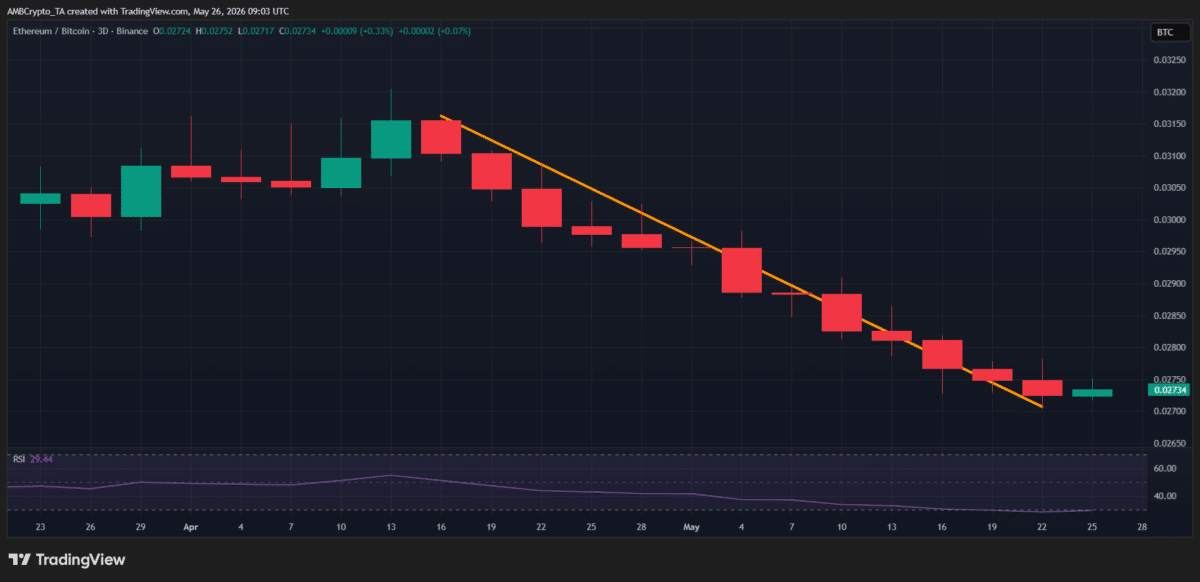
Notably, Ethereum’s [$ETH] ROI also clearly reflects this.
According to CoinGlass data, $ETH’s Q2 so far is down 0.13%, while Bitcoin [$BTC] has posted nearly 13% ROI.
Meanwhile, $ETH’s Q1 drawdowns were nearly 1.5x deeper than $BTC’s, reinforcing the idea that Ethereum has been lagging on a relative performance basis through multiple recent market phases.
In this context, the recent $ETH whale move can be viewed as a potential “sell-the-top” type setup, where long-dormant holders exit into strength to lock in gains.
From that angle, it aligns with Ethereum’s relative underperformance versus Bitcoin. However, a key signal also suggests this could instead reflect a broader reassessment of conviction in Ethereum.
Staking demand remains strong despite Ethereum’s price divergence
The reason behind the whale move triggering a frenzy wasn’t random.
According to Arkham Intelligence, the Ethereum whale held 2,000 $ETH for over 10 years after buying it at $0.31.
At current market prices, that position reflects an extraordinary gain, turning an initial investment of just $620 into $4.2 million in value, highlighting the scale of long-term appreciation in Ethereum.
Against this backdrop, Ethereum’s staking queue adds another layer of context. As the data below shows, just 64 $ETH are waiting to be unstaked, while roughly 3,394,545 $ETH are queued for staking.
That creates a clear imbalance, with staking demand outweighing exit demand by about 53,000x.
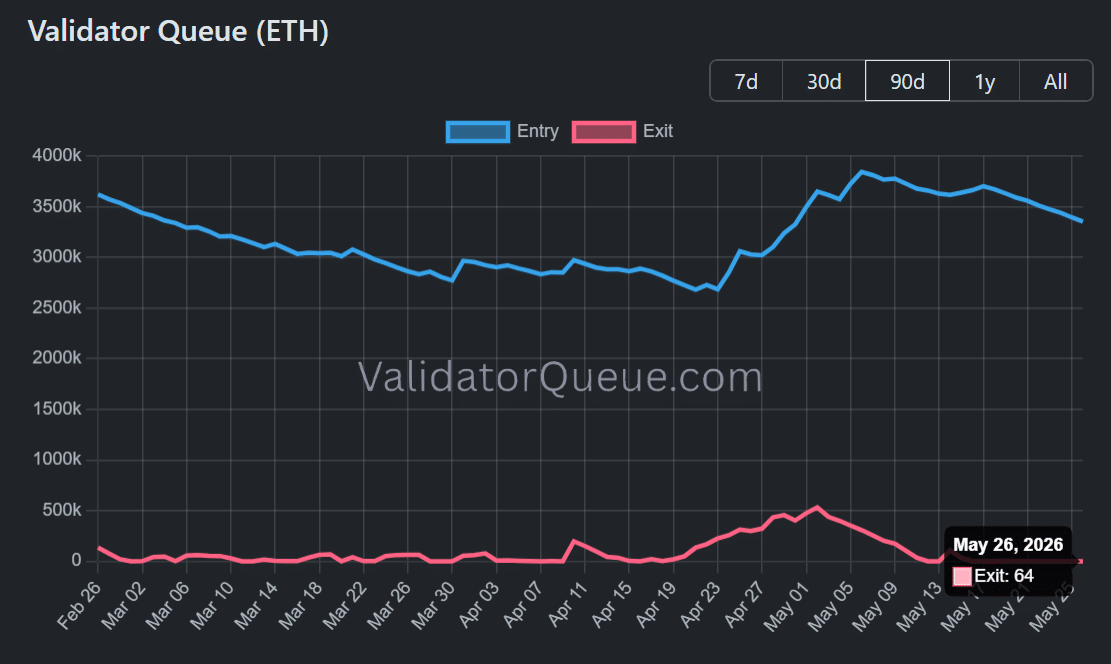
In this context, $ETH’s recent whale move further reinforces the long-term holding incentive.
The logic is simple: Staking demand continues to absorb available supply at scale, while exit pressure remains extremely limited in comparison. More importantly, it signals that participants still prefer yield generation and long-term positioning over liquidation.
Therefore, $ETH/$BTC weakness could just be short-term rotation rather than a structural breakdown. This makes the Ethereum whale selling 2,000 $ETH more of a profit-taking event within a broader accumulation-heavy structure, rather than a clear bearish reversal signal.
Final Summary
- An Ethereum whale moves 2,000 $ETH after 10 years, sparking debate between profit-taking and potential distribution amid $ETH/$BTC weakness.
- Strong staking demand still dominates, suggesting long-term holders continue to prefer yield and accumulation over exiting.

 en.bitcoinsistemi.com
 cryptopotato.com