


 6
6
A recent discussion shared by analyst Leo Lanza examined the relationship between Ethereum’s valuation and its total value secured, alongside a comparative market data chart tracking Ethereum’s fully diluted market capitalization and ecosystem TVL from 2016 to 2026.
The commentary focused on how valuation dynamics shift when large volumes of capital are secured on-chain.
Valuation and Security Dynamics Discussion
In the post, Leo Lanza compared assets under management (AUM) in traditional finance with total value secured (TVS) in blockchain systems, noting that the terms can be similar with respect to assets managed or secured.
The distinction outlined in the discussion centered on structural differences in security models. The example provided referenced how an asset manager such as BlackRock can manage trillions in AUM relative to its market capitalization, as the security of those assets is not directly dependent on the firm’s native equity valuation.
The post extended this comparison to Ethereum, arguing that proof-of-stake design links network security to $ETH value, since control of the network is tied to stake acquisition.
A hypothetical scenario was presented in which a large disparity between $ETH market capitalization and ecosystem TVS could create an economic incentive for acquisition-based control. The discussion described this as a reflexive relationship between secured value and token valuation.
Market Cap and TVL Comparison Data
The accompanying chart referenced in the discussion tracks Ethereum’s fully diluted market capitalization against its total value locked across ecosystem applications.
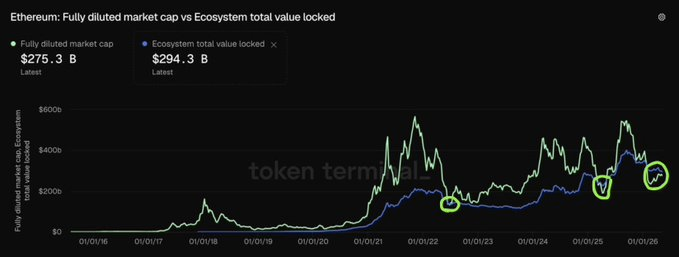
At the most recent measured point, Ethereum’s fully diluted market capitalization stood at approximately $275.3 billion, while TVL was reported at approximately $294.3 billion. The data shows periods where TVL temporarily exceeds or converges with market capitalization during different market cycles.
The historical dataset showed both metrics expanding during the 2021–2022 cycle, followed by a contraction phase and later recovery trends. Several convergence periods were also observed, where Ethereum’s ecosystem total value locked moved closer to or briefly exceeded the network’s fully diluted market capitalization.
According to the discussion, these periods are important because Ethereum’s proof-of-stake model ties network security to $ETH valuation, meaning the network could become economically more vulnerable if the value secured across the ecosystem grows significantly faster than $ETH’s market capitalization.
Related: Ethena’s Seraphim Czecker says “Ethereum is Dead” and Outlined Plans to Bring $10B TVL

 bitcoinworld.co.in

 cryptoticker.io
 ambcrypto.com
 coinpaper.com
