

 2
2
Michael Saylor, the CEO and Executive Chairman of Strategy (formerly MicroStrategy), stepped into the Bitcoin [$BTC] space six years ago.
From when Bitcoin was trading near $11,500 in 2020 to now, when it is hovering around $81,000, Saylor’s confidence in $BTC has only increased.
Strategy’s Bitcoin game
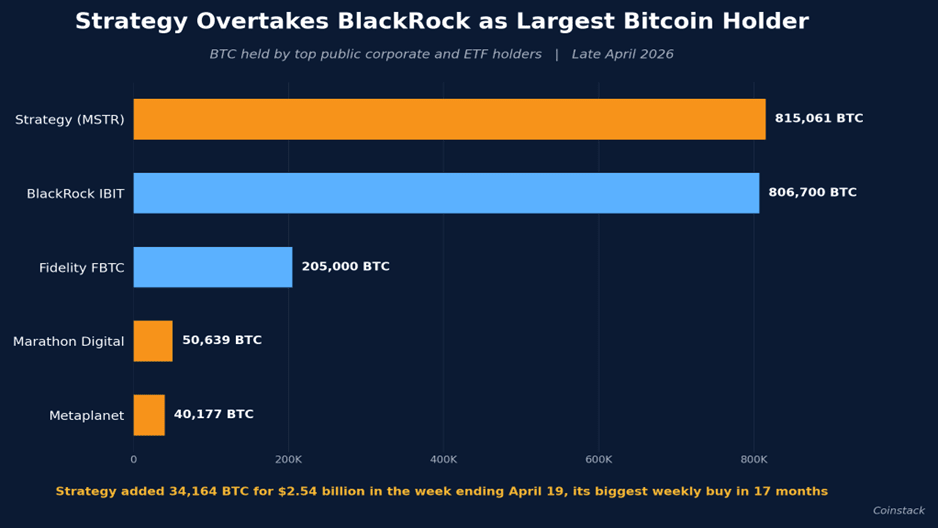
Starting from the 11th of August 2020, when Strategy purchased 21,454 $BTC worth $250 million, the firm has now accumulated a total of 818,334 $BTC worth $63.54 billion.
With a total of 107 $BTC purchases, Strategy has even outpaced BlackRock’s Bitcoin holdings of 812,276.2 $BTC.
Needless to say, many players in the Bitcoin market now use Strategy’s Bitcoin strategy as a point of reference.
In fact, Boyaa Interactive is often referred to as “Hong Kong’s MicroStrategy,” while Japan’s Metaplanet is “Asia’s MicroStrategy” because of how much they mimic the firm’s buying tactics.
BitMine gains similar traction in the Ethereum ecosystem
Outside the Bitcoin market, Michael Saylor’s corporate treasury strategy attracted interest in the Ethereum [$ETH] space as well.
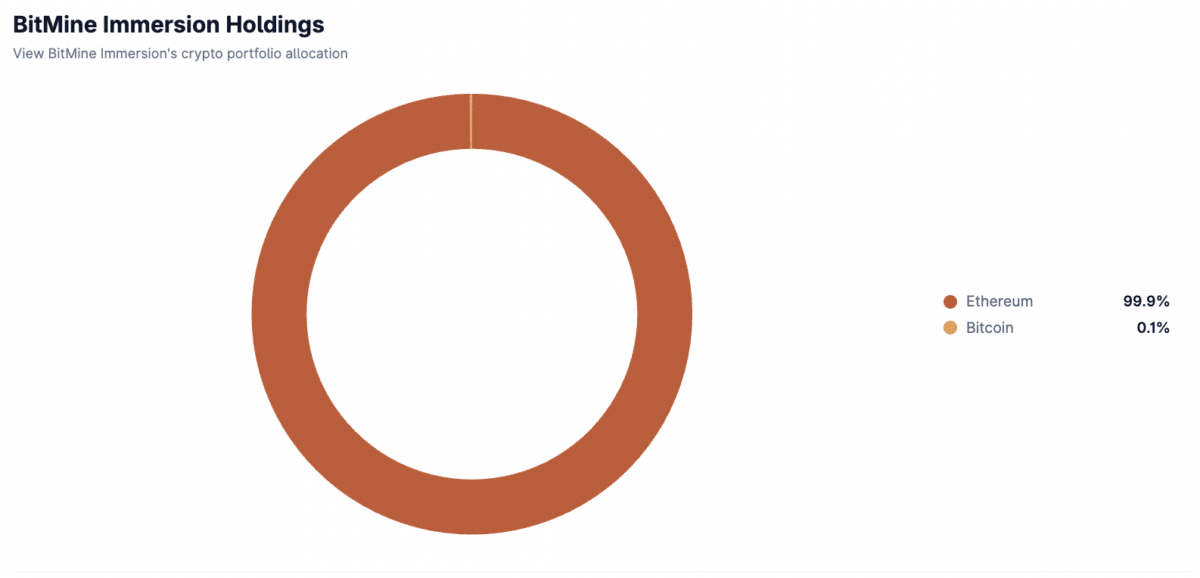
In the Ethereum treasury market, Tom Lee’s BitMine Immersion Technologies has become a prominent player, much like Strategy is in Bitcoin. Notably, BitMine started its crypto corporate journey by adding 100 $BTC to its treasury in June 2025.
Indeed, Tom Lee’s company did not fully switch to Ethereum until August 2025. Yet, despite this, BitMine quickly emerged as one of the most talked-about firms in the corporate Ethereum treasury market.
BitMine has so far acquired 5,180,131 $ETH worth $12.36 billion at an average price of $2,336 per $ETH.
This has prompted a notion that BitMine might be Ethereum’s Strategy. Now these aren’t just speculations, as back in November 2025, Messari, a crypto analytics platform, had noted,
Strategy pioneered the model with $BTC, BitMine is now following with $ETH.
Echoing similar sentiments in March 2026, Arkham, an on-chain analytics platform, added,
Tom Lee is to Ethereum what Michael Saylor is to Bitcoin.
In fact, at a recent appearance at the Consensus Hong Kong 2026, BitMine’s Chairman Tom Lee also affirmed,
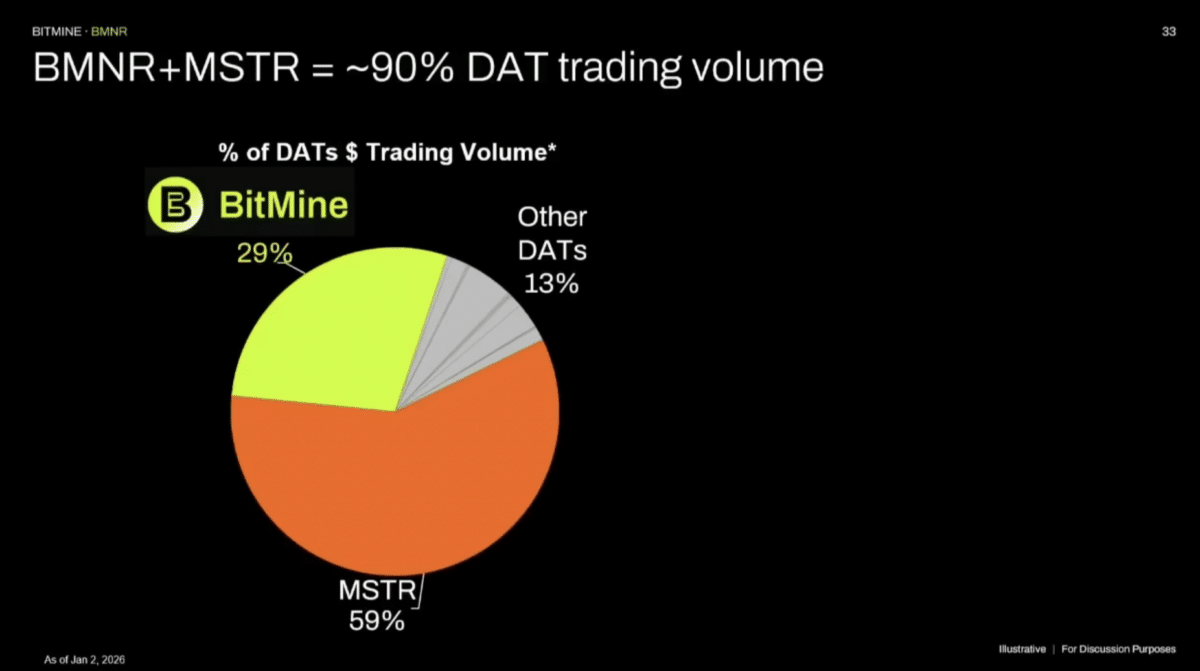
The two dominant DATs so far are MicroStrategy and Bitmine.
Strategy vs. BitMine
That said, the flip side of the coin is also worth analyzing, because Strategy and BitMine have entirely different business models.
With the goal of increasing Bitcoin per share indefinitely, Strategy employs a Bitcoin-maximum model in which the company continuously raises capital to purchase more Bitcoin. In contrast, BitMine adheres to the “Alchemy of 5%” model.
Unlike Strategy, BitMine has a cap on its goal to acquire 5% of the entire Ethereum supply, or roughly 6 million Ethereum.
In fact, in a recent update, BitMine’s total staked $ETH reached 4,553,557 $ETH worth $10.77 billion, which is about 87.9% of its total holdings.
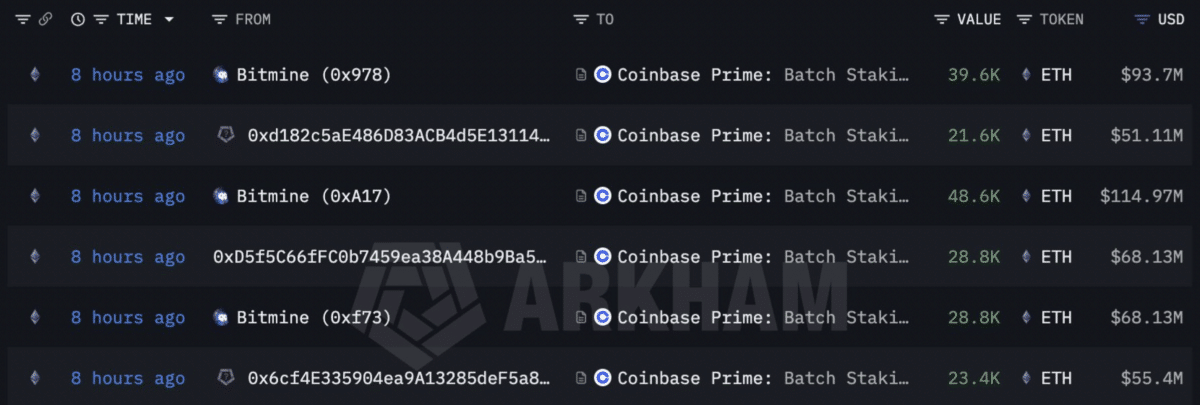
Furthermore, MSTR employs a high-leverage model by issuing convertible notes and preferred shares known as “Stretch,” or STRC, to purchase Bitcoin.
This creates a leveraged $BTC proxy for investors, entails greater interest and dividend obligations ($1.49 billion annually), and incurs a larger debt load (currently over $8 billion).
BMNR, on the other hand, keeps a much cleaner balance sheet, with almost $1 billion in cash and no debt. They don’t need to take on more debt to pay for operations because their $ETH produces yield.
Curiously, though, both businesses share one similarity, and that is the “buy the dip” strategy. Given these considerations, BitMine is perceived by some as a yield-driven variant of Strategy that is centered on Ethereum.
Can institutional capital push $ETH in the same way it did Bitcoin?
Well, the Ethereum/Bitcoin ratio at the time of publishing, sitting at 0.02939, indicated that Ethereum was underperforming Bitcoin.
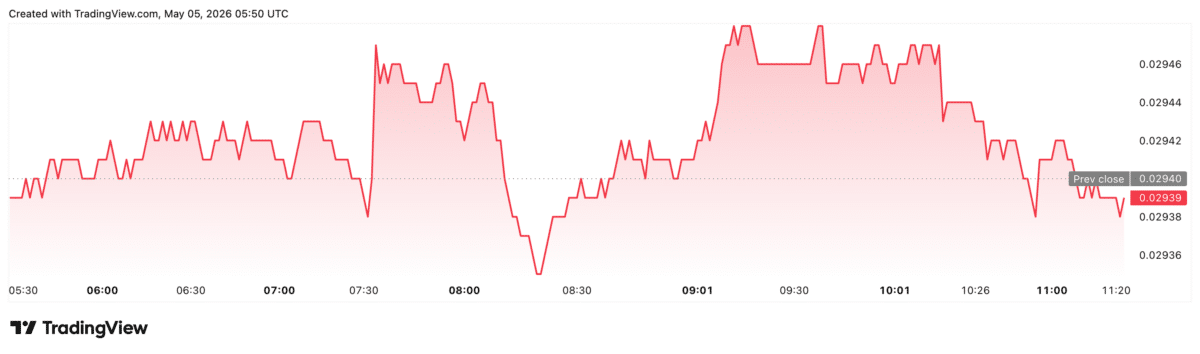
The DAT space also shows a sharp contrast, wherein Bitcoin DATs hold $150.077 billion worth of $BTC while Ethereum DATs hold only $17.095 billion in $ETH.
Subsequently, in the ETF space, Bitcoin’s inflow has surged past the $59 billion mark, whereas $ETH ETFs have seen inflows of over $12 billion so far.
Taken together, one can conclude that it’s less likely for $ETH to attract a similar scale of institutional capital as $BTC.
Final Summary
- Tom Lee’s BitMine is being referred to as Ethereum’s Strategy given their accumulation plans around Ethereum.
- However, the differing business models of the two crypto corporate treasuries suggest otherwise.

 coinpaper.com
 newsbtc.com
 cryptonewsz.com

 finbold.com
