

 3
3
Aave Labs is targeting new avenues to unlock project unlock capital efficiency while attracting new users in two recent moves by the project as it charges ahead toward its V4 upgrade.
On one hand, the project introduced Aave’s V4 Reinvestment Module, a new component of V4’s unified liquidity design. That adds on to the article published by Mario Baxter Cabrera, which provided a walkthrough on the account architecture behind the new Aave App.
Apparently, the app allows anyone to sign up with just an email and password and access DeFi features without using a seed phrase.
Aave pursues DeFi expansion
The V4 Reinvestment Module addresses one of Aave’s biggest problems. Out of Aave’s roughly $20 billion in total stablecoin deposits so far, approximately $6 billion (up to 30%) remains idle. This is because the protocol needs liquidity to be available to facilitate instant withdrawals and absorb any sudden borrowing demand.
V4’s Reinvestment Module takes that excess capital and sends it into pre-approved and low-risk yield strategies like short-term treasuries, money market instruments, and delta-neutral basis trades. Afterwards, it automatically rebalances when borrowing demand rises and liquidity is needed again.
On that same day, Stani Kulechov and Mario Baxter Carbera (@0xMari0) came out to share Aave’s new approach to account management in the Aave App. According to Kulechov; “the new system full user control of assets while ensuring seamless signups and account recovery.”
This means that users will retain full custody of their assets through a cryptographic signer key generated on their device, while the new smart account layer (built on Alchemy’s Modular Account v2) handles gas sponsorships, transaction batching, and sensitive action gating.
As such, if a user loses their password but still has a device that signed in previously, they can easily recover their account with passkeys like their Face ID.
If they cannot access any previous devices, an opt-in biometric recovery system through CoinCover then reconstructs their key with a face scan, and splits the encryption key between CoinCover and Aave.
$WLFI numbers nobody can explain
The innovation angle of the product releases from Aave has caught the attention of stakeholders who struggle to understand how the project’s numbers compare with the Trump-linked World Liberty Financial ($WLFI) project.
According to on-chain data circulating on X this week, Aave has: $25.65B TVL, $42.69B total supplied, and $75.7M in annualized revenue. On the other hand, $WLFI, the native token of World Liberty Financial (backed by Donald Trump and built directly on Aave V3’s infrastructure) has $298M TVL, $572.7M total supplied, and $2.7M in annualized revenue.
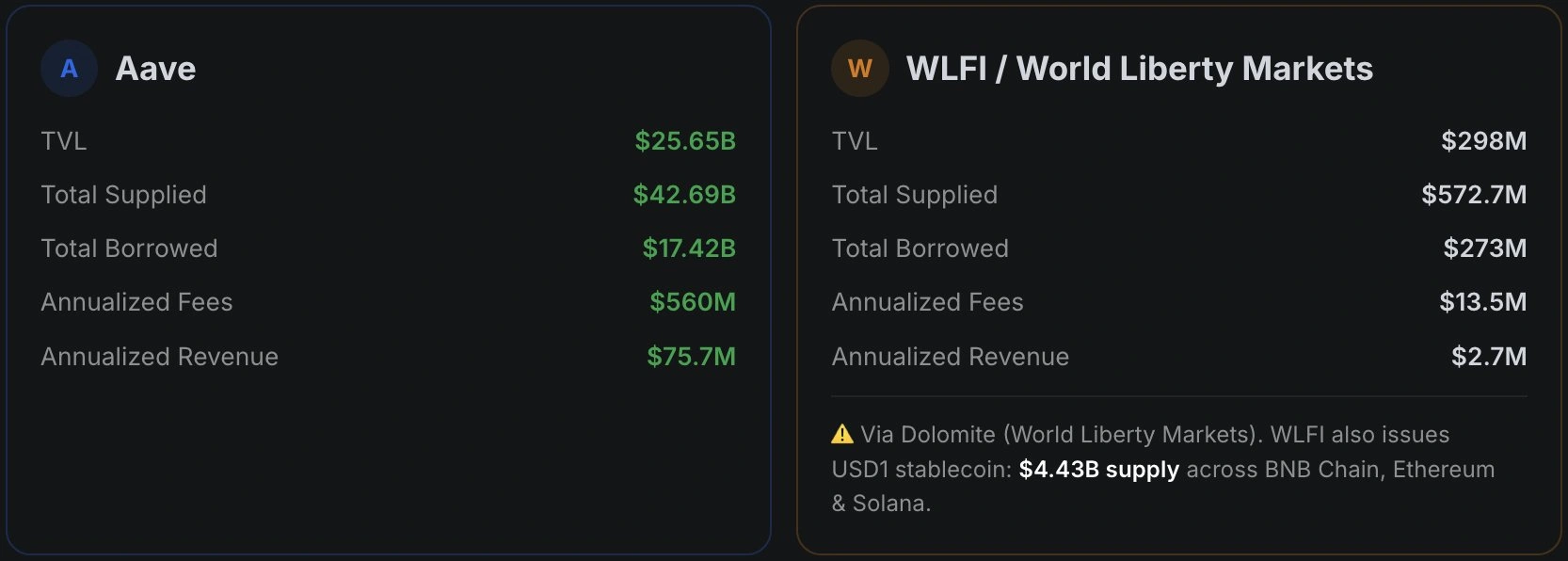
Apparently, Aave’s TVL is also 86 times larger, and its revenue is 28 times greater than $WLFI.
Yet, $WLFI’s fully diluted token valuation is higher than Aave’s. This gap highlights a valuation issue that reflects the respect that the market attaches to political brand association over actual protocol fundamentals.
Why there’s so much noise around this
These expansion updates came during a period that has been anything but peaceful for Aave. BGD Labs, the firm that built and maintained Aave’s V3 will be leaving the protocol in April. The Aave Chan Initiative (ACI) was also dissolved earlier this month after its governance demands were ignored.
This week just added another seed of doubt. John Morrow, the co-founder of Gauntlet, rekindled his beef with Chaos Labs founder Omer Goldberg in a discussion about the USR oracle attack that caused millions in losses, as reported by Cryptopolitan.
In his X tweet, he said, “It’s only been a couple weeks since you guys pushed that oracle update that caused millions in losses for Aave. That is downstream of the fact you have slowly replaced Aave’s oracle architecture with a Rube Goldberg machine of your own making that is so complex you don’t even know how to use it.”
Smart contract risk is a part of DeFi. It's only been a couple weeks since you guys pushed that oracle update that caused millions in losses for Aave. That is downstream of the fact you have slowly replaced Aave's oracle architecture with a Rube golberg machine of your own making…
— John Morrow (@jmo_mx) March 24, 2026
These criticisms point at the growing complexity of Aave’s risk infrastructure and whether the people responsible for it have sufficient command of what they have built.
This is not a minor ask, because Aave V3 continues to dominate DeFi by TVL. The protocol’s annualized fees at $566 million put it in a category few DeFi projects have ever reached.
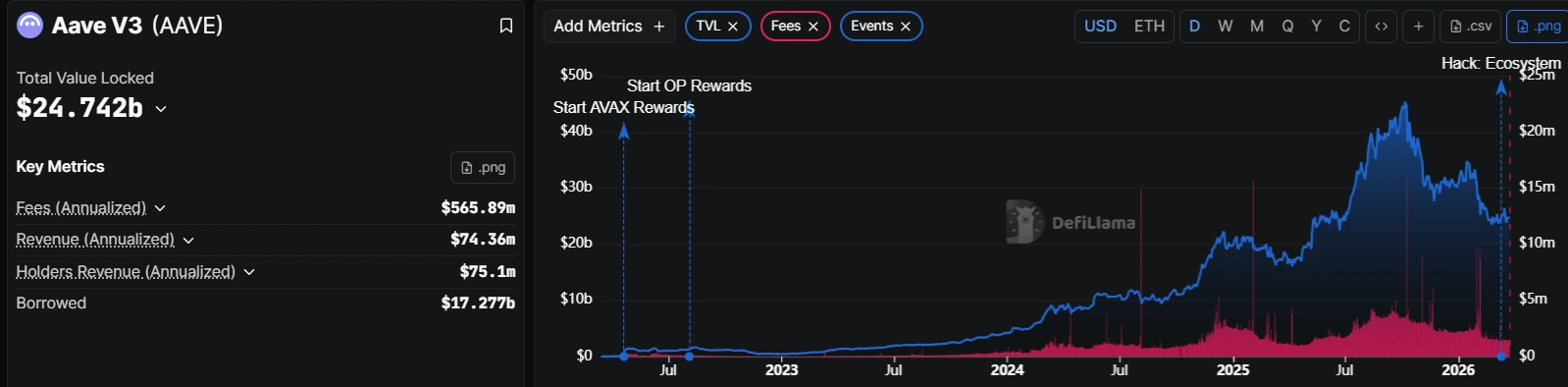
Nonetheless, the governance fights and the oracle criticism seem to be symptoms of a protocol operating at real scale, not one fighting for survival.

 blockchainreporter.net

 news.bitcoin.com