

 5
5
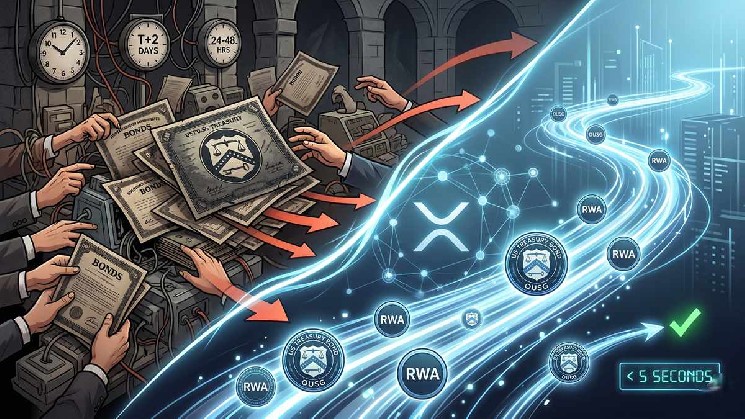
- Instant Settlement: The $XRP Ledger has demonstrated the capacity to process bond redemptions in less than five seconds, compared to the two days required by the traditional system.
- Institutional Adoption: Ripple, JPMorgan, Mastercard, and Ondo Finance recently completed a cross-border pilot for tokenized Treasury bonds.
- RWA Growth: The total value of real-world assets (RWA) in the XRPL ecosystem surpassed $3 billion in May 2026.
During his appearance on the program Crypto in America, Ripple CEO Brad Garlinghouse described the current bond settlement system as an obsolete and fragmented infrastructure. The executive noted that the $XRP Ledger presents itself as the technical solution to transform these markets toward real-time execution.
Bond settlement is coming to XRPL 🤯
Bond settlement is still slow, arcane, and broken @bgarlinghouse says it's only a matter of time before it all moves onchain and xrpl is built for exactly that
WE'RE SO F*CKING BACK ripple:native https://t.co/vaqIehrr6h pic.twitter.com/1EuzRxWvO7
— Xaif Crypto (@Xaif_Crypto) May 6, 2026
Garlinghouse characterized the conventional bond transfer process as a “slow and arcane” scheme. He added that reliance on multiple intermediaries—including custodians, clearinghouses, and settlement agents—entails unnecessary costs and increases the risk of corporate errors. In the current model, a transaction can take between 24 and 48 hours to complete due to manual reconciliations.
Bond tokenization and fixed-income markets
Blockchain infrastructure proposes a profound structural change. On the $XRP Ledger, settlement occurs seconds after the transaction is validated by the network. By acting as a single source of truth, the ledger allows ownership changes to be final and irreversible almost immediately, eliminating the chain of successive institutional confirmations.
Recent industry data supports this transition. According to a report from RWA.xyz published in May 2026, the value of real-world assets on XRPL grew by 78% in the last 30 days. This increase is due to the migration of fixed-income products toward digital networks that allow for fractional ownership and more agile identity verification.
The technical viability of this proposal was reflected in a recent pilot. In collaboration with JPMorgan, Ondo Finance, and Mastercard, Ripple executed the redemption of U.S. Treasury bonds (OUSG) using the $XRP Ledger as the asset layer. According to the trial’s technical documentation, the operation was completed in less than five seconds, operating even outside of traditional banking hours.
In this process, JPMorgan’s Kinexys payment engine facilitated the settlement in dollars, while Mastercard’s Multi-Token network managed the payment instructions. This flow demonstrates that public infrastructure can interoperate with private banking rails to move institutional capital without the delays of the T+2 model.

Regulatory and technical backing in 2026
The legal framework in the United States also appears to be leaning toward modernization. According to the interpretation issued by the SEC on March 17, 2026, securities represented on blockchains are subject to federal laws, but their capacity to offer more efficient and transparent transactions is recognized.
Official data suggests that the current regulatory approach prioritizes the economic reality of the asset over the technology used. This allows conservative financial institutions to begin integrating the $XRP Ledger into their treasury flows. Network data indicates that as of May 7, 2026, tokenized Treasury bonds on this network already exceed $418 million.
The next milestone for this ecosystem lies in the expansion of institutional liquidity corridors. With the implementation of advanced custody systems and the regulatory clarity achieved, it is projected that more sovereign debt issuances could migrate to blockchain protocols before the close of the fiscal year.

 blockchainreporter.net

