


 3
3
- Ethereum, Ripple, Solana, Circle, TON, TRON and PayPal are among 21 organizations that have teamed up to back the launch of the Open Wallet Standard (OWS).
- OWS was open-sourced by MoonPay for local wallet storage and signing, and it’s designed to enable AI agents to capitalize on agentic payments systems like x402.
Some of the largest digital asset organizations, led by the Ethereum, Solana and TRON Foundations, have partnered to launch a new wallet standard for agentic AI payments.
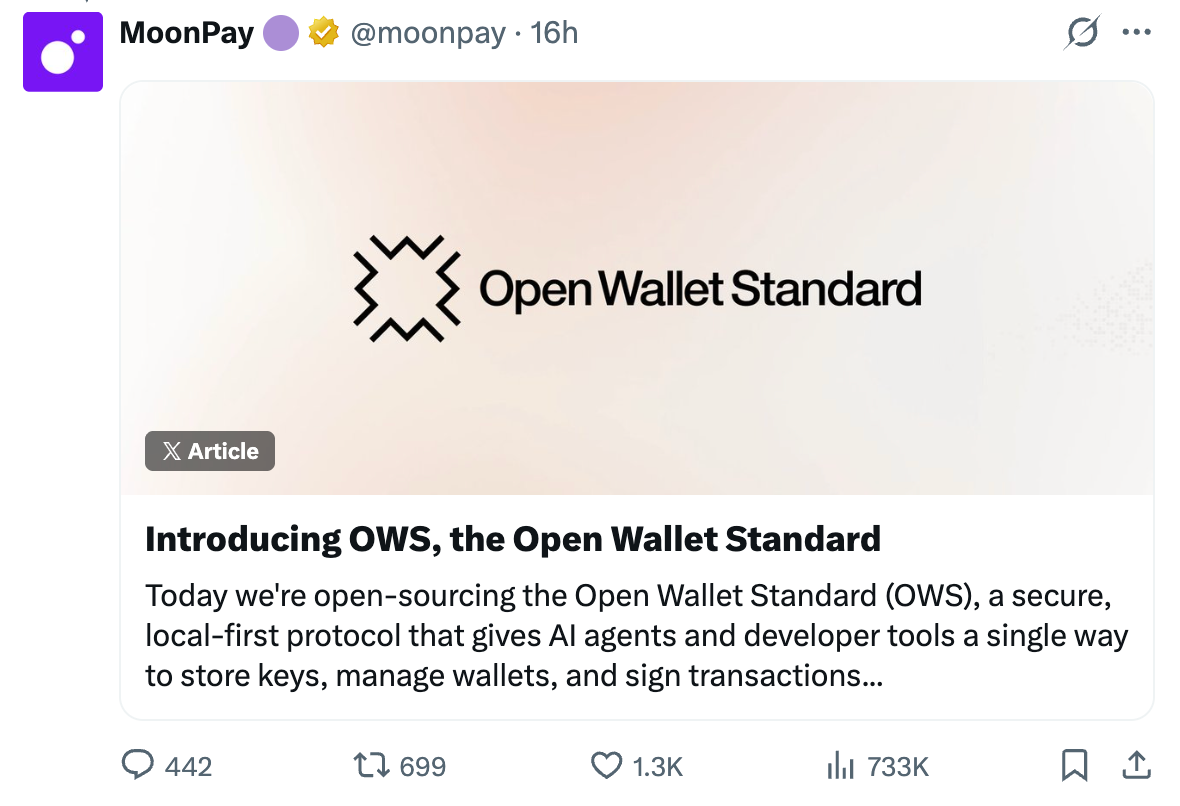
Known as the Open Wallet Standard (OWS), it was developed by the crypto payments company MoonPay and open-sourced. It serves as a secure, local-first protocol that enables agents to store keys, manage wallets and sign transactions on most major blockchains.
In recent months, dozens of blockchains have been building agentic payment stacks that integrate x402, MPP, and A2A. The most recent is Stellar, which launched x402 earlier this month to supercharge AI and machine payments across the web, as CNF reported. x402 was developed by Coinbase and Cloudflare and later open-sourced, while A2A (agent-to-agent) was released by Google last year. MPP, developed by Stripe, is the latest release, hitting the market a week ago.
While all these standards are advancing agentic payments, they all assume the AI agent already has a supported wallet. These standards define how the agent pays, not how it signs for transactions, where its private keys are stored or how it’s protected. For developers to use these standards, they had to build the wallet infrastructure from scratch, which was time-consuming, expensive and introduced new security risks.
This is the market that the new OWS is targeting. Moonpay founder Ivan Soto-Wright commented:
The agent economy has payment rails. It didn’t have a wallet standard. We built one, open-sourced it, and now the full stack exists.
Crypto Comes Together to Launch OWS
MoonPay describes the idea behind OWS as: “one encrypted vault on your machine, one interface for every chain, and a security model where the private key is never exposed to the agent, the LLM, or any parent process.”
It will rely on a single mnemonic for every supported chain, a single signing interface where the agent never sees the private key, a core written in Rust for every runtime and will be encrypted at rest and wiped immediately after signing.
MoonPay says that the standard had to be open because wallet interoperability requires a shared format. On why it has launched OWS now, the crypto payment services says it’s because “the number of agents that need wallets is growing faster than the number of wallet standards.”
MoonPay had the backing of 21 major crypto organizations on OWS. These include the foundations behind the development of Solana, Ethereum and TRON (as well as the TRON DAO).
.@MoonPay just open-sourced a wallet standard for AI agents, backed by 15+ contributors including @Solana, @PayPal and @Circle
One seed phrase gives you wallets on EVM, Solana, Bitcoin, XRP, and more https://t.co/jI52eyUoU6
— Solana (@solana) March 23, 2026
Sui, Polygon, PayPal, OKX, Base, the Filecoin Foundation, Allium, Arbitrum and Circle were also part of the OWS launch. Commenting on the new standard, Sam Blackshear, the co-founder of Mysten Labs, which is the company behind the Sui Network, stated:
This unified representation makes it easier for an agent to focus on the task instead of the details.

 coindesk.com

