


 7
7
NilChain, a privacy-focused blockchain built with the Cosmos SDK by Nillion, is winding down operations on Cosmos as part of broader shifts across the interoperability-focused ecosystem.
In an X announcement on Feb. 17, the team said the network will halt operations on March 23, urging holders of the NIL token to migrate their assets to Ethereum before the shutdown.
NilChain was designed as a network for secure computation. But the chain has seemingly not been able to reach broad usage inside the Cosmos ecosystem.
Leaving Cosmos, however, doesn’t mark an end to Nillion itself, as the company plans to continue operating on Ethereum. Amid the news, nilChain’s native token NIL briefly jumped over 10% on the day to $0.06 and is currently trading around $0.053, per data from CoinGecko.
It remains unclear why the team decided to migrate away from Cosmos. The Nillion team declined The Defiant’s request to comment on the move for this story.
NilChain may not be widely known compared with larger Layer 1 or Layer 2 networks, but Nillion has raised sizable funding. In December 2022, the company closed a roughly $20 million seed round led by Distributed Global, with participation from GSR Markets and HashKey.
It raised another $25 million in October 2024 in a round led by Hack VC, with backing from the Arbitrum Foundation, Worldcoin, Sei, HashKey Capital, and Animoca Brands.
Exodus from Cosmos
The move comes as Cosmos itself reassesses its direction. In July 2025, the Cosmos Hub scrapped plans to add native smart contract support, citing high costs and weak developer demand. Teams that had planned to deploy applications on the Hub were encouraged to build on other Cosmos-based chains instead.
That shift forced a reset for many teams and coincided with a wave of departures. Since mid-2025, several projects have announced exits or wind-downs across the Cosmos ecosystem.
The stablecoin-focused project Noble said earlier in January of this year it would leave Cosmos to launch its own EVM-compatible L1, saying the team wants to “meet users and developers where they already are.” Others have taken different paths with chains like Pryzm and Quasar announcing shutdowns or significant changes.
Some have publicly said they are leaving Cosmos after years of struggling with liquidity, user distribution, and developer traction following the collapse of Terra in 2022. Others, including infrastructure providers, argue the ecosystem still makes sense for teams focused on interoperability rather than consumer DeFi.
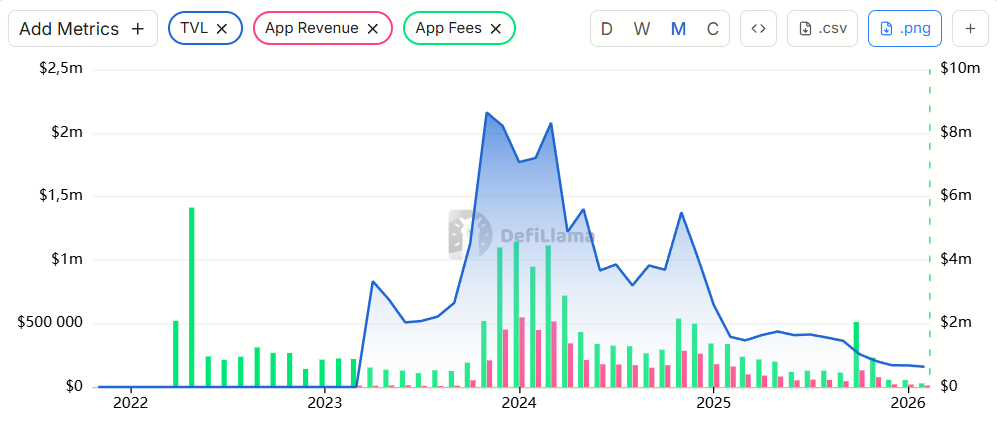
The Cosmos Hub itself has also seen declining activity. Data from DefiLlama shows total value locked on the network falling from about $2.65 million to roughly $131,000 earlier this month, the lowest level on record.
Network fees have also dropped sharply. By January, fees reached an all-time low of around $218,000, with only four of the 11 protocols deployed on the Cosmos Hub generating any revenue.
ATOM, the native token of Cosmos Hub, is down about 4% over the past 24 hours, though it rallied over 18% in the past week, per CoinGecko.

 bsc.news

 theblock.co