


 16
16
Autonomous systems are evolving from passive assistants into active economic participants. They are starting to authenticate, transact, monitor markets, coordinate workflows and interact with each other across platforms. Recent developer discussions across the ecosystem, including initiatives highlighted by Coinbase show that this shift is moving from theory into implementation.
To understand why this matters, it helps to view the agent economy as a layered infrastructure.
ERC-8004 as the Identity Layer for AI Agents
Early AI agents were powerful but temporary. They lacked persistence and verifiable identity. Without identity, agents could not build trust or maintain continuity across environments.
ERC-8004 introduces programmable identity for agents. Instead of wallets representing ownership, identity begins to represent capability. Agents can now operate under defined permissions such as execution authority, spending limits and access rights. This transforms them from disposable tools into persistent digital actors capable of participating in structured systems.
Identity is the foundation on which any agent economy must be built.
X402 Enables Machine-Native Micropayments
Once agents can identify themselves, the next requirement is economic interaction.
X402 enables machine-native payments that allow agents to transact dynamically. Instead of relying on subscription models designed for humans, agents can pay per query, per signal or per decision input. This introduces a new economic model where intelligence becomes callable infrastructure. Data and insights can be accessed in real time by autonomous systems without human mediation.
OpenClaw and N8N as Operating Layers
Agents need runtime environments that allow them to function persistently. OpenClaw provides a framework for coordination, memory and execution. It allows agents to interact with systems and with each other. Workflow automation platforms such as N8N are increasingly used alongside OpenClaw to orchestrate connections between APIs, messaging tools and data sources.
In practical deployments, OpenClaw often defines agent logic while N8N manages workflow execution.
A typical setup may include Opus as the reasoning layer and Codex handling coding and execution tasks. Many teams run these systems on standard VPS infrastructure without specialized hardware. Communication is frequently routed through private Discord environments. This allows agents to share updates, trigger workflows and coordinate tasks in a centralized setting.
Tempo as the Execution Layer
Execution environments are emerging that allow agents to request, pay and execute within a unified lifecycle. This reduces fragmentation between API calls, payment flows and task completion. Agents can operate in continuous loops rather than relying on isolated instructions.
Base as the Settlement Layer
High frequency agent interaction requires scalable infrastructure. Base is increasingly viewed as a suitable Layer 2 environment due to low transaction costs and developer accessibility. Micropayment driven ecosystems require cost efficient settlement. This positions Base as a strong candidate for supporting machine driven economic activity.
There is also growing attention around potential ecosystem incentives tied to participation on Base, which makes early exploration strategically relevant.
Aavegotchi and the Emergence of Agent Ecosystems
Crypto-native communities often surface new behavioral patterns early. Within the Aavegotchi ecosystem, discussions around agent participation quickly led to derivative experiments such as Aaigotchi:
These developments illustrate a broader pattern. Once identity becomes programmable, specialization follows.
We are now also seeing early operational examples such as the Aavegotchi Baazaar Agent on ClawHub, which demonstrates how agents can already function within crypto native environments.
Real Crypto Use Cases for AI Agents
Agent-native systems are already capable of supporting operational workflows such as portfolio monitoring, yield tracking, governance updates and market signal distribution. Through integrations with Discord or email systems, agents can monitor conditions and deliver updates without constant human oversight.
This marks a transition from manual monitoring toward automated intelligence.
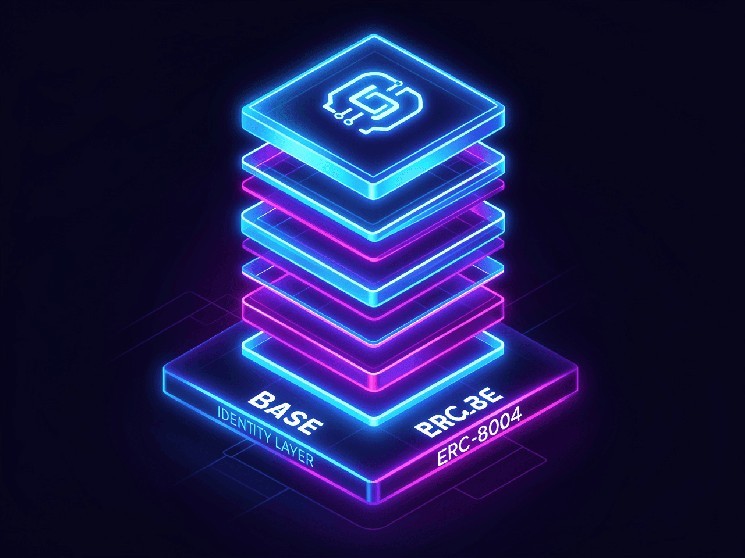
The Agent Economy Stack
The architecture now becoming visible includes:
- Identity Layer via ERC-8004
- Payment Layer via X402
- Operating Layer via OpenClaw or N8N
- Execution via Tempo-like environments
- Settlement via Base
Each of these layers has evolved independently. Their convergence is forming the foundation for machine driven coordination.
Conclusion
- Automation created assistants.
- ERC-8004 introduces identity.
- X402 enables payments.
- OpenClaw supports coordination.
- Base enables scalable settlement.
- Together, these components form the early infrastructure of the agent economy.
- As this ecosystem evolves, collaboration and knowledge exchange will become increasingly important.
- Creating a free profile on Cryptoticker allows builders and researchers to connect and explore this emerging frontier together.
- The agent economy is still forming. This is the time to engage early.

 blockchainreporter.net
