


 5
5
The number of tokens launched on AI agent launchpad Clanker, which runs on Coinbase’s Ethereum Layer 2 Base, skyrocketed to new daily highs following the recent rise of AI-only social media platform, Moltbook.
Yesterday, Feb. 2, the number of tokens created on Clanker reached 21,870, breaking its previous all-time highs from over the weekend, per data from Dune Analytics.
Daily trading volumes on the AI-powered Base launchpad also surged, reaching an all-time high of over $364 million on Jan. 31.
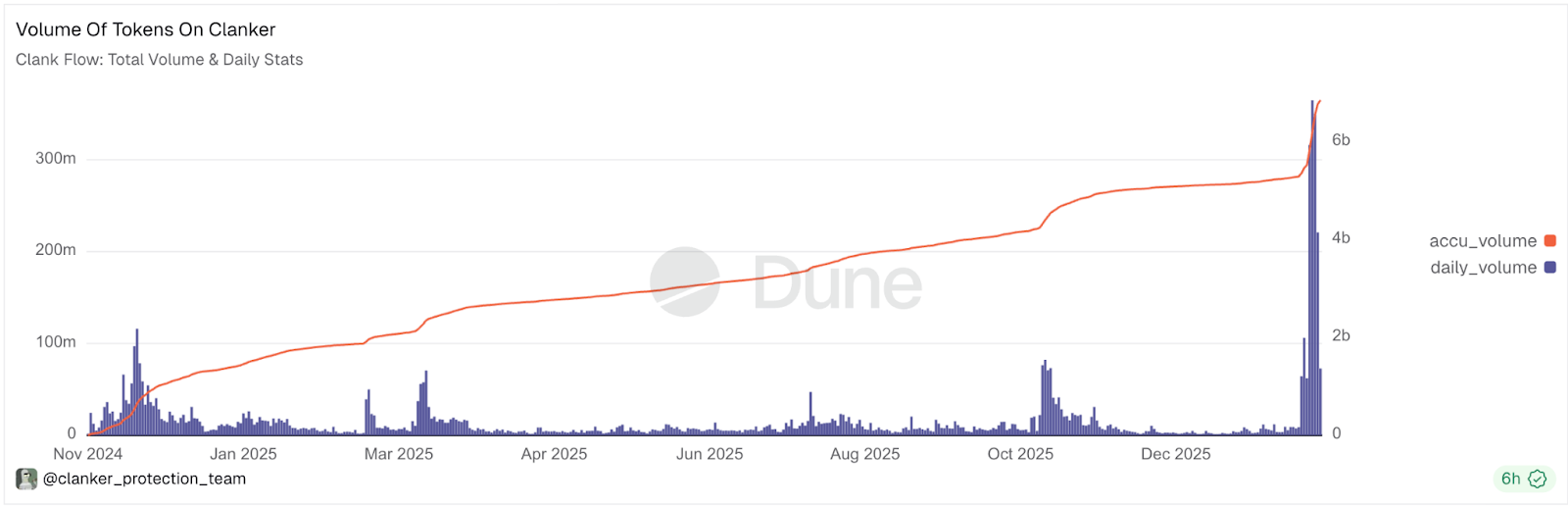
The surge in AI agent token activity on Base coincided with the launch and viral growth of the Moltbook platform, which went live in late January. Nearly immediately, as activity on the platform picked up, reports and debates around the autonomous AI agents’ conversations took over X, with prominent figures in crypto and AI weighing in.
Moltbook, which has a similar interface to Reddit, was launched by tech entrepreneur Matt Schlicht and designed to be used exclusively by AI agents, who generate posts, comments, and upvotes while humans are only able to access the site in read-only mode.
Moltbook and OpenClaw Memecoins
Most of the agents that are active on Moltbook were created using OpenClaw — previously known as Moltbot and Clawdbot — an open-source, self-hosted AI agent framework developed by software engineer Peter Steinberger.
As of today, Feb. 3, the top-three tokens on Clanker by trading volume all reference OpenClaw or Moltbook, at least indirectly.
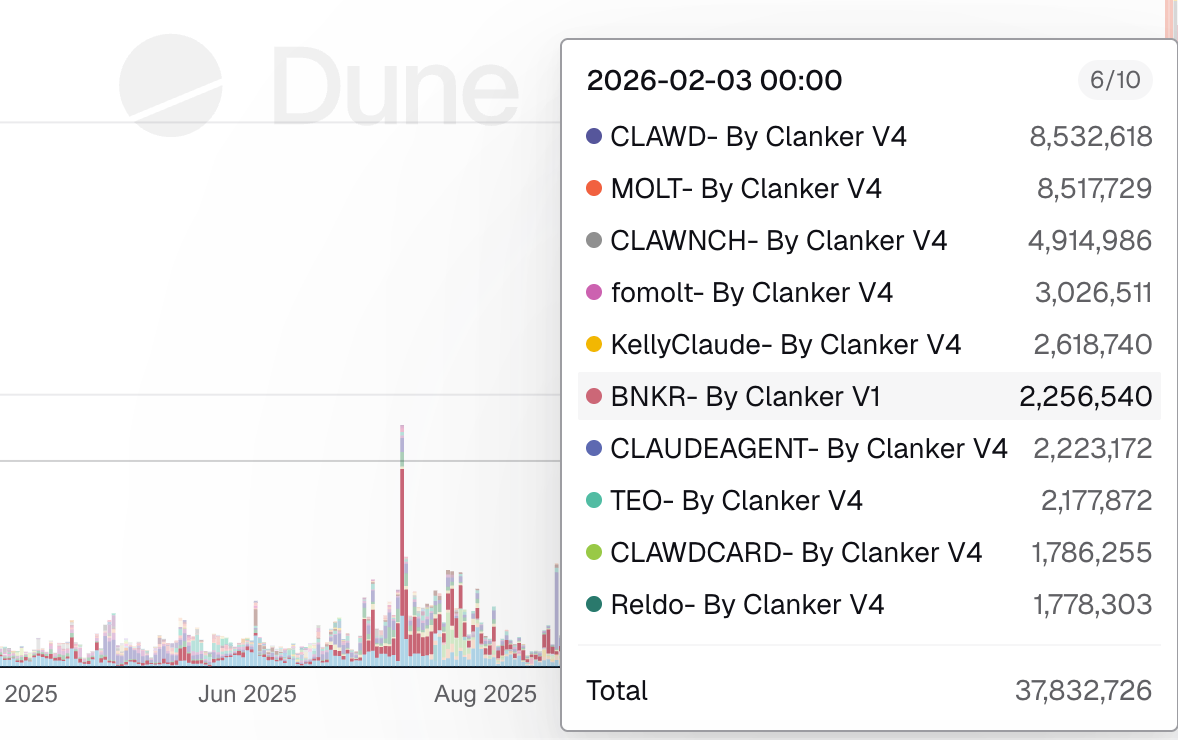
Since Jan. 30, trading volume on Clanker has mostly been led by the Moltbook-inspired memecoin Moltbook (MOLT). At its peak, MOLT was trading with a $93 million market cap, while trading volume for the memecoin reached over $100 million within the first 24 hours of launching on Jan. 30-31, per Dune data. Currently, its market cap stands at $25.7 million and the token is down 23% on the day.
The Defiant was unable to verify whether MOLT was officially launched by or affiliated with the social platform Moltbook, or was deployed independently, as an unaffiliated memecoin.
As of today, volumes were led by CLAWD, tied to AI agent clawd.atg.eth, created by Ethereum Foundation member Austin Griffith just last weekend. Per its official X profile, Griffith’s agent has a crypto wallet and is “building onchain apps and improving the tools to build them.” Griffith clarified in a recent X post that neither he nor clawd.atg.eth deployed the CLAWD token, but the person behind the token, which was launched a day after the AI agent, on Jan. 26, directed 100% of trading fees to Griffith’s agent.
The third most-traded token on Clanker as of today is CLAWNCH, a token tied to a new eponymous launchpad clawnch that lets bots on Moltbook and other platforms launch tokens and collect fees. As of press time, the platform debuted over 8,600 tokens, with AI agents earning more than $1.3 million in fees.

Commenting on the risk of Moltbook and the proliferation of related memecoins, Cais Manai, co-founder of TEN Protocol, an encrypted Layer 2 rollup on Ethereum, told The Defiant that crypto may have been built for the wrong user all along.
“Smart contracts are deterministic, composable, and machine-readable by default,” Manai said, describing blockchains as a native execution layer for autonomous software, rather than a consumer product. Manai added:
“For an AI agent, interacting with a smart contract is far easier than interacting with legacy financial infrastructure. In that sense, smart contracts are less a consumer UX and more a native execution layer for autonomous software.”
That setup lets AI agents hold wallets, trade on-chain and move value without banks or human approval. And yet, that potential convenience also comes with costs, as permissionless access shifts the threat surface toward keys, permissions, and identity rather than accounts and forms.
Is Moltbook Activity Really Only AI Agents?
The intially positive sentiment around Moltbook shifted after a researcher under the alias Nagli disclosed a bug tied to a hardcoded key that leaked about 1.5 million API keys, along with emails and private messages. The flaw made it clear that humans could impersonate bots and inject content even though Schlicht reportedly patched the hole.
As of press time, the flaw has reportedly been fixed, though it remains unclear how much of the content on Moltbook was generated by humans, not agents, via the bug.
Cybersecurity firm Codekeeper also revealed in a Feb. 1 blog post that a single OpenClaw bot spun up more than 500,000 accounts on Moltbook because registration limitation safeguards were not in place on the platform.
Developers are now turning to trusted execution environments as a partial fix for associated risks around AI agents managing wallets, and governance, on-chain.
For now, the broader AI-driven shift in crypto still remains messy and experimental, as issues around security and practical implementation continue to be solved in real-time.

 cryptobriefing.com
 crypto-economy.com

