
 news.bitcoin.com
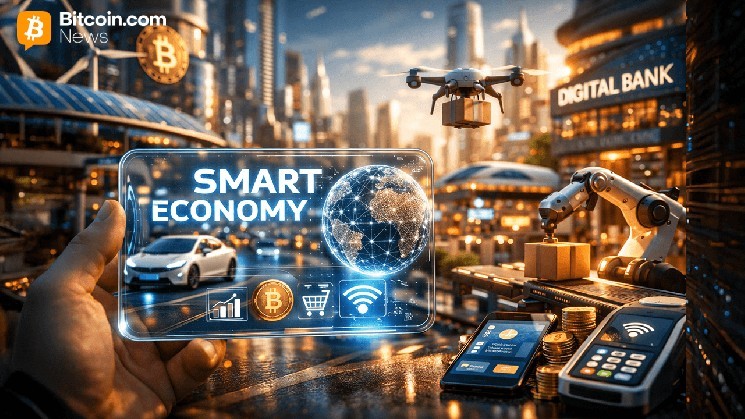
By integrating AI agents with blockchain infrastructure, John Wang of Neo Ecofund, envisions a decentralized world where autonomous “silicon-native” entities act as sovereign economic participants.
Beyond AI and Blockchain Integration
The evolution of the blockchain industry has long been defined by the “Smart Economy”—a world of programmable assets and automated contracts. However, according to John Wang, head of Neo ecosystem growth and managing director of Neo Ecofund, the industry is on the precipice of a more profound shift toward what he calls the “Sentient Economy.”
In a recent discussion regarding the launch of Spoonos, Neo’s new framework for artificial intelligence (AI) agents, Wang detailed a future where the primary participants in the global economy may not be human at all.
While the industry often treats AI and blockchain as separate silos, Wang views their integration as the foundation for a new economic class. The Sentient Economy is defined as an economic system where AI agents—rather than just human operators—can own assets, make autonomous decisions, and interact trustlessly onchain.
Wang emphasizes that this movement is not merely about combining two popular technologies. Instead, it focuses on enabling AI agents to become real participants in the digital economy by ensuring they are verifiable, accountable, and composable. Under this framework, an AI agent is a sovereign economic entity. By living onchain, these agents can prove their identity, execute financial transactions without a human intermediary, and remain accountable through transparent, immutable code.
To turn this vision into reality, Neo has introduced Spoonos. Positioned as the successor to the “Smart Economy” philosophy that Neo has championed since 2017, Spoonos provides the technical scaffolding for building and coordinating these autonomous agents.
The framework currently supports a developer runtime and a unified data layer, allowing for the creation of agents that can reason using AI models while acting via blockchain infrastructure. Wang noted that the concept is already gaining institutional and developmental traction. Through strategic collaborations with industry leaders such as ChainGPT and Morph, Neo is actively cultivating a broader ecosystem where these agents can interact across different platforms and protocols.
Addressing the Hurdles of Programmable Intelligence
Despite the momentum, Wang remains candid about the significant obstacles standing in the way of a fully realized Sentient Economy. He noted that developer tooling remains in its early stages, meaning the kits required to bridge high-level AI reasoning with low-level blockchain execution are still being refined. Furthermore, the mechanisms for value capture by agents are still nascent, as the industry works to determine how agents will generate and retain value autonomously. Finally, the learning curve remains steep, requiring developers to master the complex intersection of AI, blockchain, and decentralized coordination.
For Wang and the Neo ecosystem, this transition represents a natural progression in the utility of decentralized technology. If the last decade focused on making assets “smart” and programmable, the next decade is dedicated to making the economy itself “sentient.” As Wang summarized, the team previously built for programmable assets, but they are now building for “programmable intelligence.”
As AI agents begin to manage portfolios, optimize supply chains and negotiate contracts on-chain, the Sentient Economy may soon transition from a visionary concept to the standard operating procedure of the digital world.
Wang’s vision for the Sentient Economy extends far beyond decentralized finance, focusing instead on the capacity for AI to interpret the physical and digital worlds. During the Scoop AI Global Hackathon—which saw over 500 developers across Silicon Valley and London—Wang observed that the most compelling innovations were those that prioritized “probabilistic intelligence” over simple automation.
Also read: Bitcoin’s Cycle Turns as Cryptoquant Flags Demand Slowdown
One standout application involved using Spoonos to recursively derive mathematical curves from raw data, uncovering hidden causal relationships between unrelated phenomena. For Wang, this represents the true potential of the framework: creating agents that serve as a bridge between raw information and human understanding.
“To me, that’s the essence of the Sentient Economy—not just automating transactions, but building agents that perceive, reason and reveal structure in the world,” Wang said.
He believes this shift will occur through quiet integration rather than a sudden technological upheaval. As these tools become more sophisticated, they will begin to fundamentally alter how society processes information and makes decisions.
“By the time people realize it’s happening, the Sentient Economy will already be here,” Wang predicted. “It won’t arrive with a big bang. It will quietly embed itself into how we observe, decide and act.”
A Civilizational Shift
The Neo Ecofund managing director believes the global Web3 ecosystem is currently undergoing a “civilizational” transformation. He argues that the industry has moved past the era of purely digital property—focused on tokens and consensus—into a new phase defined by programmable cognition.
For Wang, the most exciting shift is that blockchain is no longer just a tool for financial transactions; it has become the “coordination substrate” for autonomous, silicon-native agents. By providing AI with the cryptographic keys to reason, transact and persist on-chain, he suggests the industry is moving from building simple tools to “building minds.”
He describes this transition as the opening of a “trustless civilization of sentient actors,” a shift so profound it transcends the importance of any specific technical token standard. In his view, this evolution from “programmable value” to “programmable intelligence” marks the beginning of a “new social physics” where humans, AI and hybrid intelligences interact in a unified, networked economy.
“As carbon-based intelligence gives way to silicon-native agents, we’re no longer just building tools—we’re building minds,” Wang said. “The moment we gave AI the keys to sign, transact, reason and persist—on-chain—we cracked open something far larger than a financial system.”
FAQ 💡
- What is the Sentient Economy? It’s a blockchain‑based system where AI agents act as sovereign economic participants.
- Why did Neo launch Spoonos? Spoonos provides the framework for building and coordinating autonomous AI agents on‑chain.
- How does this differ from the Smart Economy? The Smart Economy focused on programmable assets, while the Sentient Economy enables programmable intelligence.
- Where is adoption happening first? Neo’s collaborations across Silicon Valley, London, and global Web3 hubs are driving early traction.
 blockchainreporter.net
 1
1
 cointelegraph.com