

Bitcoin ($BTC) has shed 2.06% in value in the day, missing the $87,000 resistance line and pulling back to $84,425 at press time. Other than rising speculations of increased aggressiveness in the Middle East conflict, the drop is also a short-term consequence of the recent hike in US government bond yields.
Bitcoin drops amid spike in US bond yields
The 10-year US Treasury yields have risen to 5.11%, a level last witnessed during the 2007 global financial crisis.
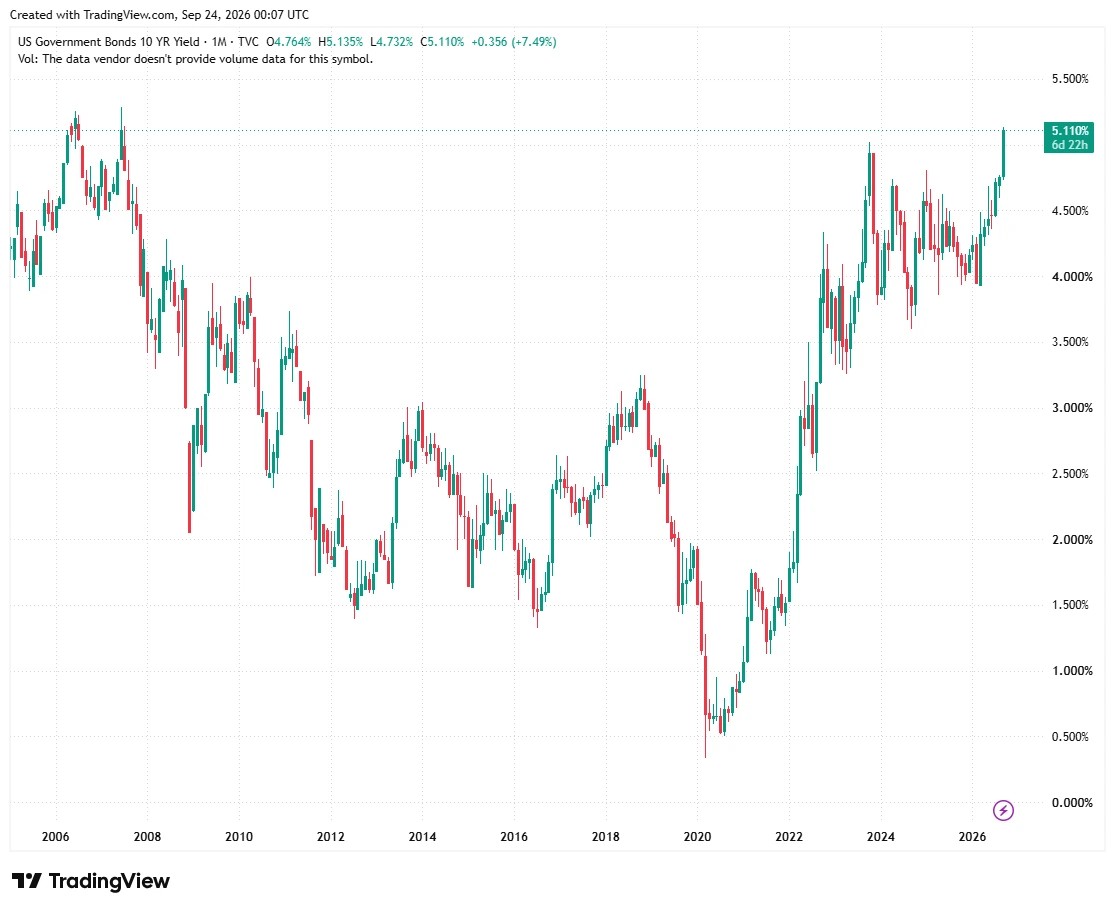
Source: TradingView
Other than geopolitically induced inflationary fears, the hike is also a result of the recent US Federal Reserve interest rate hike. This, in addition to a recent statement from Fed Governor Michael Barr, has fueled speculation of additional interest rate hikes.
Worsening matters is America’s national debt, which has crossed the $40 trillion threshold. The government is now forced to issue additional Treasury debt to cover its budget shortfalls. At the same time, artificial intelligence (AI) entities are also massively borrowing to cover infrastructure growth costs. This intense debt issuance has tightened competition for investor funds, forcing yields higher.
The hike has in turn narrowed the gap between US and foreign nations’ yields, causing the latter to rotate their capital back home. China, for instance, has reduced its stockpile of US Treasuries by 11% over the course of the year.
$BTC’s current and forecasted reaction
Historically, a spike in US bond yields has caused a dual-stage reaction for Bitcoin.
Initially, investors take on a risk-off position, disposing of crypto assets in favor of assured returns on Treasuries. This is the reason why Bitcoin recently toppled, and also a contributing factor to the 2022 crypto winter that dragged $BTC to $16,000.
The second stage is the 3-12 month structural decoupling period, where Bitcoin recovers to higher prices. The mid-September interest rate hike caused $BTC to fall towards $75,000, before reclaiming $81,000 within days.
Additionally, investors gradually shift capital to Bitcoin and gold as a hedge against currency debasement. This is evidenced by the Bitcoin-gold correlation hitting its highest level since 2020 (+0.50).
No, it's not the start of the bear market.
— Michaël van de Poppe (@CryptoMichNL) September 23, 2026
It's just a regular correction in an upwards trend.
They do happen.
If something goes up 15% on a day, people start to think that this is the standard.
Well, if you want to have that, you'll need to accept that there will be days…
Bitcoin’s price has recently been cushioned by spot ETF flows, with Monday marking the single largest inflow ($999 million) since October 2025. The ceiling now lies at $87,000, while lower support is at $83,520, with a break below this risking a pullback to $81,000.

 ambcrypto.com

 cryptoslate.com
 beincrypto.com

 theblock.co