


 3
3
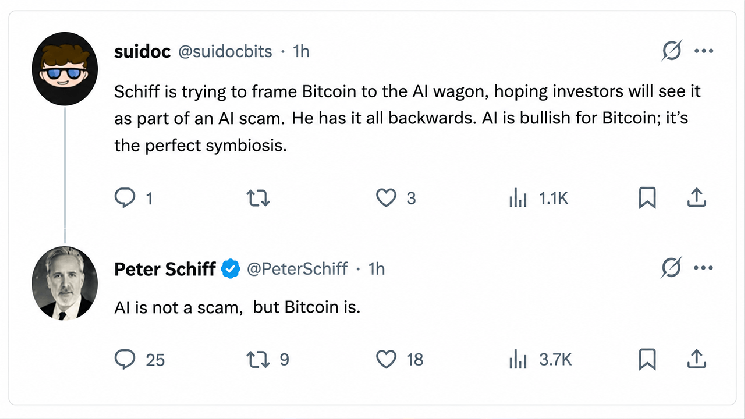
The gold advocate and longtime $BTC critic made the argument Sunday afternoon, saying bitcoin supporters are attempting to connect the cryptocurrency with the booming AI investment trade when the technologies may actually be competitors.
“Bitcoin pumpers are trying to hitch Bitcoin to the AI wagon, hoping investors will see it as part of the AI trade. They have it backwards. AI isn’t bullish for Bitcoin; it’s a threat to it,” Schiff wrote on the social media platform X.
The economist added:
“AI competes with Bitcoin for speculative capital, electricity, and>Bitcoin miners have already felt that pressure. Some mining companies have begun converting portions of their infrastructure to support AI and high-performance computing (HPC) because those businesses can offer another source of revenue.
That development, however, does not necessarily threaten the Bitcoin network itself. It creates competition for bitcoin mining companies, which must decide whether using available electricity for mining or AI computing produces better returns.
Bitcoin was designed to adjust when mining participation changes. Roughly every 2,016 blocks, the network changes its mining difficulty to keep blocks arriving around once every ten minutes. If substantial computing power leaves Bitcoin, mining eventually becomes easier for the remaining participants.
$BTC supporters and Schiff critics quickly piled into the economist’s X thread. “AI is a threat to gold more than it is to Bitcoin, Peter,” one account fired back. Schiff, apparently unconvinced, responded, “How so?” The user then laid out the counterargument:
“You could ask AI yourself … But here you go … 1. AI finds huge new gold deposits. 2. Robots make mining far cheaper. 3. AI unlocks low-grade/deep-sea gold. 4. Better tech dramatically improves gold recycling. 5. Eventually, asteroid mining could flood supply. 6. More supply + less scarcity → gold prices fall.”
AI Security Warning Faces a Higher Bar
Schiff’s second argument goes further. He says increasingly powerful AI could discover vulnerabilities in Bitcoin’s code, cryptography, wallets or network that human researchers have overlooked. Software vulnerabilities are possible, and Bitcoin is not magically immune to programming mistakes. Wallet applications, exchanges, and Bitcoin implementations can contain bugs, which is why developers continually review and test software.
Finding a bug, however, is not the same as changing Bitcoin’s monetary rules. Bitcoin’s 21 million supply limit is enforced by independently operated worker nodes, computers that verify whether transactions and blocks follow the network’s rules. Software attempting to create bitcoin outside those rules would be rejected by nodes still enforcing them.
A fundamental break in Bitcoin’s cryptography would represent a much larger problem. Modern banking, secure websites, corporate systems, and government communications also depend heavily on cryptographic security. An AI system capable of defeating widely used cryptography could therefore threaten far more than Bitcoin.
AI Could Strengthen the Defenses
There is another problem with treating AI solely as an attacker. Developers and security researchers can use the same technology to examine code, discover bugs, automate testing, and identify weaknesses before criminals exploit them.
That leaves Schiff’s strongest point centered on economics rather than Bitcoin’s ultimate survival. AI can compete with bitcoin miners for electricity, capital, and data centers, potentially squeezing mining margins and accelerating the industry’s search for cheaper power.
What matters next is whether that competition pulls substantial computing power away from the Bitcoin network and whether AI produces meaningful advances in vulnerability discovery. For now, competition between AI and bitcoin mining is somewhat measurable, although muddy, while the prospect of AI breaking Bitcoin’s fundamental rules remains misguided.

 beincrypto.com
 u.today

