



 12
12
After making a respectable gain in July, Bitcoin entered August, but historical data indicates that the market may be about to enter one of its most erratic times of the year. Although July has historically been a positive month for Bitcoin, August has performed inconsistently in prior market cycles, so the upcoming weeks will be crucial in determining whether the recovery can continue.
Evaluating median returns
The average August return for Bitcoin since 2013 is slightly over 1%, according to historical monthly return data; however, the median return is actually negative. This disparity can be attributed to a few exceptionally powerful August rallies, like the 65% gain in 2017, while many other years ended with losses.
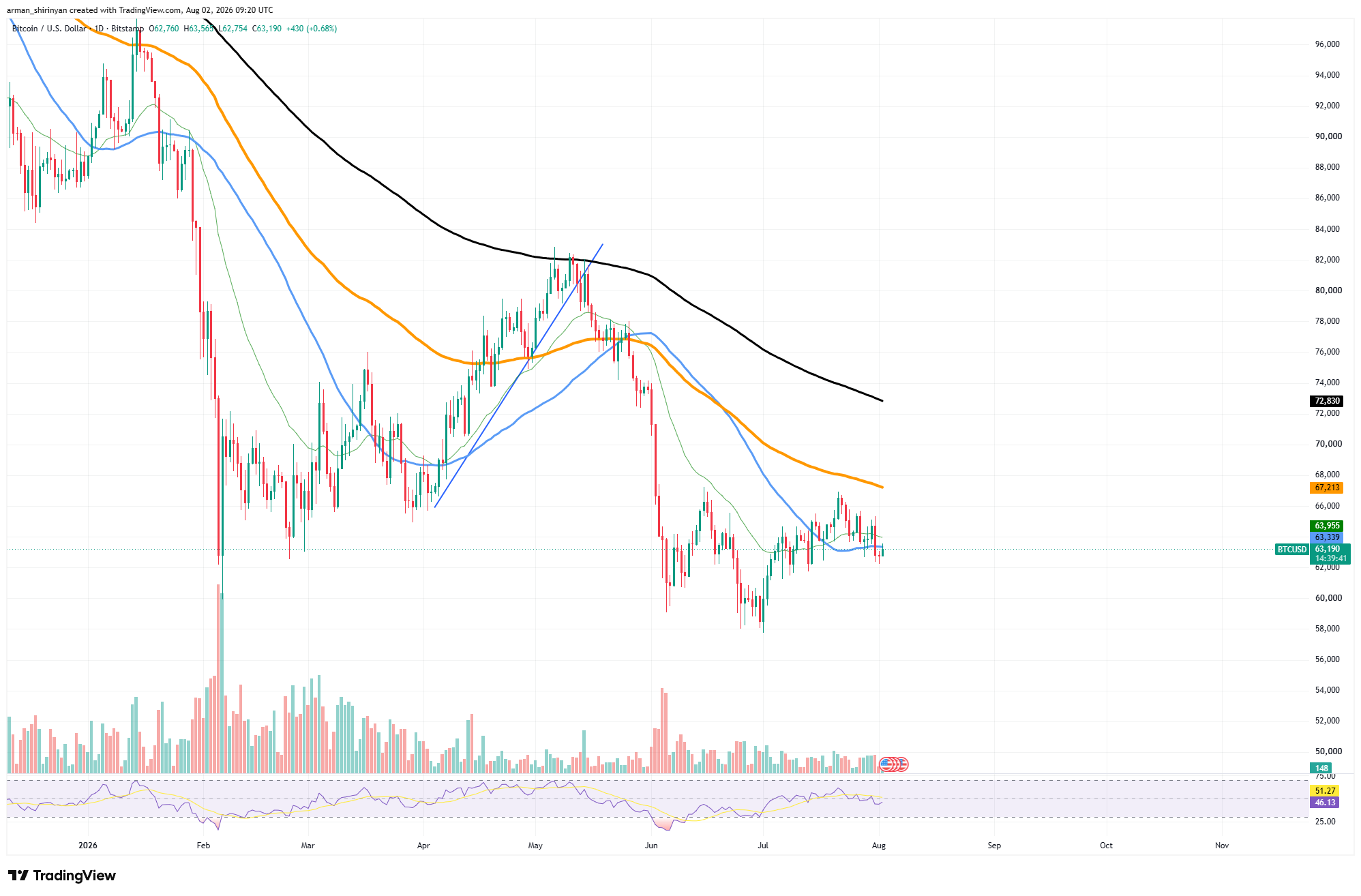
Additionally, recent history presents a mixed picture: in August 2022, Bitcoin dropped by almost 9%, in August 2023, it lost more than 6%, and in August 2024, it managed only a slight increase. Technically speaking, rather than being in a verified uptrend, Bitcoin is still in recovery mode. Bitcoin spent the majority of July consolidating in the $63,000–$65,000 range after rising sharply from June's lows.
Bitcoin's momentum
The price is currently trading near its 50-day and 100-day moving averages, which shows that buyers and sellers are in balance. Still, the overall trend is negative. The 200-day moving average, which is significantly above current prices, is still sloping downward toward $73,000. Despite the recent stabilization, longer-term market structure still favors caution until Bitcoin can regain that level.
The Relative Strength Index is close to the neutral 50 mark, indicating that neither buyers nor sellers have a clear advantage at this time. Because of this, Bitcoin is susceptible to whichever side produces higher volume first. In the past, August has frequently been a month of transition rather than the start of a long-term trend.
Summertime often sees a slowdown in trading activity, which lowers liquidity and increases the market's vulnerability to bigger price swings from relatively mild buying or selling pressure. Investors start positioning ahead of September, which has historically been one of the worst months for Bitcoin. Regaining resistance around the 200-day moving average and eventually breaking above the $67,000 area is the bulls' immediate goal.
If those levels were successfully crossed, sentiment would considerably improve and attention might be drawn to higher resistance around $72,000. On the other hand, Bitcoin may return to support around $60,000 if the current consolidation zone is not maintained.
August is probably going to be influenced more by technical breakouts, macroeconomic developments, and institutional flows than by seasonal patterns alone, because historical seasonality does not provide a clear directional edge.

 cryptoslate.com
 beincrypto.com

 theblock.co