



 20
20
Bitcoin is holding above $62,000 after the massive drop that defined last week’s market action and erased months of recovery progress in a matter of days. The price is stabilizing — but analyst MorenoDV has published a demand analysis that places the current market conditions in a historical context that makes the stability feel considerably more fragile than the held price level suggests.
Bitcoin demand has entered one of its most extreme contraction regimes since 2019. The 30-day growth of combined spot and perpetual futures demand has fallen toward -650,000 $BTC — a threshold that has been reached only three times across the chart’s entire history. The rarity of the reading is the first signal that the current environment is not a routine demand slowdown but something structurally more severe.
The architecture of the contraction is what makes MorenoDV’s analysis particularly significant. Spot demand and perpetual futures demand are contracting simultaneously — meaning the weakness is not isolated to speculative leverage unwinding. Organic buyers who would normally absorb declining prices through spot purchases and derivatives participants who express directional conviction through futures exposure are both withdrawing at the same time. The two demand streams that together provide Bitcoin’s marginal buying capacity are disappearing in parallel rather than one offsetting the other.
What remains is a market with fewer buyers, less capacity to absorb selling pressure, and a demand structure that has only looked this extreme on three previous occasions in Bitcoin’s modern market history.
Three Times in History and the Previous Two Were Not Bottoms Yet
The MorenoDV analysis applies the historical framework that prevents the extreme demand contraction reading from being interpreted as automatic capitulation confirmation. The two previous occasions when combined demand fell toward the -650,000 $BTC threshold carried specific and instructive implications that the current setup should be evaluated against.
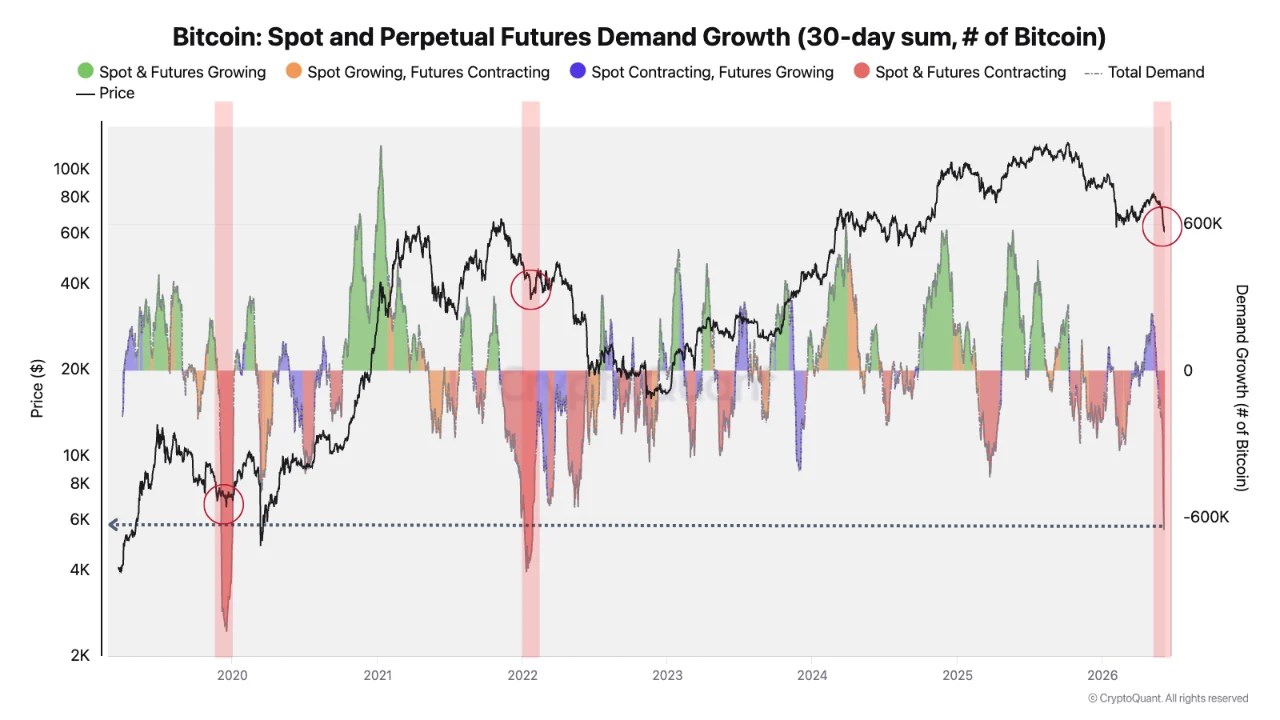
Bitcoin Spot and Perpetual Futures Demand Growth | Source: CryptoQuant
The first breakdown toward this level occurred before the COVID crash — demand deterioration was already developing before the final liquidity shock arrived. The metric reaching extreme contraction was not the bottom. It was the early warning that preceded the actual capitulation event that followed weeks later.
The 2022 bear market showed a similar distinction. Extreme demand contraction reflected deep structural deterioration rather than marking the floor. The subsequent interactions with higher support zones occurred as the market moved through its broader bottoming and rebuilding process — a prolonged sequence rather than a single decisive moment.
The current setup therefore resembles the beginning of a final cleansing phase more than a confirmed reversal. MorenoDV identifies the most probable path as an initial expansion in volatility followed by what the analysis describes as price anesthesia — weak momentum, compressed activity, and prolonged sideways action that exhausts remaining participants without delivering the dramatic capitulation event that would provide psychological closure.
That phase may prove more damaging than the sell-off itself. Sharp declines create fear but also resolve — they force decisions and clear positions. Extended sideways action at depressed levels erodes conviction gradually, tests patience beyond its limits, and tends to shake out holders who survived the initial drop but cannot endure the silence that follows it.
Bitcoin Price Testing Critical Demand
Bitcoin is attempting to stabilize above the $62,000 level after one of the sharpest selloffs of the cycle erased the May recovery and drove price back into a critical long-term support region. On the weekly chart, $BTC is currently trading directly above the 100-week moving average (red line), which has acted as a major support level throughout previous corrective phases. The fact that buyers stepped in near this area suggests that long-term participants still view the zone as attractive despite the recent weakness.
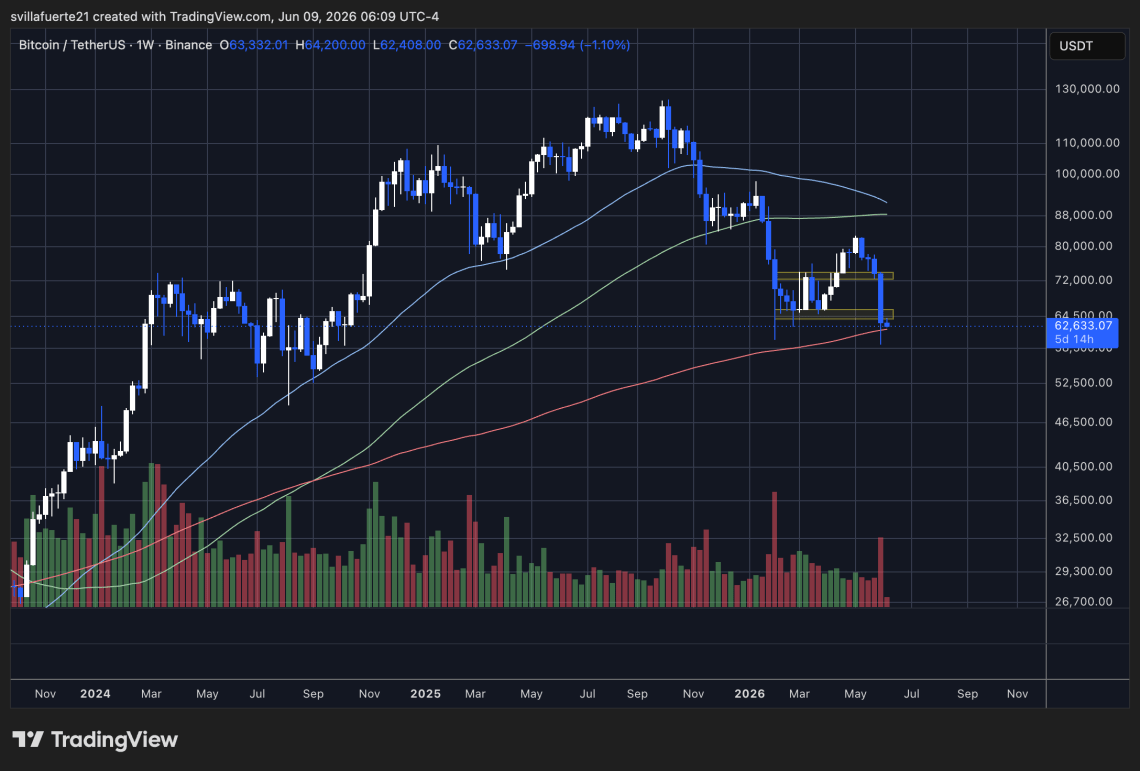
Bitcoin testing key demand level | Source: BTCUSDT chart on TradingView
However, the broader technical structure remains fragile. The rejection from the $72,000–$74,000 resistance zone confirmed that previous support has now become resistance. Bitcoin failed to reclaim that range and subsequently broke below the consolidation area that held between March and May, triggering a rapid decline toward the current support region.
The key level to watch remains the $60,000–$63,000 region. Holding above it would preserve the possibility of a prolonged base formation. A decisive break below that zone could expose Bitcoin to a deeper retracement toward the mid-$50,000s. To regain momentum, bulls must reclaim the former support zone near $66,000 and eventually challenge resistance around $72,000. Until then, the trend remains defensive despite the recent bounce.
Featured image from ChatGPT, chart from TradingView.com

 cryptoslate.com
 cryptopotato.com
 1
1

 decrypt.co


 bitcoinmagazine.com