



 4
4
A monthly research report from Bitwise's European arm published this week pegs bitcoin's theoretical "fair value" at roughly $224,000 if the asset were widely adopted as portfolio insurance against G20 sovereign debt defaults.
The research team described the figure as a "model-implied illustrative figure, not a price target or forecast," however.
The figure stems from a theoretical framework first proposed by analyst Greg Foss in 2021, which treats bitcoin as a credit default swap on sovereign bonds.
Because the bitcoin network has no central issuer and operates without a sovereign backstop, the Foss model frames it as a non-correlated hedge against the possibility of major sovereign defaults.
The implied $224,000 fair value depends on the weighted default probability across group of 20 (G20) sovereigns and the market capitalization of the bonds being notionally insured.
It built the case around stress in sovereign bond markets. Japanese 30-year government bond yields have hit record highs while 10-year JGB yields sit at multi-decade peaks.
The International Monetary Fund and OECD have warned that governments and companies are set to borrow $29 trillion from bond markets this year, 17% higher than 2024, with the IMF describing markets as becoming less forgiving and investors as increasingly questioning the limits of sovereign borrowing capacity.
Bitwise singled out Japan's JGB market as particularly vulnerable, citing its roughly $7.5 trillion size as the world's second-largest sovereign bond market, Japanese investors' approximately $1.2 trillion in U.S. Treasury holdings, and Japan's roughly 230% debt-to-GDP ratio.
It noted that 10-year swap spreads, which measure sovereign risk premia, are at their highest levels since the 2011-2012 European debt crisis across major sovereign bonds.
But the report flagged some near-term headwinds for bitcoin as well.
Higher global bond yields have made Strategy's (MSTR) STRC perpetual preferred equity dividends less attractive to investors, and STRC has recently traded below par.
Strategy buys have accounted for roughly two-thirds of institutional bitcoin demand via global treasury companies and bitcoin ETPs through 2026 to date, per Bitwise's count, meaning a stall in Strategy's STRC-funded accumulation could materially dent the flow.
The upside scenarios Bitwise outlines hinge on monetary policy and sovereign stress.
A Fed pause under newly confirmed chair Kevin Warsh against rising inflation could push real yields lower, which the report cited as a historical tailwind for bitcoin. A sovereign bond capitulation that forces central bank intervention to safeguard financial stability could validate bitcoin's role as a decentralized hedge against sovereign counterparty risk.
On valuation, the report flagged one of the most extreme divergences between bitcoin and U.S. large-cap tech it has observed. Bitcoin's market-value-to-realized-value ratio sits in the lower half of its historical distribution, with only 36% of historical readings below the current level.
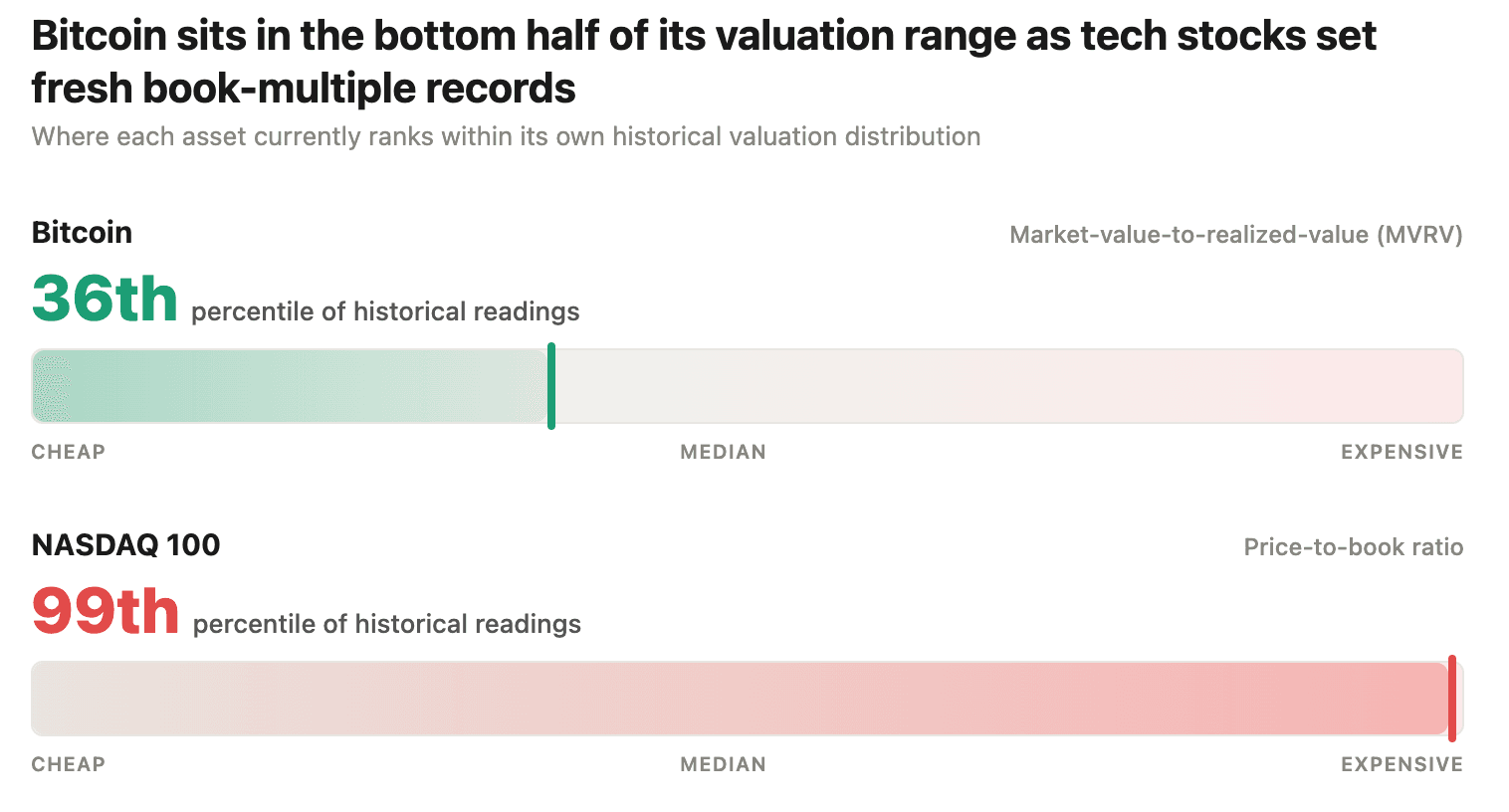
The NASDAQ 100's price-to-book ratio, by contrast, is at its highest level on record, with 99% of historical readings below the current level.
Bitcoin was trading near $66,300 on Wednesday after sliding from above $71,000 earlier this week.

 en.coinotag.com
 cryptopolitan.com
 coinpedia.org