


 1
1


 7
7
On the surface, it looks like the market is currently rotating between metals and risk assets.
From a technical angle, the $BTC/XAU ratio is already up 19% in Q2, marking its strongest quarterly performance since the Q2 2025 cycle. The key takeaway is that this move is happening while macro FUD is picking up again, suggesting Bitcoin is still attracting relatively stronger capital inflows compared to gold.
That said, not everyone views this as a sustainable trend. As highlighted in the post below, Peter Schiff has described the recent sell-off in both gold and silver as a “buying opportunity.” This, based on longer-term expectations like rising inflation ahead, driven by higher yields, supporting gold’s classic role as a hedge.
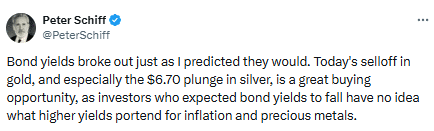
On the technical side, $BTC/XAU edging back towards its mid-January resistance is coming into focus. Back then, Bitcoin [$BTC] dropped by more than 30% from its $93K local top, sliding all the way to around $62K by mid-February. The question now is whether this kind of setup is about to play out again, and whether that could put Bitcoin’s “hedge” narrative under pressure.
From a macro angle, the thesis isn’t too far-fetched. Inflation has picked up to around 3.8% in April, while Treasury yields are pushing to multi-month highs above 4.5%. Taken together, this lines up with Peter Schiff’s view of a more bearish macro setup for U.S markets ahead.
Naturally, the question arises – Which asset, Bitcoin or gold, has the stronger position in this kind of FUD?
Japan’s Treasury sell-off could reshape Bitcoin’s liquidity outlook
As the most dominant currency, the impact of a rising DXY is feeding through global economies.
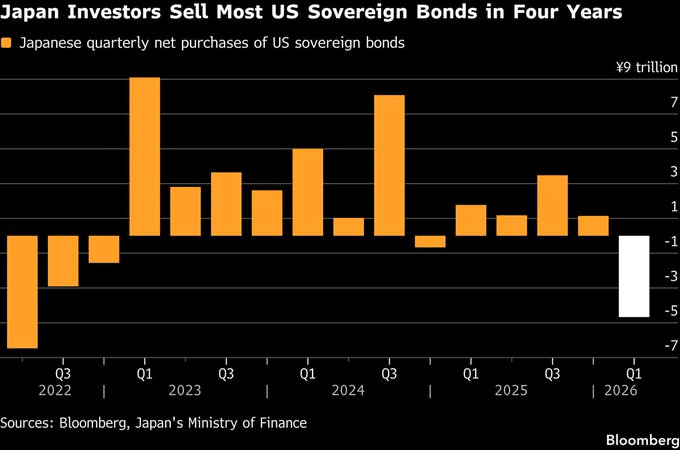
Japan is a clear example. USD/JPY is up over 1.3% this week, marking its strongest weekly move since mid-February. The yen is clearly under pressure, and markets are now pricing in higher odds of BoJ rate hikes. At the same time, the BoJ’s $33 million in Treasury sell-offs in Q1 adds another layer to the shift, reflecting a broader tightening impulse coming out of Japan.
The key takeaway is that this sell-off lined up with $BTC/XAU’s 28% correction in Q1. In simple terms, as yields rose and the DXY strengthened, it pushed the BoJ towards Treasury adjustments to support the yen. As macro uncertainty picked up around the U.S dollar, capital naturally rotated more into gold than Bitcoin.
Fast forward to now, and the setup is closely mirroring the Q1 structure.
On the macro side, Treasury yields are strengthening, while the U.S dollar is approaching the 100-level as inflation pressures persist. In this context, $BTC/XAU hitting resistance couldn’t come at a worse moment. If the Q1 cycle is any guide, another breakdown will become a real possibility, aligning with Peter Schiff’s thesis.
For Bitcoin, a repeat of a Q1-style correction can’t be ruled out.
Final Summary
- $BTC/XAU is near its resistance while macro pressure is rising, increasing the chances of a Bitcoin pullback if liquidity tightens again.
- With a stronger dollar, higher yields, and Japan-driven flows, a Q1-style Bitcoin correction can’t be ruled out.

 cryptopolitan.com


 newsbtc.com

 coingape.com