


Alternative investment vehicles such as exchange-traded funds (ETFs), led by BlackRock's IBIT, hold sway over bitcoin's price. That is well known by now.
But another ETF from the betting world has been moving in lockstep with bitcoin’s cycles since 2020, with an interesting pattern that, to the naked eye, appears to show leading signals for $BTC trend changes.
That ETF is the NYSE-listed Roundhill Sports Betting & iGaming ETF (BETZ). The fund debuted in June 2020 and has since attracted only $98 million in net inflows. As of Tuesday, it had roughly $50 million in assets under management, which is paltry compared to the billions of dollars in the IBIT fund.
The 90-day correlation coefficient between the two assets was 0.73 at press time, according to data from TradingView. Meanwhile, the 365-day coefficient stood at 0.91. That translates into an R² of approximately 0.83, implying that over 80% of the variation in the two assets’ movements is statistically linked. Talk about moving in lockstep!
But here’s where it gets interesting. If you overlay the ETF price on $BTC’s price chart, a clear pattern emerges, in that the fund tends to hit major peaks and bottoms a couple of weeks ahead of bitcoin market turnarounds.
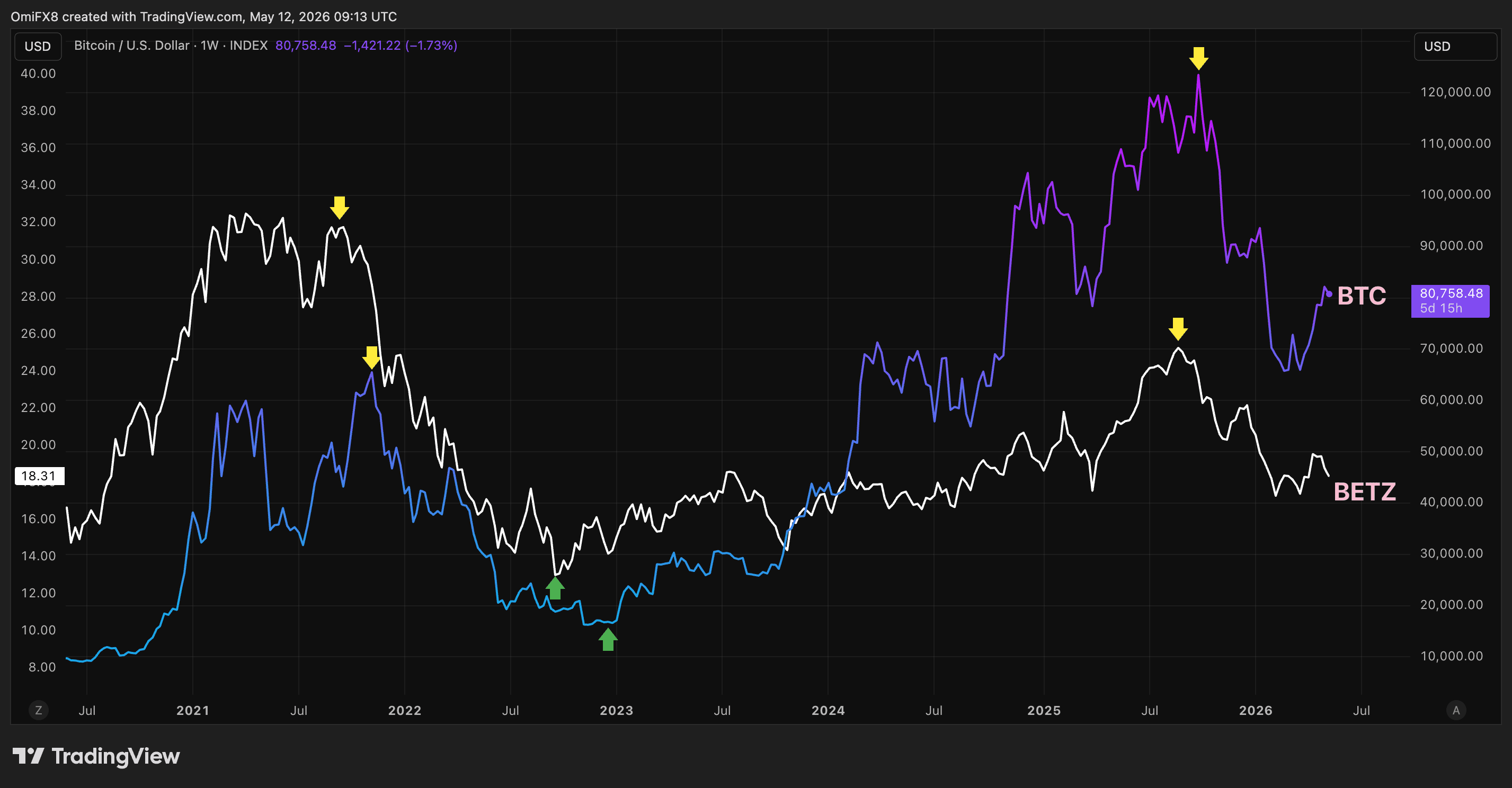
The blue line represents bitcoin, and the white line, the BETZ ETF.
The betting ETF peaked in September 2021, and by the time $BTC followed in November, it was already declining. The ETF’s eventual bottom in September 2022 also preceded bitcoin’s by three months.
A similar pattern played out last year, when the ETF peaked in August, two months before $BTC.
While the correlation between the two asset is far from definitive causation, the consistency of these timing offsets across multiple cycles is difficult to ignore. It strengthens the broader argument made by several leading observers, including Ray Dalio, that bitcoin continues to behave more like a risk-sensitive macro asset than a traditional safe-haven instrument.
For traders, the take away is clear: The ETF is more like a complementary sentiment and liquidity proxy rather than a standalone predictor of $BTC trends.
The fact that the BETZ ETF has, in recent days, decoupled from rising $BTC prices may be an early signal worth monitoring, its just a noise in a relationship that has historically held but not guaranteed to persist.


 en.bitcoinsistemi.com
 4
4


 coinedition.com