



 5
5
A structural shift appears to be underway among Bitcoin [$BTC] miners, who play a critical role in securing the network, as part of their computational capacity gets redirected elsewhere.
The rapid expansion of artificial intelligence, which accounted for nearly 80% of venture capital funding in early 2026, totaling $242 billion, alongside the growing demand for data centers, may have contributed to this trend. However, this does not necessarily mean miners have turned bearish on $BTC.
Hash rate records rare contraction
Bitcoin’s hash rate contracted in the first quarter, marking its first negative growth period in over five years.
On a year-on-year basis, the network’s hash rate has declined by approximately 4% as of writing, pointing to a reduction in the total computational power securing the blockchain. This slowdown aligns with a broader industry pivot.
Notably, several mining firms have begun reallocating infrastructure toward AI-focused data processing, where demand and pricing dynamics have remained strong.
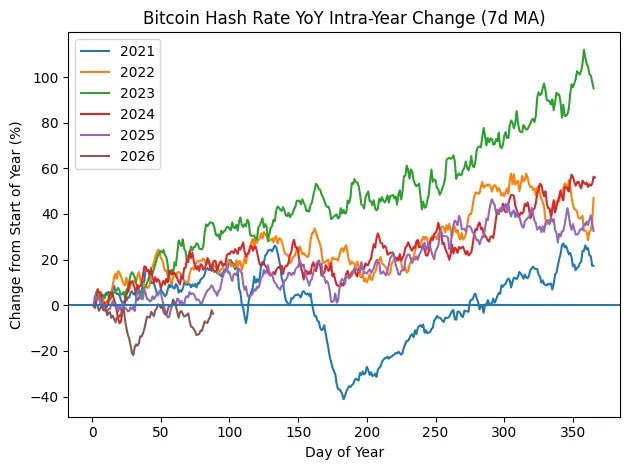
For many operators, this transition offers a practical hedge against tightening mining margins that have persisted since Q4 2025, when the market declined. Rather than relying solely on block rewards and transaction fees, miners are diversifying into compute leasing and AI data services.
The shift is no longer isolated. Companies such as Riot Platforms, IREN, Bitfarms, TeraWulf, and Marathon Digital Holdings have all taken steps to expand into AI and high-performance computing. Their positioning reflects a calculated response to rising demand for AI infrastructure rather than a retreat from Bitcoin itself.
Miners hold firm despite the shift
Even as computational resources are redirected, miner behavior in the market tells a more measured story.
According to CryptoQuant, the Bitcoin Miner Position Index (MPI), which compares miner outflows to the one-year moving average, has dropped to -1.2 at press time. A negative MPI reading indicates that miners are selling less than usual. In practical terms, this suggests reduced distribution and a preference to hold onto mined Bitcoin.
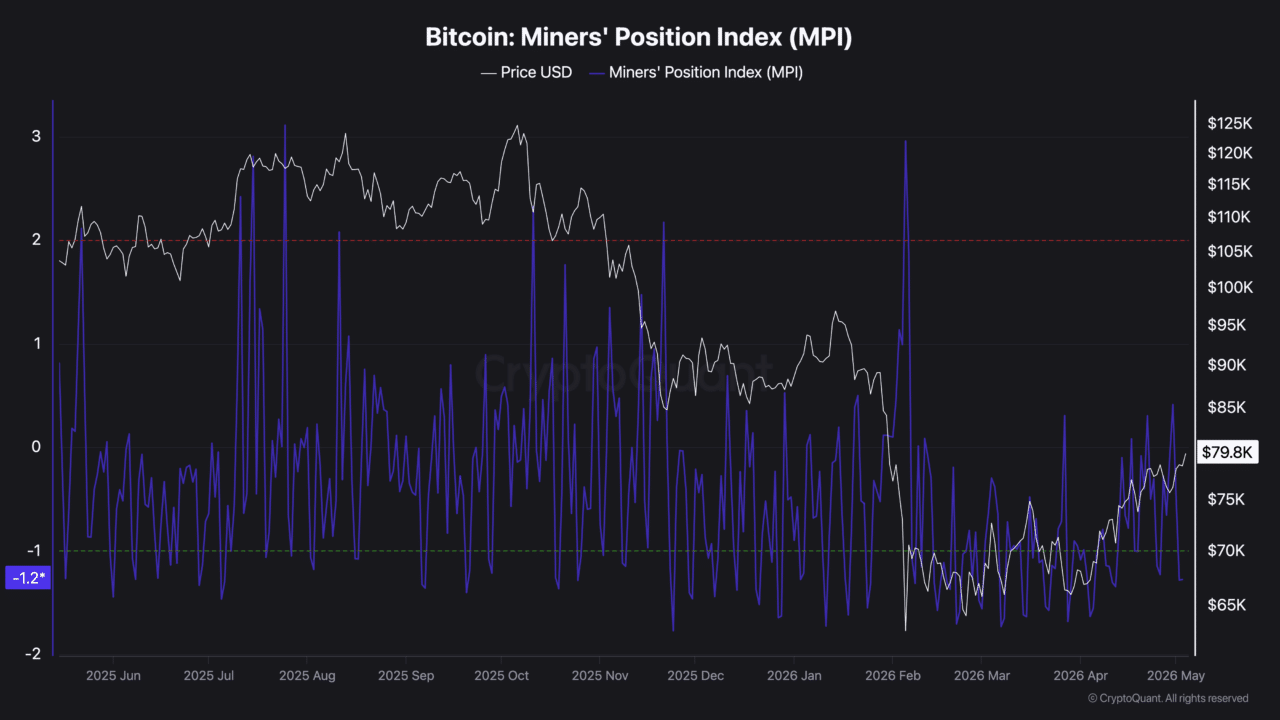
This trend becomes clearer when looking at miner reserves. The total amount of Bitcoin held by miners has increased, reinforcing the view that accumulation remains intact.
As of the 19th of April, miner reserves stood at approximately 1.8 million $BTC. In dollar terms, this equates to about $140 billion, marking the highest level recorded since the 2nd of February 2026.
Such accumulation typically reflects expectations of future price strength. Rather than exiting positions, miners appear to be maintaining exposure while adjusting their operational strategy.
Broader market flows support the outlook
Miner activity represents only one layer of the Bitcoin market structure. Broader capital flows continue to provide additional context.
At the time of writing, spot exchange data showed roughly $120 million in net Bitcoin purchases. This indicates a return of buying interest following four days of sell-side pressure.
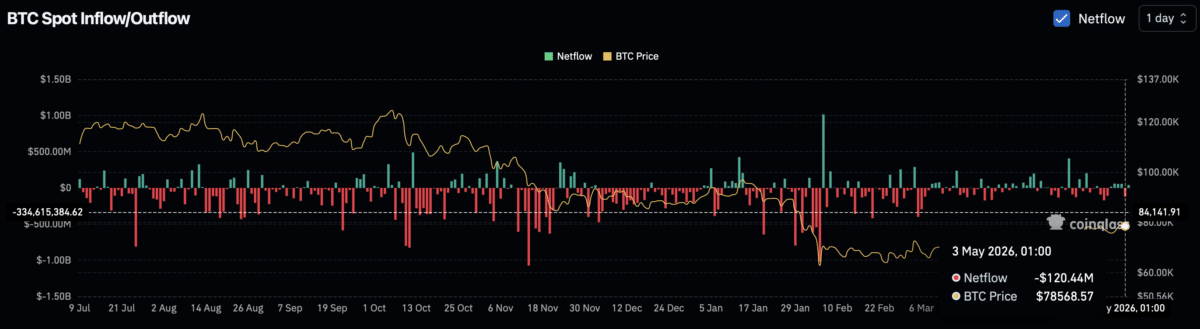
Institutional activity further reinforces this trend. On the 1st of May, large investors executed one of their biggest Bitcoin purchases of the year, deploying approximately $629 million.
The move also extended a streak of consecutive weekly inflows, underlining sustained institutional participation.
Final Summary
- Bitcoin hash rate has declined, posting a negative year-on-year change as miners redirect computational power toward AI infrastructure.
- Miner reserves have climbed to $140 billion, the highest level since February 2026, signaling continued accumulation.

 coindesk.com
 coinpedia.org

 crypto.news