


 3
3
The United Arab Emirates officially withdrew from OPEC and the broader OPEC+ alliance on April 28, 2026, and bitcoin fell below $76,000 within hours of the announcement.
Key Takeaways:
- The UAE exits OPEC on May 1, 2026, ending 59 years of membership and removing OPEC’s third-largest producer.
- Bitcoin fell from a weekly high of $79,490 to below $76,000 on April 28, as traders responded to geopolitical uncertainty and profit-taking.
- ADNOC holds capacity near 4.85 million barrels per day, and analysts say stabilized Hormuz routes could eventually ease inflation pressure on risk assets, including $BTC.
ADNOC Breaks Free From OPEC Quotas
The UAE joined OPEC in 1967 through Abu Dhabi and continued as a unified state after 1971. Its departure removes the cartel’s third-largest producer, behind Saudi Arabia and Iraq, and ranks among the most consequential exits in the group’s history, following Qatar’s departure in 2019.
The UAE’s official state news agency WAM published the withdrawal statement, citing national interest and a shift in long-term energy strategy. “This decision reflects the UAE’s long-term strategic and economic vision and evolving energy profile, including accelerated investment in domestic energy production,” WAM stated. The exit takes effect May 1.
Bitcoin had been trading near weekly highs of $79,486 before the announcement, lifted in prior sessions by ceasefire hopes and risk-on momentum. After the UAE news broke, $BTC dropped sharply, trading below the $76,000 range as traders moved away from risk assets. Altcoins fell alongside it, and total crypto market capitalization registered notable losses on the day. $BTC hit an intraday low of $75,674 on Bitstamp.
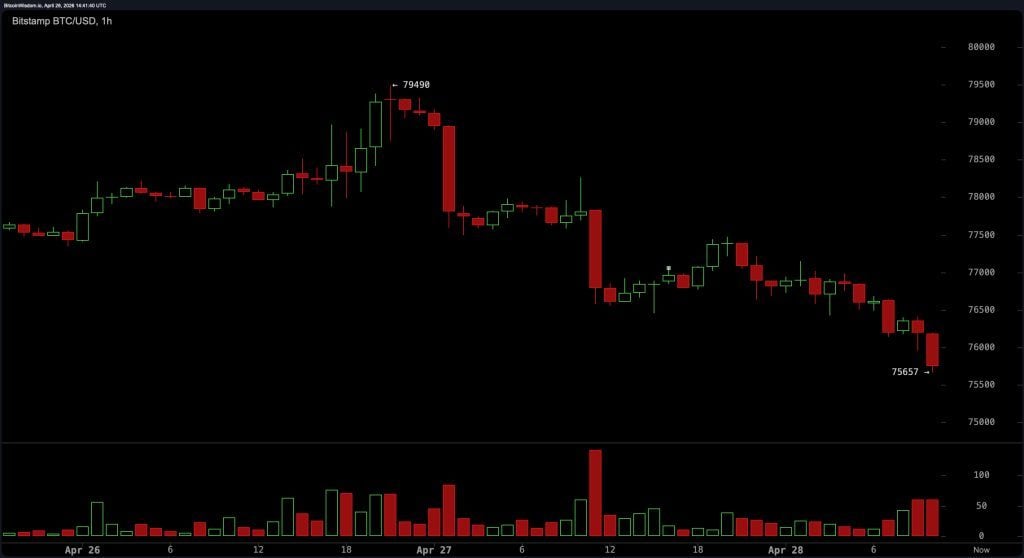
The sell-off was not driven by a single trigger. Geopolitical pressure from the ongoing Iran conflict, now in its ninth week, has severely disrupted the Strait of Hormuz, the chokepoint for roughly 20% of global oil and LNG trade. Analysts estimate 9 to 13 million barrels per day in regional output have been affected, pushing Brent crude above $110 and WTI past $100 per barrel. Bitcoin, which had risen alongside risk sentiment tied to ceasefire talks, pulled back as that narrative stalled.
The UAE announcement initially caused oil prices to pare gains. Brent trimmed from highs near $110 to $111 to $104, and West Texas Intermediate (WTI) settled around $98 as traders factored in the prospect of increased UAE production once supply routes normalize. That dynamic created conflicting signals for bitcoin. Lower oil prices and reduced inflation pressure are generally positive for risk assets over time, but the near-term read was uncertainty, and traders sold first.
Energy Minister Suhail Al Mazrouei described the withdrawal as a sovereign national decision following an internal review. No prior consultation with other OPEC members was reported.
The move follows years of friction between the UAE and OPEC+ over output limits. ADNOC, the Abu Dhabi National Oil Company, has expanded capacity toward 4.85 to 5 million barrels per day ahead of 2027, but quota limits have often held actual production to around 3 million barrels per day. That gap surfaced as a public dispute in 2021 and generated departure rumors in 2023 that the UAE denied at the time.
WAM acknowledged the current supply strains while framing the exit as forward-looking. “While near-term volatility, including disruptions in the Arabian Gulf and the Strait of Hormuz, continues to affect supply dynamics, underlying trends point to sustained growth in global energy demand over the medium to long term,” the agency stated.
Officials also signaled measured output increases post-exit. “Following its exit, the UAE will continue to act responsibly, bringing additional production to market in a gradual and measured manner, aligned with demand and market conditions,” WAM said.
The statement did not frame the departure as a break with OPEC’s membership. “We reaffirm our appreciation for the efforts of both OPEC and the OPEC+ alliance and wish them success. However, the time has come to focus our efforts on what our national interest dictates,” WAM stated.
The UAE move could eventually be constructive for bitcoin. Greater energy supply flexibility, reduced inflation pressure, and a gradual shift away from petrodollar dynamics could support risk assets once Hormuz-related disruptions ease. In the short term, traders are watching oil price trajectories and any formal OPEC response.
Bitcoin’s trajectory from here depends partly on how quickly those routes reopen and whether energy markets interpret the UAE’s post-OPEC production plans as supply relief or added volatility.

 en.bitcoinsistemi.com
 u.today
 cryptopotato.com