



 6
6
A well-known market technician identifies four Bitcoin price zones that could potentially mark the bottom for this downtrend.
Bitcoin has been trading within a range after dropping to $60,000 in early February and rebounding quickly, with the price now hovering around $70,000.
This movement has created uncertainty in the market, as analysts remain divided on whether the bottom is already in or if further downside could still occur. Amid the uncertainty, analyst Ali Martinez has shared four important price zones that could potentially mark Bitcoin’s bottom.
Key Points
- Market watchers remain divided on whether Bitcoin bottomed at the early February low of $60,000 or not.
- Ali Martinez has presented four zones that could mark the bottom if prices continue to slide.
- The $70,685 to $63,111 range forms a major support cluster based on UTXO Realized Price Distribution.
- A long-term trendline between $56,000 and $60,000 has historically triggered major rallies.
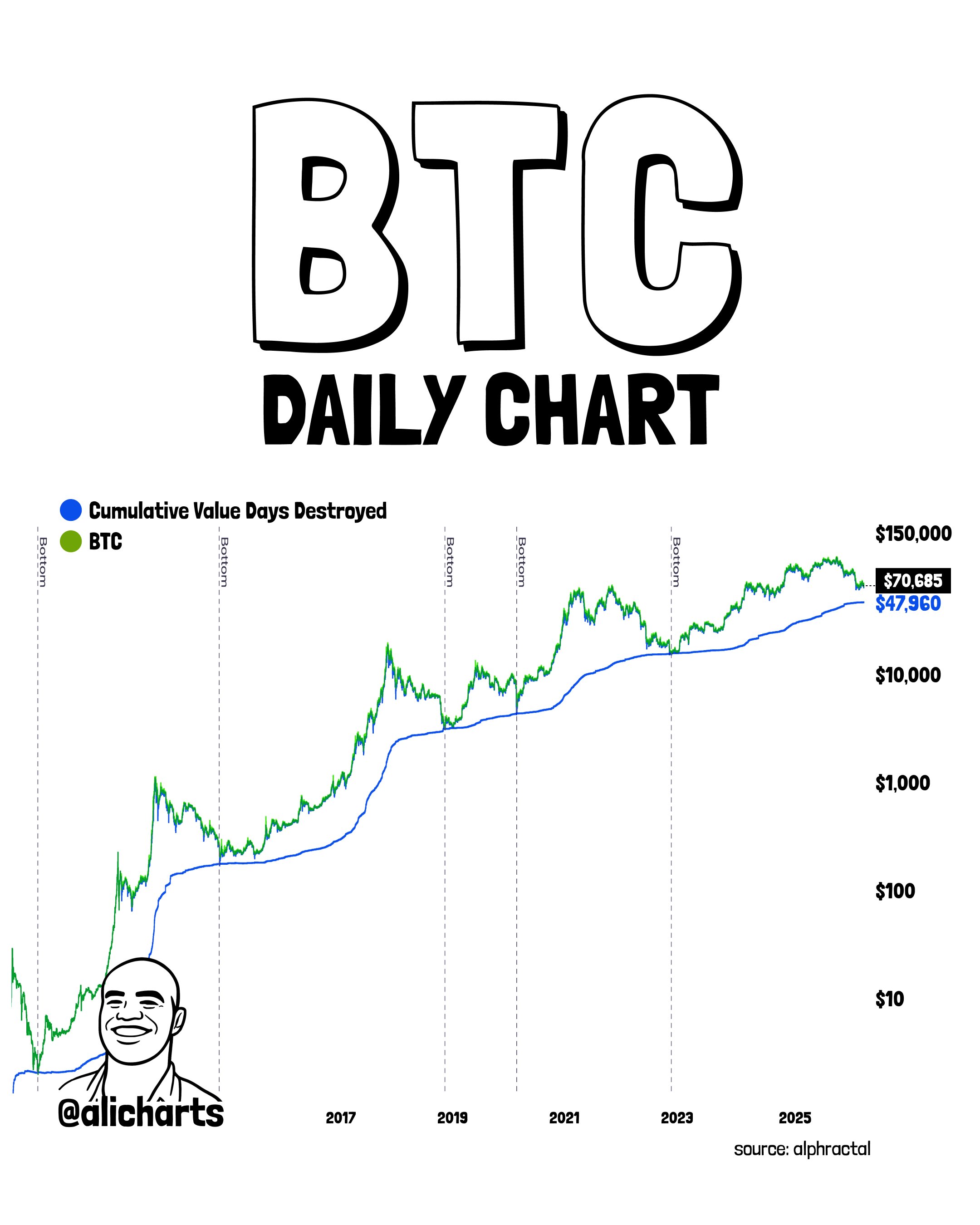
- Key structural support levels include $47,960 (CVDD), $49,387 (LTH realized price), and $43,647 (MVRV 0.8 band).
Immediate Bitcoin Support Wall and Decade Trendline
Martinez presented these four zones during an analysis on X. The market technician used different indicators to highlight areas where the price has strong support and where past market behavior suggests buyers may step in again.
He first highlighted the UTXO Realized Price Distribution (URPD), which shows where Bitcoin last changed hands.
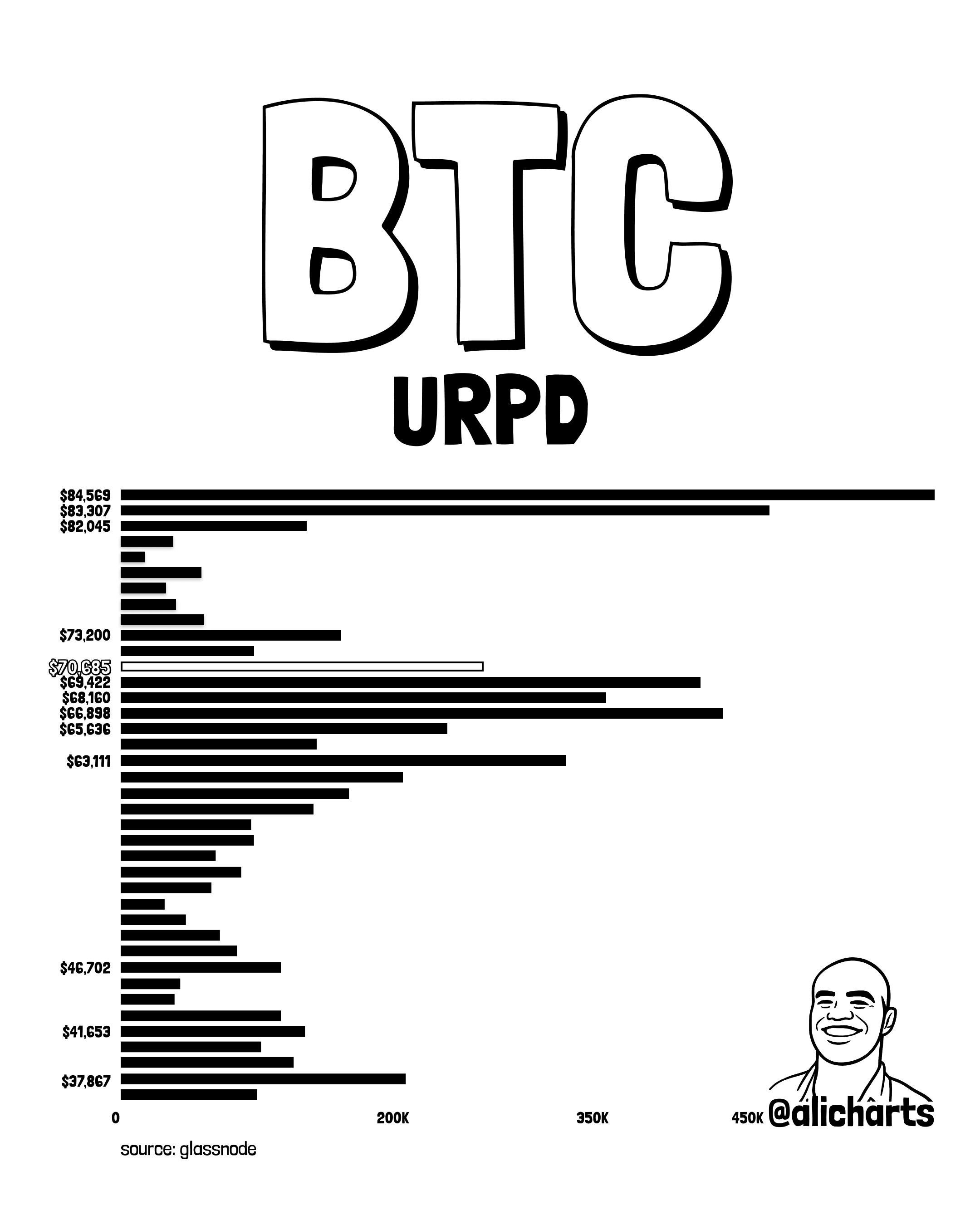
Current data reveals a large cluster of activity between $70,685 and $63,111, meaning many investors bought within this range. As long as the price stays here, these holders will likely defend their positions.
However, he warned that if Bitcoin drops below $63,111, the market could enter a weaker zone with less support, making it easier for the price to fall further.
Speaking further, he then mentioned a major long-term trendline that has guided Bitcoin’s movement for nearly ten years. This trendline has acted as an important support level in the past, with each retest leading to major rallies.
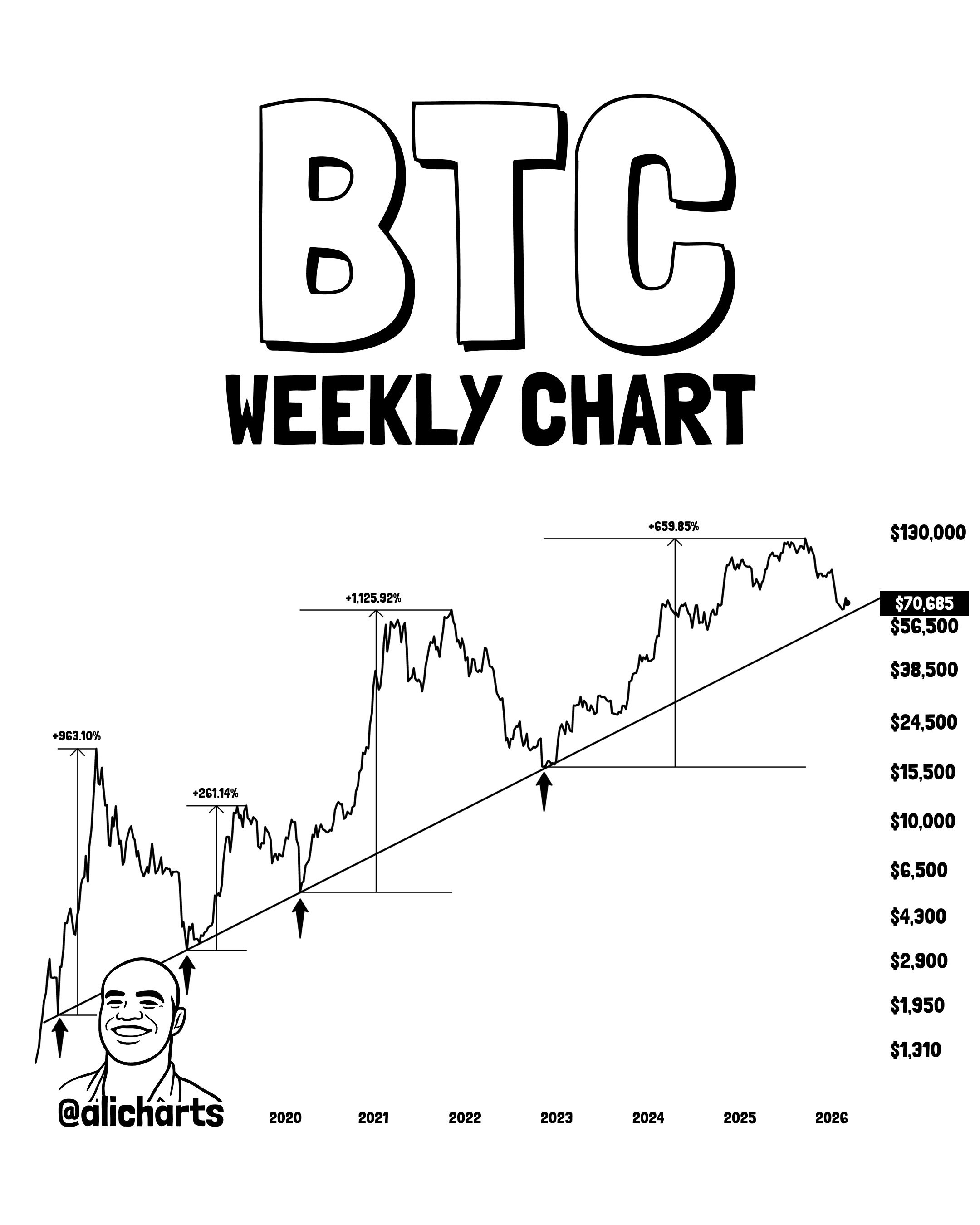
These included gains of +963% in 2017, +261% in 2018, +1,126% in 2020, and +660% in 2022. Bitcoin is now approaching this level again, which sits between $56,000 and $60,000. In previous cycles, this is where large investors often completed their accumulation before prices moved higher.
Bitcoin Structural Floor and Extreme Pain Zone
For deeper support, Martinez looked at the Cumulative Value Days Destroyed (CVDD), which tracks when long-term holders move their coins. This metric currently points to a key level at $47,960. In the past, Bitcoin has not stayed near this level for long and has often rebounded quickly after reaching it.
Meanwhile, he also highlighted the Market Value to Realized Value (MVRV) 0.8 band, which now sits at $43,647. This shows a point where selling pressure becomes extreme, and most short-term traders have already exited the market, leaving behind stronger, long-term holders.
Martinez then noted the Long-Term Holder (LTH) Realized Price at about $49,387 as another important support level.
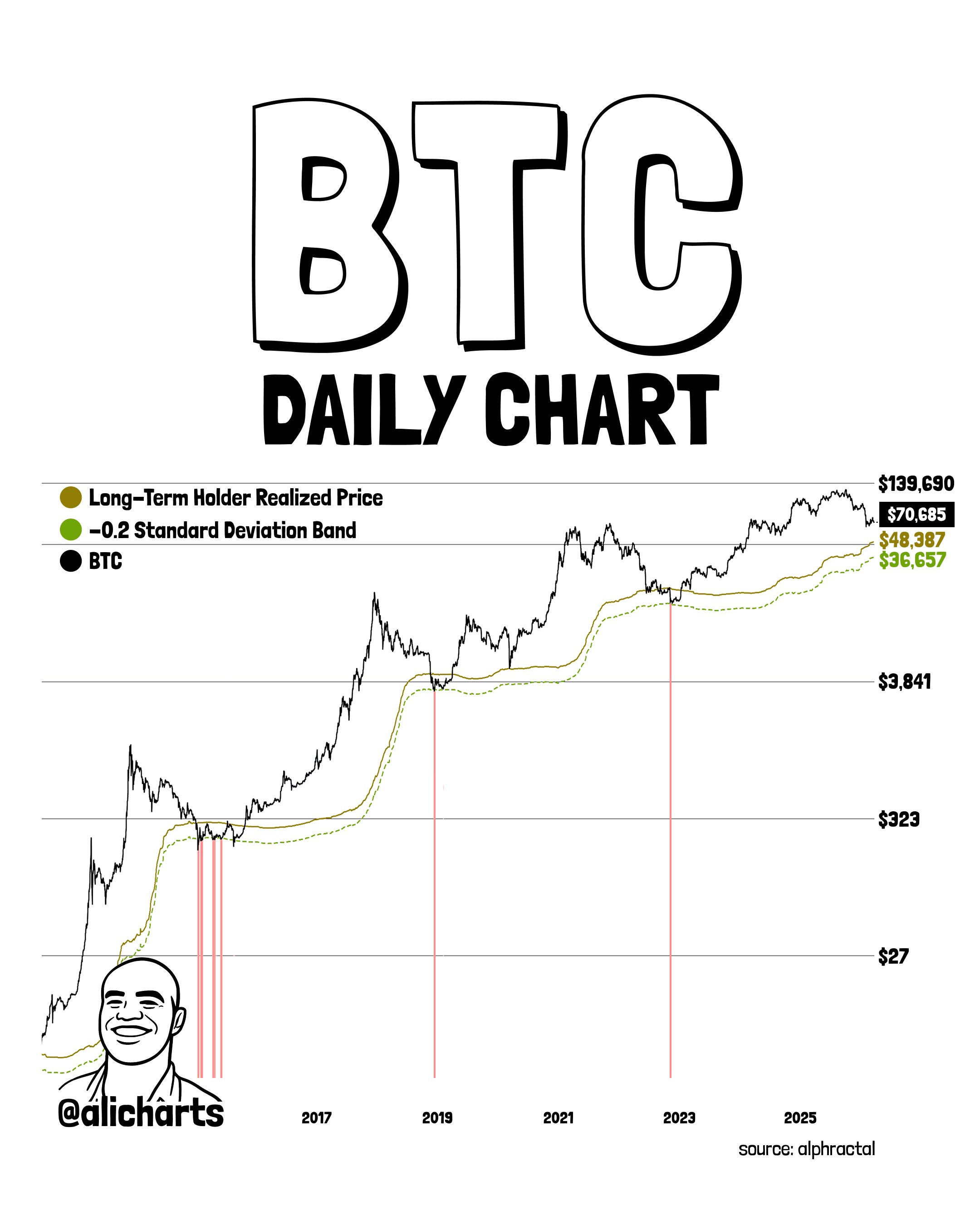
In a more severe downturn or unexpected market event, Bitcoin could briefly drop as low as $36,657, which aligns with the -0.2 standard deviation band. According to him, this represents the lowest range where a strong recovery could begin.
Four Price Zones Bitcoin Could Bottom
Martinez noted that instead of trying to find the exact bottom, he would spread his investments across different levels.
His approach includes buying around $63,111 as the first zone, then $56,000 to $60,000 as the second zone, followed by $47,000 to $49,000 for the third area, and finally $36,000 to $43,000 as the fourth zone if the price falls that far.
Martinez argued that these four zones represent areas where Bitcoin could actually find its bottom for this cycle. According to him, he will continue to increase his capital commitments at lower prices.
He also pointed out that many traders are currently staying out of the market due to fear or are selling their holdings. In past cycles, the best buying opportunities have often appeared during these quiet and uncertain periods, not during times of excitement.

 decrypt.co
 crypto.news
 cryptoslate.com