


 3
3
Bitcoin [$BTC] continues to present mixed directional signals, even as bulls attempt to regain control. At press time, the $BTC was nearing the $70,000 level after trading below it for about eleven days.
Despite this recovery attempt, underlying demand conditions remain fragile. Both retail participants and long-term holders appear to be reducing exposure, raising questions about the sustainability of the current move.
Apparent demand highlights structural weakness
Bitcoin Apparent Demand, a key metric used to assess whether newly issued supply is being absorbed, suggests that April has opened on a weak footing. The metric measures the difference between Bitcoin issuance and the volume of coins that remain inactive for over one year.
Recent data shows apparent demand has dropped to negative 86,000 $BTC, equivalent to approximately $5.95 billion at press time. This indicates that newly supplied Bitcoin is not being sufficiently absorbed, reflecting weak market demand rather than strength.
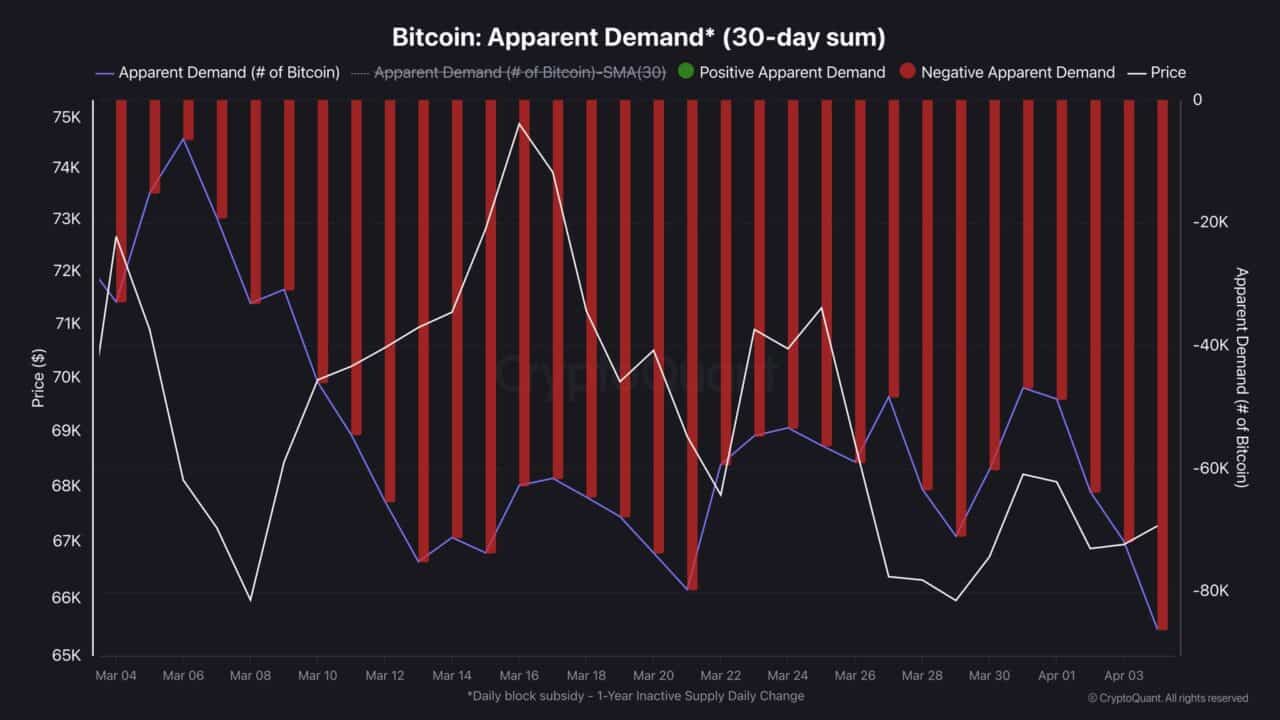
There is currently a clear relationship between apparent demand and price action.
A sustained negative trend in demand typically aligns with downward price pressure. Notably, this marks the weakest reading in over a month, reinforcing concerns about underlying market structure.
Long-term holders shift to distribution
Long-term holders are contributing to this weakness. This cohort, historically associated with accumulation and low selling activity, now appears to be distributing.
Data from CryptoQuant shows the Binary Coin Days Destroyed (CDD) has reached 1. When this metric prints 1, it signals that older coins are being moved, an event commonly associated with selling activity from long-term holders.
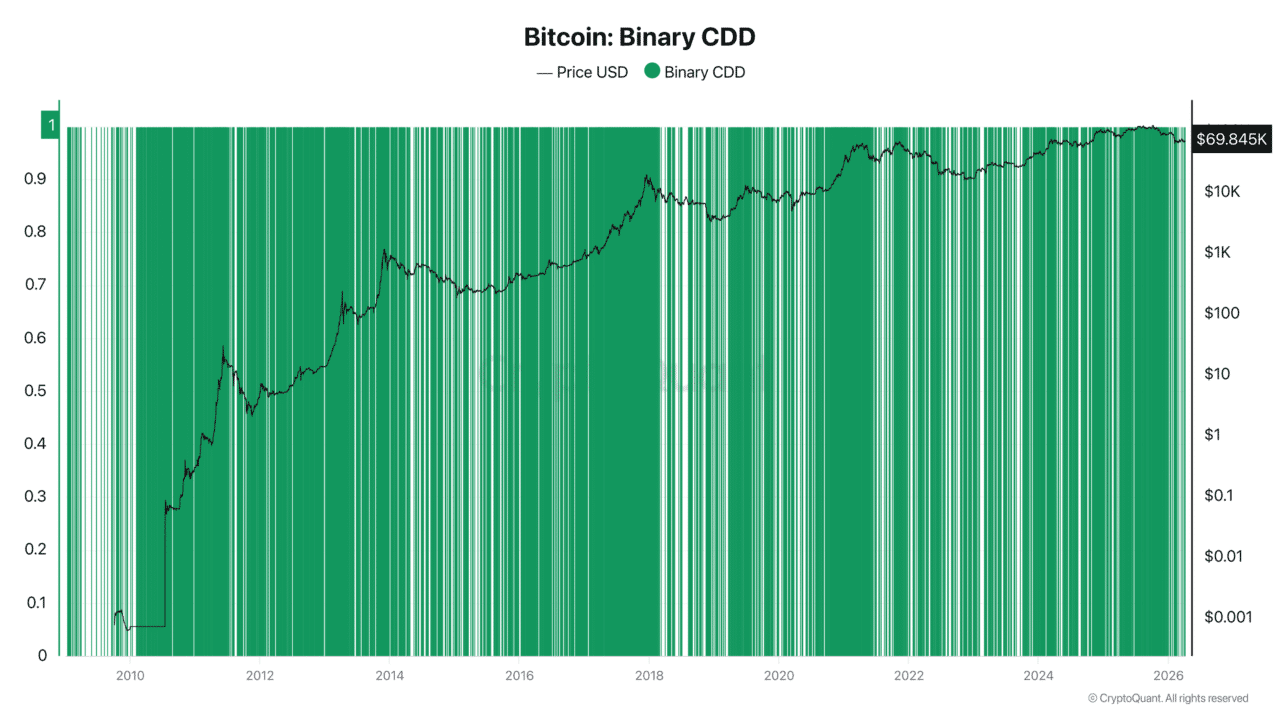
If sustained, this behavior could weigh further on Bitcoin’s price outlook. In contrast, whales are taking the opposite stance. Large holders have increased their presence in the market as Bitcoin attempts to recover.
Spot average order size data shows that whales, particularly larger entities, have dominated trading activity across major exchanges in recent sessions. Their orders account for a significant share of volume, positioning them as key drivers of short-term momentum.
Given Bitcoin’s recent rebound, this activity suggests that whales have turned tactically bullish, at least over the past 48 hours.
Whale activity alone may not sustain the rally
However, relying on whale accumulation as a standalone signal remains risky. Whale behavior is often reactive and can shift quickly with market conditions.
AMBCrypto previously reported that in Q1, Bitcoin investors holding between 100 and 10,000 $BTC recorded combined losses of $30.9 billion, with whales accounting for an average daily loss of $337 million. This context underscores that large holders are not infallible, and periods of accumulation do not always translate into sustained upward trends.
With long-term holders distributing and apparent demand reflecting weak supply absorption, the current whale-driven momentum may lack the fundamental backing required for a sustained rally.
Final Summary
- Bitcoin’s apparent demand has fallen to negative 86,000 $BTC, worth about $5.95 billion, pointing to weak absorption of supply.
- Long-term holders are distributing while whales accumulate, creating a divergence in market behavior.

 newsbtc.com


 blockchainreporter.net