


 1
1
Bitcoin could be approaching its next major market bottom in late May 2026 if historical cycle patterns continue, according to an analyst tracking post-halving trends.
That outlook comes from JA Maartun, a community analyst at blockchain data firm CryptoQuant. Writing on X, he noted that Bitcoin is now 703 days past its most recent halving. In earlier cycles, market bottoms began forming around day 777. If that pattern holds, Maartun estimates a potential bottom roughly two months from now.
Key Points
- A CryptoQuant analyst projects a potential Bitcoin market bottom in late May 2026 based on prior halving-cycle timing.
- Bitcoin is currently 703 days past its April 2024 halving, while past cycle bottoms began forming around day 777.
- The present cycle peaked at $126,080 in October 2025 before a correction exceeding 50%.
- On-chain indicators remain in a Bear Phase, suggesting capitulation may be incomplete.
- Realized price models suggest $55,000 is the likely final floor of the bear market.
- Bitcoin’s correlation with gold has dropped to a record −0.9, a level historically associated with market bottoms.
Halving Cycle Provides the Timeline Anchor
To understand the projection, it helps to look at how halving cycles work. Bitcoin halvings reduce mining rewards by 50%, constraining new supply and reinforcing the asset’s scarcity narrative. Consequently, many investors view them as long-term bullish catalysts.
The latest halving took place on April 20, 2024, cutting block rewards from 6.25 $BTC to 3.125 $BTC. The next halving is expected around March or April 2028, after another 210,000 blocks are mined, with rewards projected to fall to 1.5625 $BTC. These supply-shock events typically occur every four years.
Historically, price action follows a recognizable rhythm. Strong rallies often emerge six to twelve months after a halving, while bull market peaks tend to appear within twelve to eighteen months.
Current Cycle Broke the Historical Pattern
However, the ongoing cycle has featured unusual timing. Bitcoin surged to a record $73,777 in March 2024, before the halving, marking the first pre-halving all-time high. Market observers attributed the early breakout largely to demand from U.S. spot Bitcoin ETFs.
Despite that anomaly, the cycle structure remained intact. A post-halving rally followed, consistent with prior cycles, and the four-year expansion phase culminated in October 2025 when Bitcoin set a new all-time high of $126,080.
Cycle Timing Insight ⏳
Bitcoin is now 703 days post-halving.
In prior cycles, bottoming began around day 777 — roughly 2 months from here. pic.twitter.com/ArYKmZKfsN
— Maartunn (@JA_Maartun) March 23, 2026
Market Correction Followed the Peak
Soon after the peak, momentum reversed sharply. Bitcoin lost more than half its value during the downturn. The decline pushed prices near $60,000 in February 2026, marking a cycle low.
Prices later stabilized but remained well below the peak. At the time of reporting, Bitcoin traded at $70,296. That level is still 44.3% under its record high.
Such pullbacks are typical in past cycles. Historically, the deepest corrections occur around 30 months after a halving and roughly one year after cycle peaks. Within that framework, Maartun argues that if the four-year structure remains intact, a definitive bottom could form in late May 2026.
On-Chain Signals Suggest Additional Downside Risk
Beyond price action, blockchain analytics provide further context. CryptoQuant reported last month that Bitcoin has not yet reached full capitulation, with on-chain indicators still in a Bear Phase. In previous cycles, major lows formed only after metrics entered an Extreme Bear Phase.
The firm also highlighted realized price support levels, identifying $55,000 as a likely “ultimate” bear-market floor. That threshold has not yet been tested, and CryptoQuant noted that such base-building processes typically take time to develop.
Bitcoin-Gold Correlation Shows Rare Divergence
Meanwhile, cross-asset data points to shifting market dynamics. Michaël van de Poppe, chief investment officer and founder of MN Capital, examined Bitcoin’s relationship with gold and found the correlation had fallen to a record low.
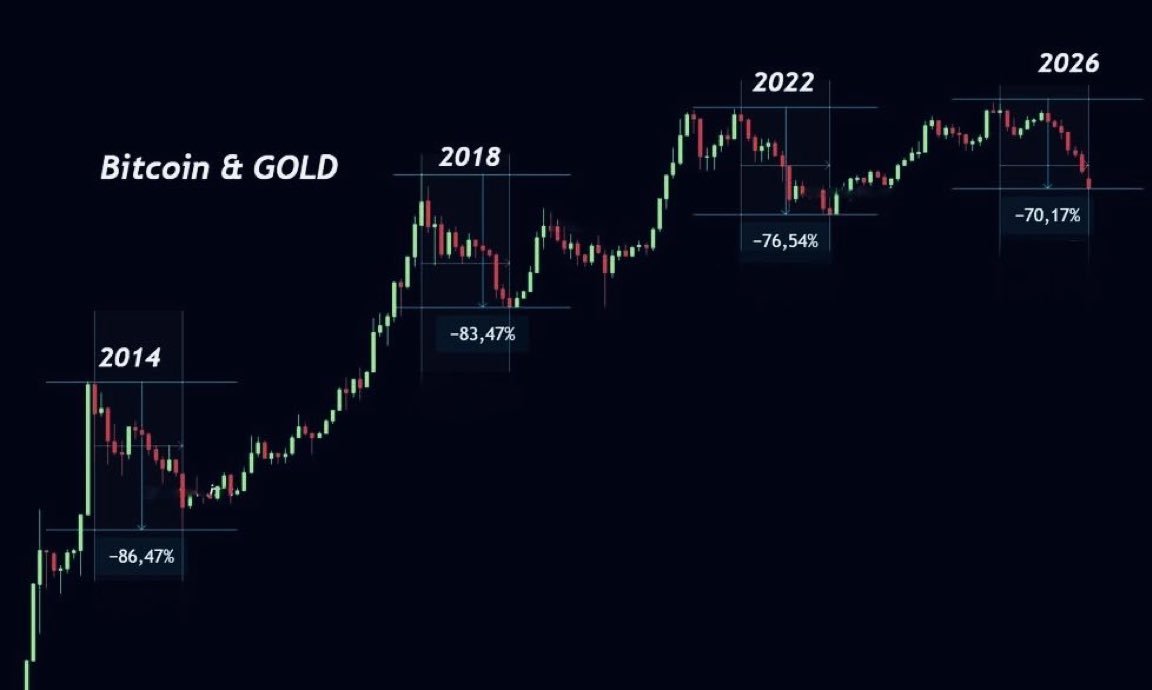
The reading dropped to -0.9 in March, a level that has historically coincided with market bottoms. At the same time, the $BTC-to-gold ratio has declined by roughly 70%, forming trough structures similar to those seen in 2014, 2018, and 2022.
Van de Poppe said the divergence suggests Bitcoin is increasingly moving independently of traditional safe-haven assets, an evolution that may signal changing market behavior.

 coinpedia.org
 1
1
 coingape.com
 en.bitcoinsistemi.com

 beincrypto.com