



 6
6
The Bitcoin Open Interest has failed to recover at the same pace despite Bitcoin’s price recording a notable rebound push this month.
Bitcoin has now gained 23% from its February lows of around $59,900 amid an impressive recovery effort. However, market data shows that the Bitcoin Open Interest has not surged alongside price at the pace it should have, leading to concerns about the sustainability of the ongoing campaign.
Key Points
- Since dropping to a floor of $59,930, the Bitcoin price has recovered 23%, as it currently attempts to establish dominance above $74,000.
- However, while the price recovery has led to impressive gains in price, the Bitcoin Open Interest has failed to keep up.
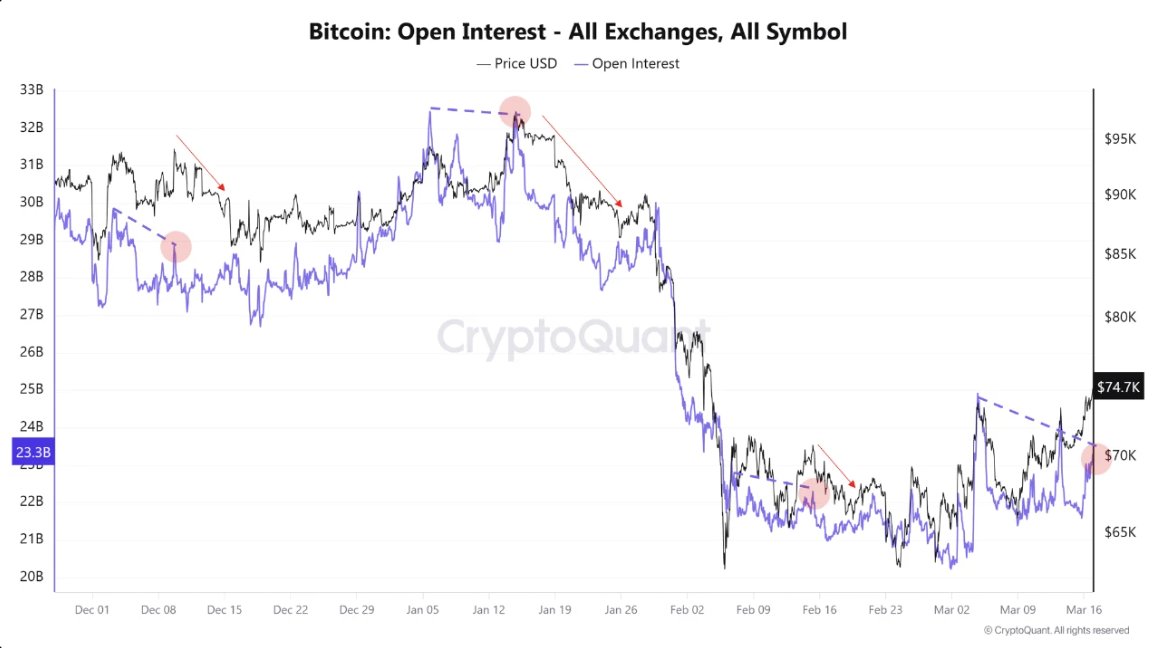
- Recently, the Bitcoin price spiked to a higher high of $74,800, but Open Interest only rose modestly to a lower high of $23.3 billion, confirming a concerning divergence.
- Such divergence indicates that the ongoing recovery is not receiving any backing from the derivatives market, making it fragile.
- Historically, periods of sustained price recoveries have often coincided with corresponding spikes in the Bitcoin Open Interest.
Bitcoin’s Recovery Eyes $74K
Verified CryptoQuant analyst Mac_D was first to point out this concerning divergence between price and OI as BTC attempts to recover some of the losses of the year. Specifically, Bitcoin has been staging a notable comeback since the Israel-Iran conflict broke out, and the effort recently picked up momentum.
The rally first touched a high of $74,000 earlier this month before sliding back to $65,000 on March 8. Since this low, Bitcoin has put together eight straight intraday gains, working its way back above $73,000.
The uptrend continues to run into strong resistance around the $74,000 level. However, despite the $74,000 ceiling holding firm, Bitcoin has gained 10% in March alone, putting it on track for its first positive monthly close since October 2025.
Divergence Between Bitcoin Open Interest and Price
While the ongoing campaign looks strong on the surface, Mac_D warned that it may turn out to be a bull trap. He called attention to a divergence forming on the one-hour timeframe between the Bitcoin Open Interest and price, as futures traders appear unwilling to take on added risk despite spot prices climbing higher.
According to Mac_D, on-chain data also shows that long-standing investors are currently moving their holdings out while newer participants step in, pointing to a clear transfer of ownership.
However, on a brighter note, accumulation addresses, representing wallets that have never sold their tokens, have continued growing in balance, which could mark a healthy sign for Bitcoin’s long-term direction. Nonetheless, the analyst insists that, overall, the short-term picture does not look very encouraging.
Why the Bitcoin Futures Market Carries Weight
Speaking further, Mac_D highlighted a market reality that many observers have often overlooked. Specifically, since stablecoins began seeing broad adoption starting in 2018, the Bitcoin futures market has grown to roughly ten times the size of the spot market.
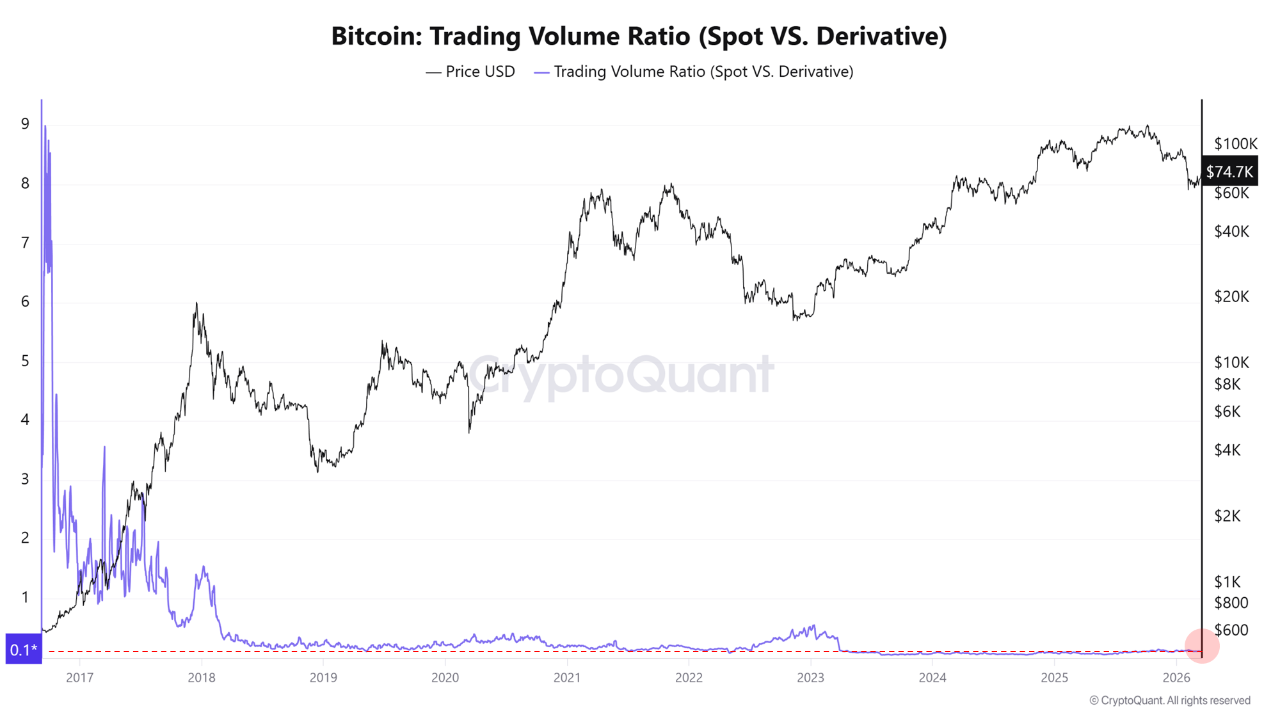
He argued that this gap is important because historically, a true bull market only takes hold when both the spot and futures markets show strength at the same time. The current setup, where spot buying leads while futures activity trails behind, does not meet that standard.
This makes the present divergence more concerning. Given the sheer size of the futures market, it can either give a price move legs or quietly pull the rug from under it. Essentially, when futures traders hang back, the market loses one of its biggest sources of upward fuel.
Historical Data Around Bitcoin Open Interest and Price Action
Data from the accompanying chart confirms the relationship between the Bitcoin Open Interest and price recoveries. Specifically, when Bitcoin climbed from $39,500 in January 2024 to a high of $71,382 by mid-March 2024, Open Interest moved up alongside it, rising from $9.68 billion to $18.28 billion over that same period.
In addition, when prices then fell from that peak to $54,000 in early September 2024, OI dropped as well, pulling back to $15.1 billion during the same window. The same pattern of OI played out again in later cycles. Notably, Bitcoin’s push above $106,000 by late January 2025 came alongside Open Interest climbing to $36.75 billion.
When Bitcoin then reached its all-time high of $126,000 in October 2025, OI hit its own peak of $47.583 billion at the same time. Since the October 2025 ATH price, Bitcoin’s price has trended lower, and OI has followed with steady declines.
Bitcoin Open Interest Seeing Lower Highs
The current recovery does not follow this historical pattern. Specifically, on March 4, Bitcoin price hit a peak of $72,600 while Open Interest topped out at $24.29 billion.
More recently, the price climbed to a higher high of $74,800, yet OI only reached $23.3 billion, representing a lower high. Bitcoin’s price is printing higher highs while OI is printing lower highs, a setup that usually means the rally is being carried by spot buying with no meaningful support from the derivatives market.
When price rises, but OI lags, it generally means traders are not rushing to open new futures positions to ride the move. The rally may be coming from real demand or short covering rather than speculative leverage, which can point to a steadier early recovery. However, it also means the move has limited fuel behind it to keep going.
Two Paths Forward for Bitcoin
From here, Bitcoin faces two possible outcomes depending on how Open Interest behaves. In the first path, OI catches up to price, new leverage flows into the market, momentum builds, and price has the backing it needs to push higher, though with greater volatility risk.
In the second scenario, the Bitcoin Open Interest stays weak, Bitcoin’s rally loses energy, and Bitcoin faces a slowdown or pullback as the move runs short of the leveraged demand it needs to keep it going. At press time, the available data does not yet lean toward either outcome.

 coindesk.com
 newsbtc.com
 2
2
 coinpedia.org