


 1
1


 8
8
The founder of Into The Cryptoverse has revealed features that define a typical Bitcoin bear market and explained why $BTC is already in one.
Bitcoin has kept sliding in 2026, now sitting 45% below its all-time high of $126,000 and down 20.5% for the year as it trades around $69,500.
Despite the declines, most analysts insist that this is simply a pullback within a continuing bull market. However, Benjamin Cowen, founder of Into The Cryptoverse (ITC), disagrees, suggesting that Bitcoin has entered a full bear market.
Key Points
- Bitcoin has dropped 45% from its all-time high of $126,000 and is down 20.5% in 2026, currently trading around $69,500.
- Despite the downturn, most analysts believe Bitcoin is facing a drawdown within a bull market, but Benjamin Cowen disagrees.
- According to Cowen, during bear markets, Bitcoin typically spends more time trending upward, but when it drops within a short period, the drop is more powerful.
- From the November 2025 low, Bitcoin climbed 21.6% over 54 days before crashing 38.8% in just 23 days to a new low in February 2026.
- Cowen identified late March to April as the typical window of weakness for Bitcoin in midterm years, suggesting the current rally will likely break down within the next couple of months.
- February lows in past bear market cycles never marked the macro bottom, and Cowen believes the same could be true for the current $59,930 February 2026 low.
How Bear Markets Actually Behave
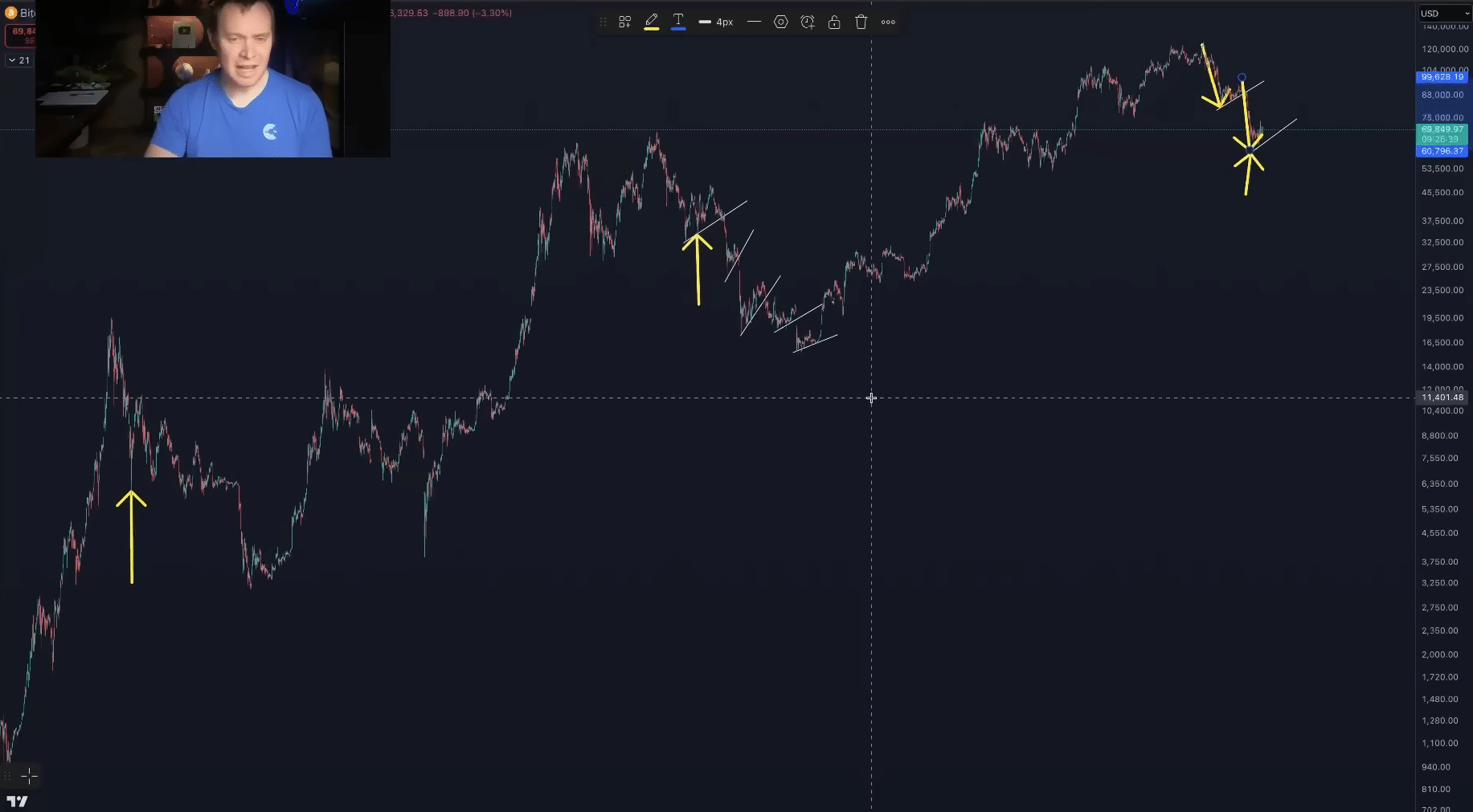
The market analyst shared these details during a recent analysis. One of the most surprising things Cowen pointed out about Bitcoin bear markets is that the price actually spends more time going up than going down.
In bear markets, Bitcoin will often spend more time going up than going down.
When it does go down, it goes down very quickly, sets a low, then trends up for a few weeks/months before going lower.
You can see the change in market structure from bull to bear. pic.twitter.com/TrImvnF7rK
— Benjamin Cowen (@intocryptoverse) March 11, 2026
For months at a time, Bitcoin will slowly climb higher before suddenly crashing to a new low within just one or two weeks. During the sharp drops, panic takes over, while those who turned bullish near the top keep telling investors to buy the dip. Notably, this pattern repeats until a new low forms and eventually gives way to something even lower.
Cowen used the low Bitcoin set on November 21, 2025, at $80,537 as an example. From that low, Bitcoin climbed for about 54 days and reached a local high of $97,939 on Jan. 14, 2026, gaining 21.6% along the way.
Then, in just 23 days, it crashed 38.8% to a new low of $59,930 on Feb. 6, 2026, wiping out everything gained during those 54 days and falling an extra 25% below the November 2025 low. Cowen pointed out that Bitcoin moved up for more than twice as long as it moved down, yet still ended up at a lower price.
Bitcoin Cheerleaders Against Market Analysts
Speaking further, the ITC founder then identified the difference between people he calls price cheerleaders and those who actually try to read the market and manage risk.
He suggested that price cheerleaders stay bullish no matter what, and many people mistake that constant optimism for real analysis. According to him, there is nothing necessarily wrong with being a long-term Bitcoin bull, and that buying during the depths of a bear market and holding through the recovery is a perfectly reasonable approach.
The problem is when people fail to recognize that a bear market has arrived, and others trust their cheerleading as though it were sound financial analysis.
To support his concern, Cowen pointed out that measured against gold, Bitcoin today sits at the same valuation it held back in December 2017, at the 14-ounce-of-gold mark that was one of the highs of that period.
He noted that someone who bought Bitcoin in 2017 and simply held all the way to 2026, nearly a decade, has essentially broken even relative to gold, while those who sold at the end of post-halving years came out ahead.
Why The Bitcoin Structure Points to an Ongoing Bear Market
Moreover, Cowen revealed why he believes the current Bitcoin structure resembles a bear market. Specifically, Bitcoin set a low near $80,000 in November 2025, trended up for roughly two months, then broke down and found support near $60,000 in February 2026.
Since hitting that $60,000 level, Bitcoin has been climbing again, which Cowen says is the same pattern playing out. He believes this current rally will likely break down within the next couple of months, with the period around late March to April typically being the window of weakness for Bitcoin in midterm years.
He then showed how this was different from the bull market structure that played out from 2023 to 2025, where Bitcoin would repeatedly drift lower before shooting up to new highs, the complete opposite of what is happening now.
Citing historical data, Cowen also argued that the $59,000 low in February may not have marked the macro bottom. Notably, $BTC saw lows of $34,000 in February 2022, $5,921 in February 2018, and $400 in February 2014. In every one of those cases, the February low was not the macro bottom, and Bitcoin went on to fall even lower later in the cycle.

 en.bitcoinsistemi.com
 bitcoinmagazine.com
 bsc.news