


 4
4
The security architecture surrounding Bitcoin continues to evolve as new infrastructure emerges to support self-custody and advanced on-chain protections. A notable step in this direction is the integration between Babylon Labs and Ledger. By combining Babylon’s protocol-level vault system with Ledger’s hardware wallet security, the collaboration seeks to strengthen how users store, manage, and interact with $BTC in decentralized environments.
How Babylon And Ledger Aim To Strengthen Bitcoin Self-Custody
The Babylon platform is expanding access to Trustless Bitcoin Vaults through a new integration with Ledger. According to the Babylon Labs post on X, once the integration goes live in the second half of the year, users will be able to authorize BTCVault transactions directly from a ledger device using clear signing. This will allow 8 million Ledger users to review and approve vault operations on a secure hardware screen.
These Trustless $BTC Vaults are anchored directly on the $BTC base layer and enable external applications to verify that $BTC collateral remains locked in place while enforcing predefined collateralization conditions. This vault architecture utilizes cryptographic mechanisms to execute rules, such as unlocking funds or triggering a liquidation event, rather than relying on discretionary control.
By combining Babylon’s vault architecture with Ledger’s secure signing infrastructure, BTCVault workflows can connect with the hardware security that many $BTC holders already rely on for self-custody. As part of the broader rollout, Ledger devices will also support Babylon’s native asset, BABY, on Ledger devices.
A Familiar Pattern Emerges In Bitcoin’s Orderbook Data
As noted by Crypto analyst Ardi, the latest order book data is showing a pattern that has appeared at key moments in the market before. Currently, asks on Bitcoin have climbed to a two-month high, with roughly $1.57 billion in sell-side liquidity stacked above the current price compared with about $1.125 billion in bids below. This shift indicates around 40% more supply than demand within 5% of the market price.
Ardi pointed out that the last time the asks reached a similar high level was during the retest that followed the $98,000 fakeout in January. In that case, $BTC briefly broke above the fakeout range, price re-entered it, and then retested the level while the sell-side liquidity accumulated heavily above the retest price.
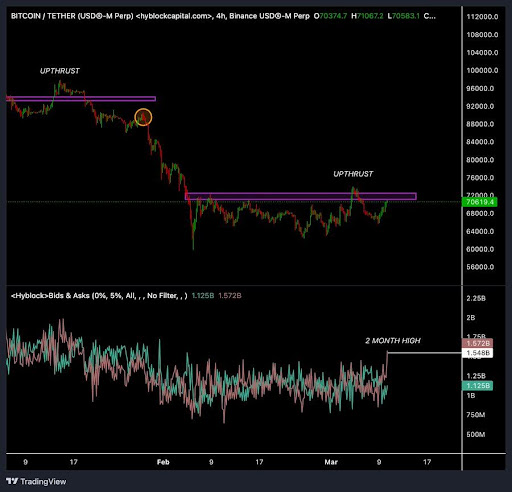
Now, the $BTC market structure appears to be retesting after the $72,000 fakeout, with orderbook data showing a similar signature. In this setup, bids below the price act as a support cushion, while asks above the price form a resistance wall.
When Asks liquidity spikes to multi-month highs during a retest, it suggests that participants are using price rebounds as opportunities to sell into strength. However, Ardi cautions that orderbook liquidity can be removed at any time, and the recurring pattern of elevated asks during post-fakeout retests has shown a specific track record on this chart.

 coinpedia.org
 bitcoinmagazine.com
 cointelegraph.com
 cryptoticker.io