



 8
8
Bitcoin declined over $2,500 on Sunday night and dipped under $65K, as investors covered from the uncertainty of a new global 15% tariff regime imposed by President Donald Trump. A possible attack on Iran is also moving risk markets down.
Bitcoin Falls Under $65K, Risk Assets Suffer Under Upcoming Tariff Uncertainty
Bitcoin slid on Sunday night as investors adjusted their positions for the geoeconomic and trade uncertainty that markets are preparing to experience in the coming weeks.
As Asian markets opened, the prime cryptocurrency lost over $2,500 in less than two hours, falling as low as $64,409 on Bitstamp and losing over 5% in the past 24 hours. The decline left over $200 million in longs being liquidated, hurting investors betting on a consolidation rather than a dip.
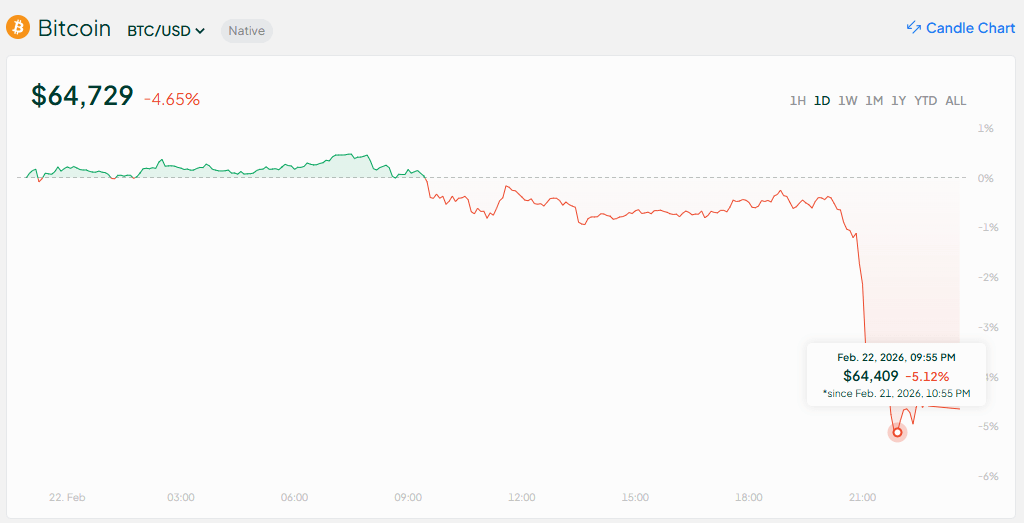
$65k was now considered a resistance as the cryptocurrency market is facing a bearish period, with several public digital asset mining companies and other digital asset treasuries (DATs) slowly exiting the market and pivoting to other activities related to artificial intelligence (AI).
Analysts blamed this fall on Trump’s new 15% tariff regime, to be applied on February 24, and the reaction from countries that have already signed bilateral trade agreements with the U.S., as billions in investments are involved in these deals.
In this regard, reports indicate European legislators might postpone ratifying Trump’s tariff deal under the previous regime, as they doubt the U.S. can comply with its part of the bargain.
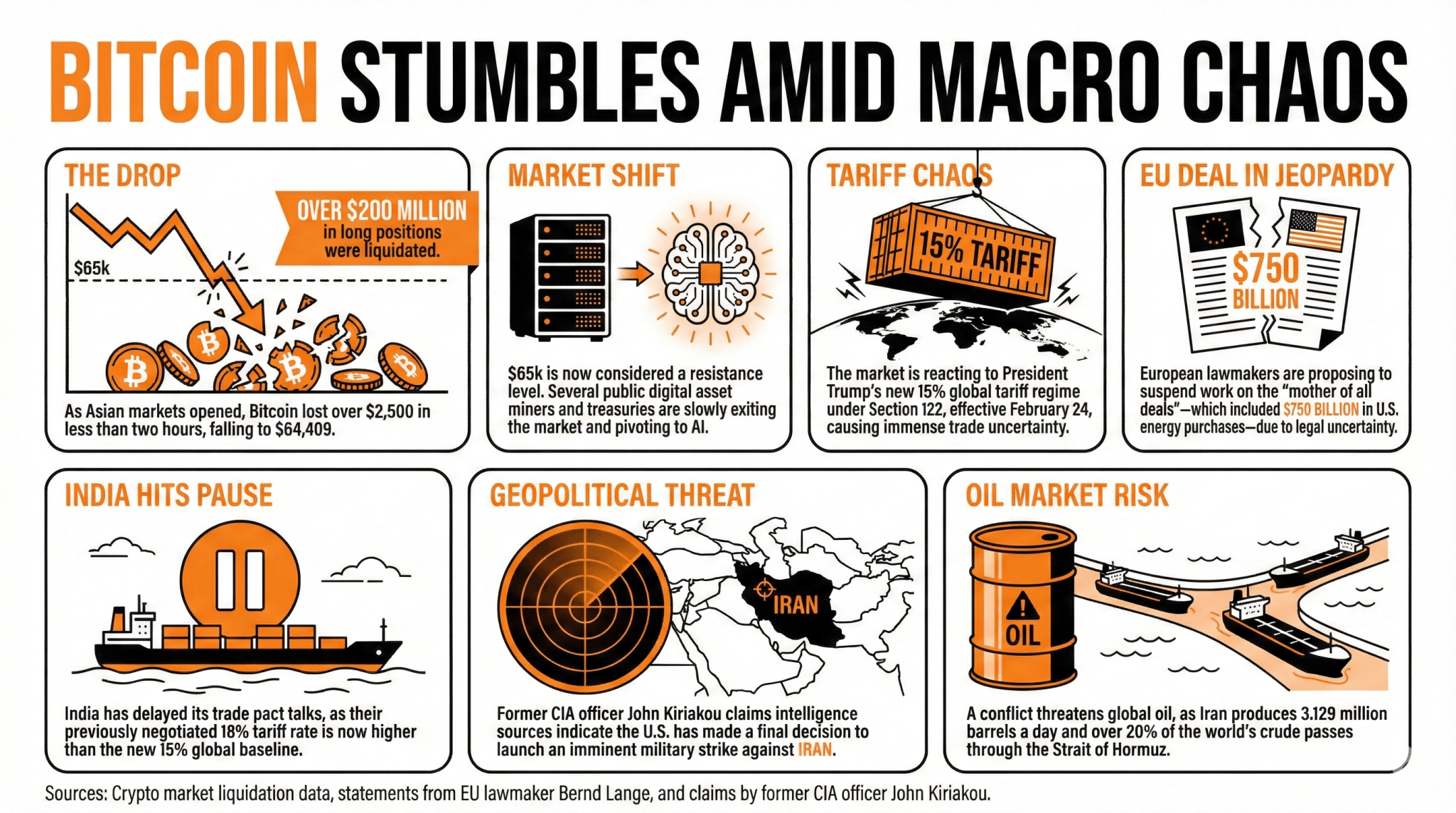
Bernd Lange, a lawmaker, stated that the U.S. was experiencing “tariff chaos,” bringing uncertainty to its commercial partners.
He stressed that:
“Clarity and legal certainty are required before any further action can be taken. Therefore, tomorrow I will propose to the European Parliament’s negotiating team that we suspend legislative work until we have a thorough legal assessment and clear commitments from the United States.”
According to the White House’s fact sheet on the EU tariff agreement, called the “mother of all deals” by President Trump in July, European countries would purchase $750 billion in U.S. energy and invest $600 billion in the country by 2028.
India is another country that has reportedly delayed its tariff talks with Washington, as the previouys 18% negotiations would be higher than the global 15% tariffs that the Trump Administration is now applying under the authority of Section 122 of the Trade Act of 1974, which are also facing increasing legal scrutiny from experts and analysts.
Another key element weighing the market down would be an impending attack on Iran. Former CIA officer John Kiriakou claims that, according to his intelligence sources, the U.S. had already decided on striking Iran even when publicly there are still ongoing negotiations with the Iranian government.
A conflict in Iran might affect the global oil market, as the country produced 3.13 million barrels per day in January. Military U.S. action and a hypothetical Iranian defense move might disrupt supply chains if the Strait of Hormuz gets involved. Over 20% of the world’s crude passes through the strait, according to estimations.
FAQ
-
What caused Bitcoin’s recent decline over the weekend?
Bitcoin dropped over $2,500 in less than two hours due to investor adjustments in response to geoeconomic and trade uncertainties. -
How much did Bitcoin value drop in the recent trades?
The cryptocurrency fell to $64,409 on Bitstamp, resulting in over $200 million in long positions being liquidated. -
What is the impact of Trump’s new tariff regime on the market?
Analysts attribute the recent decline to the introduction of a 15% tariff effective February 24, leading to uncertainty among countries with existing trade agreements with the U.S. -
How might potential military actions against Iran affect the markets?
A possible U.S. strike on Iran could disrupt global oil supplies via the Strait of Hormuz, where over 20% of the world’s crude passes, further contributing to market instability.

 coindesk.com

 cointelegraph.com
 1
1