



 2
2
Bitcoin now faces a technical risk that could extend its consolidation phase or delay any meaningful upside move.
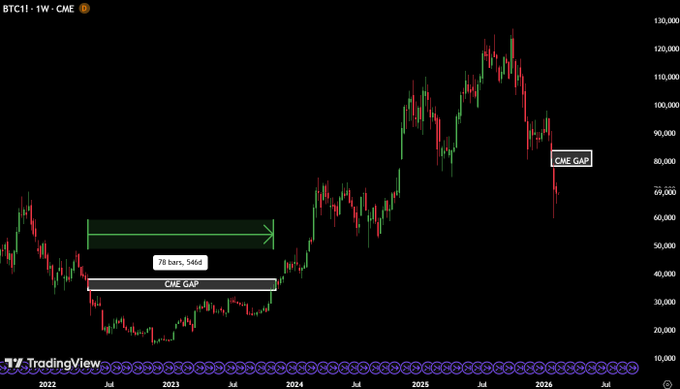
In an X post today, widely followed crypto analyst Max reignited debate over Bitcoin’s near-term trajectory after identifying an unfilled gap in the Chicago Mercantile Exchange (CME) futures around the $84,000 level.
Key Points
- Bitcoin currently has an unfilled CME futures gap near $84,000.
- At current prices, BTC must rally over 20% to close the gap.
- Although Bitcoin typically fills CME gaps within days, rare exceptions have occurred, such as during the 2022 bear market.
- If the 2022 pattern, which took roughly 1.5 years to close, repeats itself, Bitcoin’s next meaningful bullish momentum could face a prolonged delay.
Bitcoin Faces Massive CME Gap
Over the weekend, selling pressure intensified, pushing Bitcoin below $68,500. As investors look for signs of recovery, Max emphasized that a massive CME gap could complicate Bitcoin’s path to a sustained rally.
According to his analysis, Bitcoin’s recent pullback has left a CME futures gap near $84,000. With Bitcoin currently trading at $68,372, the market would need to rally approximately 22.85% to close the gap. Historically, Bitcoin has typically filled most CME gaps within days. However, rare exceptions do exist.
For instance, during the 2022 bear market, Bitcoin formed a CME gap near $35,000. Although gaps typically close quickly, Bitcoin did not fill this one until late 2023, roughly 18 months later, highlighting how prolonged bearish conditions can delay gap closures.
Given this precedent, Max expressed concern that a repeat of the 2022 scenario could lead to a similarly extended wait before Bitcoin eventually fills the current CME gap at $84,000.
Potential Implications
Max’s commentary highlights a potential risk that Bitcoin’s current downtrend could persist longer than expected. If the market follows the 2022 pattern, the $84,000 level may not be revisited for months, potentially delaying bullish momentum.
However, the comparison serves as a cautionary reference rather than a firm forecast, as market structure and liquidity conditions vary across cycles. Meanwhile, Max’s analysis has sparked mixed reactions. Some investors hope Bitcoin avoids a repeat of the 2022 pattern that delayed gap closure for over a year, while others downplayed the concern. They argue that Bitcoin often leaves CME gaps unfilled during the early phases of bear markets and typically closes them later in the subsequent bull cycle.
At the start of a bear market, #Bitcoin often leaves CME gaps unfilled.
They usually get filled much later…
on the way up during the next bull market. pic.twitter.com/xHYPA6WMG9
— Max Pain (@maxpain_crypto) February 16, 2026
Moreover, several commentators stressed that CME gap closures depend more on liquidity cycles and macroeconomic conditions than on strict historical repetition. Consequently, they advised traders not to rely solely on past patterns when assessing Bitcoin’s next move.

 bitcoinmagazine.com

 en.bitcoinsistemi.com

 cryptobriefing.com