


 1
1

 22
22
U.S. President Donald Trump has formally nominated Kevin Warsh as his pick to become the next chair of the Federal Reserve, ending months of speculation about who would succeed Jerome Powell when his term expires in May.
In a post on Truth Social, the president praised his nominee, saying he has known Warsh for years and believes he could become one of the greatest central bank leaders in U.S. history. The announcement comes after repeated public pressure from Trump on the Federal Reserve to cut interest rates more aggressively.
Wall Street Ties and Crisis-Era Experience
Warsh, 55, previously served as a governor at the Federal Reserve Board of Governors between 2006 and 2011, a period that included the global financial crisis and the collapse of Lehman Brothers.
During his tenure, he was also the Fed’s representative to the G20, placing him at the center of global financial coordination during one of the most turbulent periods in modern economic history.
Before joining the Fed, Warsh worked in the White House as a special assistant for economic policy. He is currently a lecturer at the Stanford Graduate School of Business and holds corporate roles at UPS and Coupang, while also serving with Duquesne Family Office, the investment vehicle linked to billionaire investor Stanley Druckenmiller.
In the past, he has also praised Bitcoin and crypto.
Hawkish Reputation Resurfaces
Despite recent alignment with calls for faster rate cuts, Warsh built much of his reputation as a monetary policy hawk. During the financial crisis, he frequently warned about inflation risks even as deflation fears dominated policy discussions. Critics have argued that this stance reflected an overly cautious approach toward liquidity expansion.
More recently, analysts say his historical preference for tighter monetary conditions could influence how markets price risk assets, including cryptocurrencies.
Bitcoin Reaction Shows Policy Sensitivity
The nomination chatter coincided with volatility in Bitcoin’s price.
When odds around Warsh spiked in the past 24 hours on a Polymarket contract asking who Trump would pick, the price of Bitcoin and many other cryptos had dropped. During this period, $BTC plunged over 5% to reach sub-$82K. Meanwhile, the overall crypto market cap plummeted more than 4% in the same period.
Ahead of Trump’s confirmed nomination, analysts from 10x Research said investors may view Warsh as potentially bearish for digital assets, particularly if his policy stance results in higher real interest rates and tighter financial conditions.
Founder Markus Thielen noted that higher real rates increase the true cost of borrowing after inflation, typically reducing investor appetite for speculative or high-volatility assets such as Bitcoin.
Additional criticism emerged from Renaissance Macro Research, which questioned whether Warsh’s recent dovish rhetoric aligns with his historical policy stance. Meanwhile, Bloomberg Chief U.S. Economist Ana Wong said past Federal Open Market Committee transcripts showed consistent concern about inflation risks even during periods of economic contraction.
However, not everyone is convinced that Warsh will be hawkish for markets. Commenting on the recent collapse of gold and silver prices, investor Peter Schiff said that Trump would not have picked Warsh if he thought that he was going to be a hawk.
Symmetrical Triangle Pattern Emerges on $BTC’s Chart
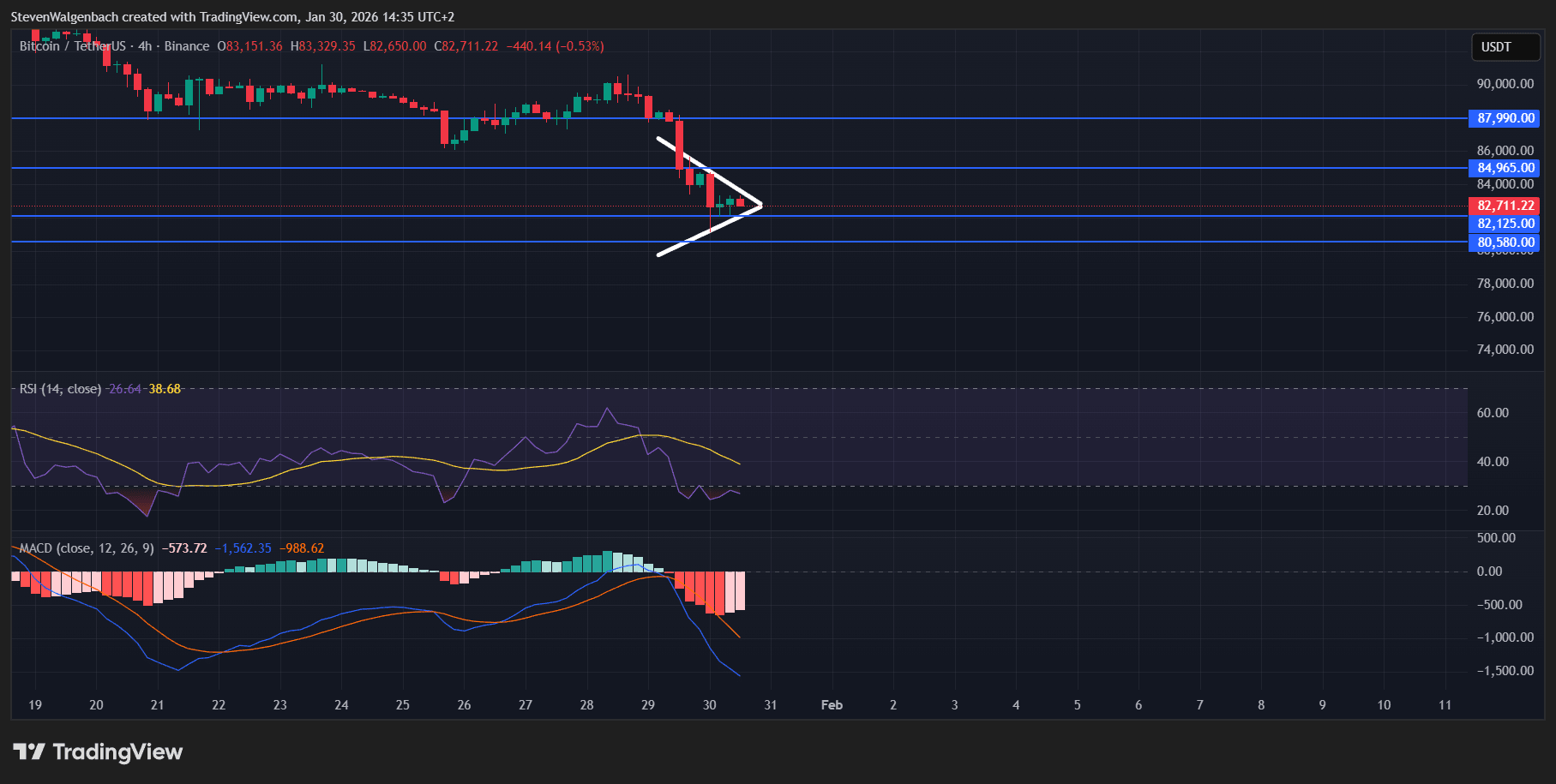
As both precious metals and cryptos suffered price drops in the past 24 hours, a technical pattern has recently emerged on Bitcoin’s 4-hour chart, which traders will want to take note of.
$BTC 4-hour chart (Source: TradingView)
The pattern, a symmetrical triangle, suggests that $BTC’s price may undergo a strong move in the near future. Since this triangle has emerged on the 4-hour chart, this could happen within the next 24-48 hours.
However, the pattern does not suggest what direction the strong move may be in. To gauge this, a look at technical indicators is needed.
Right now, bears seem to have a tight grip on $BTC’s price. The Relative Strength Index (RSI) indicator is trading below its Simple Moving Average (SMA) line. This is usually seen as a bearish indication. While the current reading does signal that $BTC is oversold, it is not unusual for the RSI to remain low for a sustained period of time when a crypto is being dumped.
From a momentum perspective, sellers have the advantage here as well. This is suggested by the Moving Average Convergence Divergence (MACD) line, which is currently positioned below the MACD Signal line. While bearish, there are some signs that this negative momentum is starting to weaken - mainly the shrinking gap between the MACD and MACD Signal lines.
If there is a breakout towards the upside, Bitcoin may end up targeting the $84,965 resistance level. Continued pressure from buyers could even lead to a climb to as high as $87,990 in the short term.
On the other hand, a continuation of the recent breakdown will likely lead to a test of the immediate support at $82,125 and even a potential plunge to $80,580 in an extreme scenario.

 cointelegraph.com

 cryptoslate.com


 u.today