



 19
19
The US dollar slid to a four-year low, while gold and silver pushed deeper into record territory as Bitcoin attempted to recliam the $90,000 level.
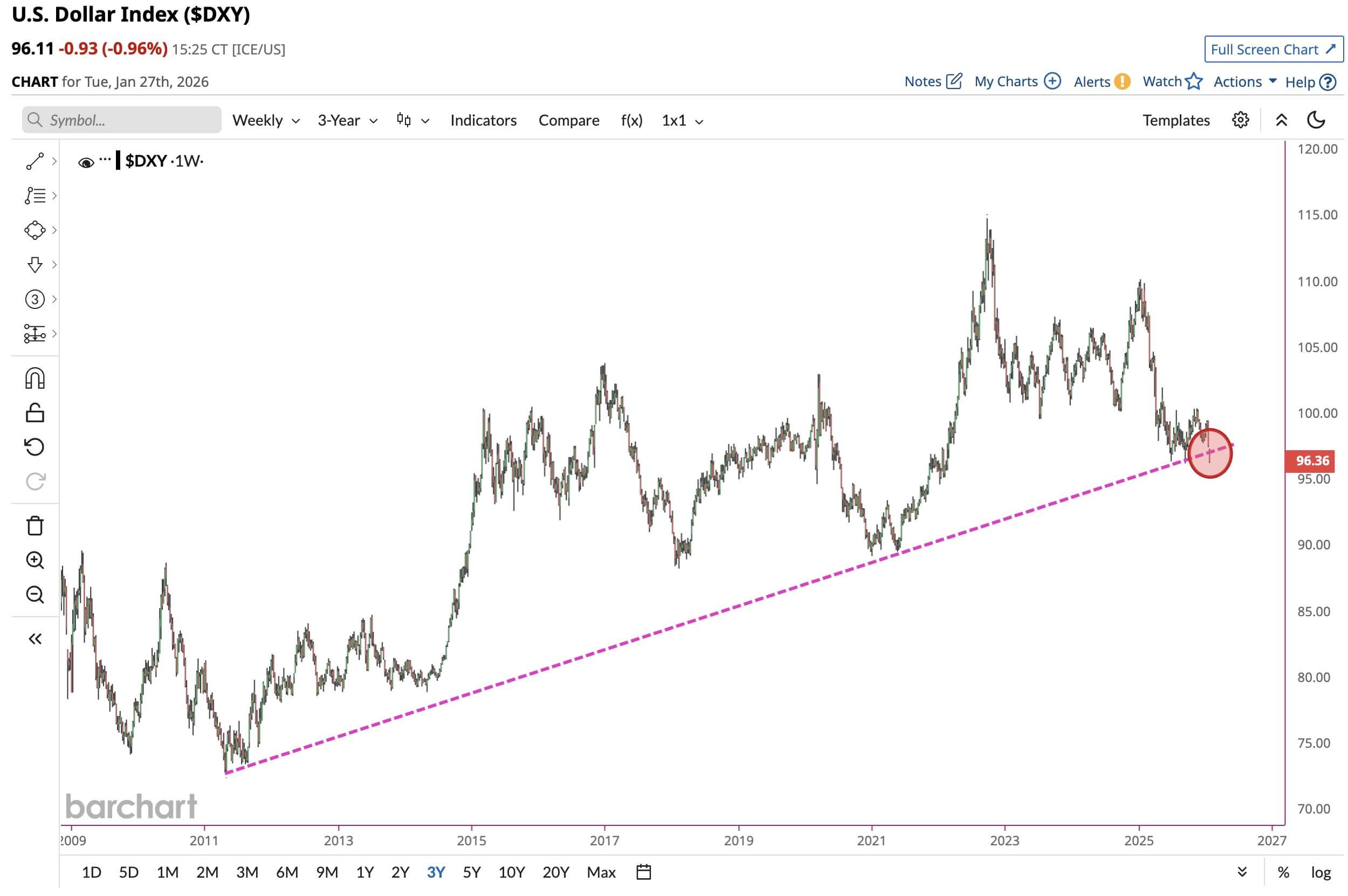
During the past day, the dollar index, a gauge of the greenback against major peers, touched 95.566, its weakest level since February 2022, after President Donald Trump dismissed concerns about the slide.
Since then, the US dollar has fallen below its 14-year support level.
As a result, the current setup is forcing institutional managers to grapple with the core question of whether Bitcoin rises as part of a broad relation trade when the global reserve currency weakens, or it behaves like a leveraged risk asset that suffers when markets de-risk.
Reflation trade lifts metals and commodities, Bitcoin lags
The clearest evidence that markets are positioning for a “dollar down, hard assets up” regime is in commodities.
Gold surged above $5,200 an ounce, with spot prices touching $5,266.37 in early trading, extending a rally of more than 20% since the start of the year. Silver climbed above $115 an ounce, trading around $115.40 in spot markets.
The speed of repricing, alongside the decline in the dollar, has created a clear macro narrative for investors who prefer older hedges to newer ones.
Andre Dragosch, head of research at Bitwise Europe, framed the tape as consistent with a classic reflation setup.
In a social media post, he said the recent decline in the dollar was “totally consistent with the rally” in precious metals and raw industrial commodities. He described it as “what a textbook reflation actually looks like,” and argued that “Bitcoin is ridiculously undervalued in this context.”
The reflation framing matters because it turns the dollar move into a broader story about liquidity, growth expectations, and the opportunity cost of cash.
In a reflationary environment, investors tend to look past near-term inflation prints and focus on the direction of policy, and whether real yields are likely to drift lower.
That mix can favor assets that benefit from easier financial conditions, including commodities, cyclical equities, and speculative markets.
Bitcoin, however, does not currently exhibit the verticality observed in gold and silver. That divergence is the central talking point among investors.
One explanation is market structure. Bitcoin is now deeply integrated into global macro trading through futures, options, and regulated access points.
That depth can amplify rallies when liquidity improves, but it also makes Bitcoin more exposed to systematic de-risking and volatility targeting.
Gold does not face the same reflexive liquidation dynamics tied to crypto leverage, particularly in derivatives markets that can compress positioning quickly when volatility rises.
Another explanation is sequencing. In prior cycles, the “distrust trade” has often shown up in gold first.
Bitcoin has sometimes acted as a second-stage hedge, catching a stronger bid only after the initial volatility wave stabilizes and investors become comfortable holding higher-volatility alternatives.
So, the lag is not necessarily a refutation of the “hard asset” narrative. It is a reminder that Bitcoin’s path can be noisier than the thesis.
Federal Reserve uncertainty creates two weak-dollar regimes
Dollar weakness is not a single signal, and Bitcoin’s response is not automatic. The forces pushing the greenback lower have widened beyond simple interest-rate differentials, and that difference is critical for crypto.
Industry experts have pointed to a confluence of expected Federal Reserve rate cuts, deficit concerns, trade-policy uncertainty, and investor unease about US policy volatility.
Moreover, the debate over who will succeed Jerome Powell when his term as Fed chair ends in May has also become part of the macro conversation, because it introduces a governance premium into rate expectations.
This creates two distinct “weak dollar” regimes.
In the benign regime, the dollar weakens primarily because the market expects easier US policy and looser financial conditions.
In that environment, the liquidity impulse tends to lift equities, high-yield credit, and crypto in the same direction. Bitcoin benefits as competition from cash yields fades, and as marginal risk capital often first manifests in the most liquid crypto asset.
In the less benign regime, the dollar weakens because investors demand a larger risk premium for US policy uncertainty.
That can still lift gold, but it can also tighten credit conditions, widen spreads, and trigger deleveraging.
However, when that happens, Bitcoin has often traded like a high-beta risk asset, vulnerable to the same forced selling that hits other volatile exposures.
Considering this, some macro investors argue the current move contains elements of both, which is why the tape looks inconsistent.
Daily signals, zero noise.
Market-moving headlines and context delivered every morning in one tight read.
Free. No spam. Unsubscribe any time.
Dollar options positioning has become more bearish, a sign that hedging and risk repricing, not only rates, are part of the story.
The dollar’s drop after Trump’s remark was interpreted by some traders as signaling tolerance for depreciation, and market commentary has cast that tolerance as a policy preference, with a weaker currency potentially helping exports while easing the path to lower rates.
Germany’s BaFin also highlighted that officials are watching the shift.
The regulator warned that there is a risk markets begin to question the dollar’s global role, while emphasizing that near-term risks for German banks were manageable and concentrated in short-term dollar refinancing vulnerabilities.
For Bitcoin, this is where the identity debate returns. A loss of confidence in US policy credibility can strengthen the long-term narrative for scarce, non-sovereign assets.
But a confidence shock can also raise volatility, and higher volatility is often the trigger for investors to reduce exposure in the most liquid, risk-on corners of a portfolio.
History suggests the dollar-Bitcoin relationship is conditional
The historical case for “weak dollar, strong Bitcoin” exists, but it comes with footnotes.
In 2017, the dollar weakened on a broad basis, and Bitcoin produced its first mainstream global mania, rising from around $1,000 to a peak near $19,118.
The coincidence does not prove causation, but it shows that a soft-dollar backdrop can coexist with a powerful crypto rally, especially in a regime where speculation is rewarded, and real yields are not rising sharply.
In stress windows, the relationship can invert. In late 2020, Bitcoin experienced sharp drops during broader market wobbles tied to pandemic news, and the dollar strengthened as investors rotated into traditional safety.
In 2022, the Fed’s tightening cycle and dollar strength were broadly hostile for crypto, with the dollar climbing toward multi-decade highs as growth fears and aggressive rate-hike expectations lifted the currency’s safe-haven appeal.
An academic study from 2025 has reinforced the idea that the correlation is unstable. Work using time-frequency methods has argued that the linkage between Bitcoin and the dollar index can be episodic and horizon-dependent, rather than a consistent inverse relationship across cycles.
That is the right way to frame the current tape. A weaker dollar can be constructive for Bitcoin if it is accompanied by easing real rates and improving liquidity, the reflationary setup Dragosch and other analysts point to when they compare the crypto’s slower move to metals and industrial commodities.
However, a weaker dollar can also coincide with higher volatility and tighter credit if investors are repricing US policy credibility, and in that regime, Bitcoin is more likely to be sold first and debated later.
For traders, the next clues are likely to come from the same places macro desks are already watching.
If dollar weakness continues alongside falling real yields and steadier credit spreads, Bitcoin’s lag could narrow, especially if inflows into crypto products and derivatives positioning confirm a return of risk appetite.
But if the dollar decline instead comes with widening spreads, tighter funding conditions, and a broader volatility shock, Bitcoin’s role as a high-beta asset is likely to dominate in the short run, even if the long-run narrative grows louder.
For now, gold and silver are acting like classic dollar hedges in a reflationary tape. On the other hand, Bitcoin is waiting on market to decide which version of “weak dollar” it is trading.

 newsbtc.com
 bitcoinmagazine.com
 cryptopotato.com
