



 14
14
In today’s newsletter, Markus Thielen from 10x Research explains why a cycle-smart strategy outperforms traditional Dollar-Cost Averaging for bitcoin.
Then, in “Ask an Expert,” Eric Tomaszewski from Verde Capital Management, shares why advisors should look past surface-level numbers to find where real value is actually growing.
If you have two minutes, TrackInsight is benchmarking how advisors are incorporating crypto ETFs into client portfolios. Take this 2-minute survey and get early access to the results.
Crypto ETFs: Why bitcoin investors should trade the cycle, not dollar-cost average
The same playbook that works for the S&P 500 is destroying capital in bitcoin. Understanding why changes how you allocate.
Dollar-cost averaging (DCA) is one of the most sensible strategies in traditional finance. Spread purchases over time, smooth out volatility and avoid the psychological trap of market timing. For equities and bonds, assets that consistently appreciate, it is close to optimal for most retail investors.
However, applying DCA to bitcoin is one of the most common and costly mistakes I see advisors make on clients' behalf.
Bitcoin has completed four full market cycles since 2011. Each followed roughly the same pattern: a halving event reduces the supply of new coins, adoption demand accelerates, price appreciates dramatically, leverage builds in the system, then the cycle reverses with drawdowns that have historically exceeded 70%.
The peak-to-trough drawdown for a buy-and-hold bitcoin investor across the full history is −80%. That is not a tail-risk scenario — It happened three times. The typical outcome: capitulation near the bottom, followed by missing the recovery. The long-run return looks extraordinary on a chart.
DCA smooths the path only marginally. An investor who bought steadily through the 2021–2022 cycle still experienced catastrophic mark-to-market losses during the bear phase. The strategy offers psychological comfort, not mathematical protection, because it does not reduce exposure when the regime has structurally turned negative.
The alternative to DCA is regime awareness. Bitcoin spends extended periods, typically 12 to 18 months, in identifiable bull or bear regimes, either compounding at an extraordinary rate or losing most of those gains. The key insight is that these regimes are not random. They are detectable in advance using observable data across both price behavior and the on-chain economics of the Bitcoin network.
What if crypto's greatest inefficiency is that investors are still measuring activity when they should be measuring ownership and value capture?
For years, the industry has celebrated metrics like Total Value Locked (TVL), yet TVL often says more about assets sitting in a protocol than the economics flowing back to its owners.
Protocols like Hyperliquid have challenged the traditional playbook by prioritizing revenue distribution and alignment with token holders, while Aerodrome's evolution toward predictive, continuous allocation suggests that capital itself is becoming programmable and dynamically optimized.
As crypto matures, the biggest opportunities may emerge not from identifying the protocols with the most activity, but those that most effectively capture, allocate and return real economic value to the people who own them.
- Eric Tomaszewski, financial advisor, Verde Capital Management
Watch of the Week
CoinDesk Data and Indices President Dave LaValle sat down with The Wealth Advisor about Wall Street's accelerating push into bitcoin ETFs.
- He spoke about The Morgan Stanley's Bitcoin Trust ETF, which launched in early April and crossed $230 million in assets within a month, the first spot bitcoin ETF from a major U.S. bank.
- He also pushed back on the idea of crypto as a separate asset class: "It's not the crypto market or the TradFi market. It's the market."
- Watch the full video at The Wealth Advisor.
Looking for more? Receive the latest crypto news from coindesk.com and market updates from coindesk.com/institutions.

-
1Algorand unveils roadmap to achieve quantum resistance by 20281 hour ago
-
2CoinDesk 20 performance update: Stellar ($XLM) jumps 10% while index declines2 hours ago
-
3Alchemy's AI-driven identity and payment service gains access to Visa network2 hours ago
-
4Hive shares jumps 10% on $220m Canada sovereign AI infrastructure deal3 hours ago
-
5The great rotation: Investors desert the Magnificent 7, crypto for AI bottlenecks3 hours ago
-
6Bitcoin's nemesis, the Dollar Index, is on the verge of a major breakout4 hours ago
-
7Aster popped over 10% on radical 'buyback and burn' upgrade. But gains were short-lived4 hours ago
-
8Crypto market positioning is 'defensive and thin' after Fed, Marex analysts say4 hours ago
-
9Malta's financial regulator explores bringing parts of DeFi under MiCA's orbit4 hours ago
-
10The bond market is flashing a clear signal on interest rates. Bitcoin bulls should take note8 hours ago

CEX Volumes Drop to Lowest Since September 2024 as RWA Perps Hit Record High

CEX Volumes Drop to Lowest Since September 2024 as RWA Perps Hit Record High
In May, combined exchange volumes fell 3.45% to $4.41T; the lowest since September 2024. RWA perpetual futures volumes rose 10.4% against the trend, hitting a new all-time high.
In May, combined exchange volumes fell 3.45% to $4.41T; the lowest since September 2024. RWA perpetual futures volumes rose 10.4% against the trend, hitting a new all-time high.
Why it matters:
In May, combined exchange volumes fell 3.45% to $4.41T; the lowest since September 2024. RWA perpetual futures volumes rose 10.4% against the trend, hitting a new all-time high.
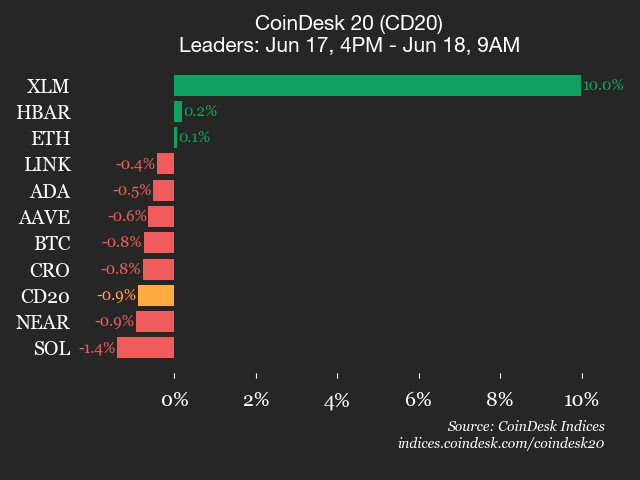
CoinDesk 20 performance update: Stellar ($XLM) jumps 10% while index declines

Crypto Long & Short: The measure of a maturing market

 ambcrypto.com