

 3
3
For years, NVIDIA was considered the undisputed queen of artificial intelligence (AI). The boom in generative AI, which exploded after the success of chatbots and advanced language models, turned the company into one of the symbols of the new tech economy.
Today, however, signs are beginning to emerge that point to a less predictable landscape. In recent months, the group led by Jensen Huang has faced growing pressure in the AI processor market.
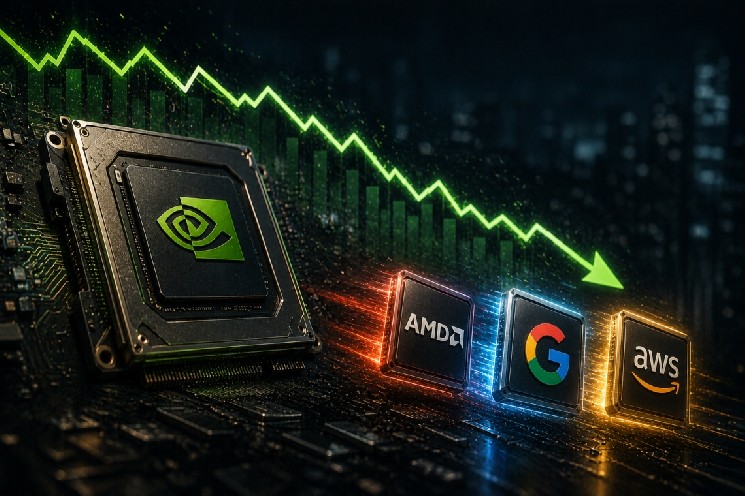
Its share in the artificial intelligence accelerator sector, which in 2024 had reached almost monopolistic levels close to 87%, is now said to have fallen to a range between 75% and 80%.
A figure that still represents enormous dominance, but shows that its competitive advantage is no longer unassailable.
Nvidia’s market share in AI processors falls as big tech accelerates on proprietary chips
Behind the above-mentioned decline are two very important dynamics. On one side is the growth of direct competition from Advanced Micro Devices, which is trying to gain ground in the high-performance AI market with its Instinct line.
On the other side, and perhaps even more significant, the strategies of Nvidia’s major customers are changing. Giants like Google and Amazon are increasingly investing in the development of proprietary chips dedicated to artificial intelligence.
This is a potentially crucial shift, because these companies are not just simple commercial partners: they represent a significant share of global demand for AI GPUs.
As already mentioned, until now Nvidia has benefited from an almost indispensable position in the AI model training sector.
Its GPUs have become the reference standard for developing advanced language models, generative systems, and cloud infrastructures. However, with the growth of in-house chips developed by big tech, part of this dependence could gradually diminish.
And the market seems to have started to perceive this risk.
Some financial indicators and prediction platforms are showing slightly weaker confidence in Nvidia’s ability to maintain absolute leadership in global market capitalization by mid-2026.
The real problem for Nvidia is not AMD, but big tech self-sufficiency
The most immediate narrative speaks of a war between Nvidia and AMD in the AI sector, but the strategic issue may be much deeper.
The central point is not just the competition between chip manufacturers, but the fact that Nvidia’s main customers are trying to reduce their dependence on external suppliers.
In recent years, companies like Google, Amazon and other hyperscalers have realized that controlling AI infrastructure represents a huge strategic advantage.
Creating proprietary chips means not only lowering long-term costs, but also customizing hardware to the specific needs of their own cloud systems and AI platforms.
This phenomenon is reminiscent of what happened in the mobile sector with Apple, which over time progressively replaced third-party components with solutions developed in-house.
Nvidia still maintains a huge advantage thanks to its software ecosystem, the CUDA platform, and the enormous experience accumulated over the years.
Designing a powerful chip is not enough to truly compete: you need an entire development environment that is stable, compatible, and supported by developers. And this is precisely where Nvidia continues to be far ahead of its rivals.
However, the market is beginning to question the sustainability of such extreme growth rates over the long term.
The company still has a gigantic order book and demand for its GPUs remains very high, but the AI sector is entering a new, more mature phase, where the initial optimism is giving way to more pragmatic assessments.
There is also another often underestimated aspect: the distinction between training and inference. Nvidia still dominates the model training segment, but many competitors are trying to gain ground in inference.
That is, in the practical execution of already trained AI models. It is a potentially huge market and more suited to customized chips that are cheaper and more efficient.
If this transition were to accelerate, Nvidia could find itself having to defend its role in a much more competitive context than in recent years.
The AI boom enters a more complex phase
The Nvidia case is also a broader signal about the evolution of the artificial intelligence sector. After a long phase dominated by almost uncontrolled investor enthusiasm, the market is beginning to distinguish between real growth and speculative expectations.
Over the past two years, Nvidia shares have become the symbol of the global race to AI. The company has benefited from exceptional demand fueled by the need to build infrastructure for chatbots, multimodal models, and advanced cloud services.
This has pushed its valuation to historic levels, even leading to speculation that it could become the largest company in the world by market capitalization.
Now, however, some inevitable questions are emerging. How long can this expansion last? Will major customers really continue to buy Nvidia GPUs at the same pace?
And above all: will the AI market be able to turn today’s enormous expectations into sustainable long-term revenues?
Growing competition could also have positive effects on the entire tech ecosystem. A less monopolized market tends to foster innovation, cost reductions, and greater diversification of available solutions.
For customer companies, having alternatives to Nvidia means being able to negotiate better prices and reduce the risks associated with dependence on a single supplier.
Despite everything, it would be premature to talk about Nvidia’s decline. The company remains the absolute benchmark for AI hardware and retains a technological advantage that will be difficult to close in the short term.
However, the market seems to have understood that not even the giant symbol of the AI revolution is immune to competitive pressure.

 coindesk.com
 crypto.news
 thecryptobasic.com
