


 6
6
Liquidity remains the foundation of the crypto market, and stablecoins sit at its center. Their expansion reflects deployable capital on the sidelines, often preceding directional moves in risk assets.
While Bitcoin and other large-cap assets have yet to respond meaningfully, the steady rise in stablecoin supply suggests that capital has not exited the system.
Recent data shows stablecoin market capitalization continuing to print higher highs, even as the broader market trades within a subdued range.
Historically, similar conditions have resolved with capital rotation into risk assets rather than prolonged stagnation.
Global liquidity expands, but transmission lags
According to CryptoQuant, stablecoin growth now represents just 1.4% of the U.S. global M2 supply, a small share in absolute terms, but increasingly relevant as a directional signal within digital asset markets.
Global M2 measures total liquidity across major economies, including cash and near-cash assets. Expansion in M2 typically supports risk assets, as increased liquidity lowers the cost of capital and encourages allocation into higher-return markets.
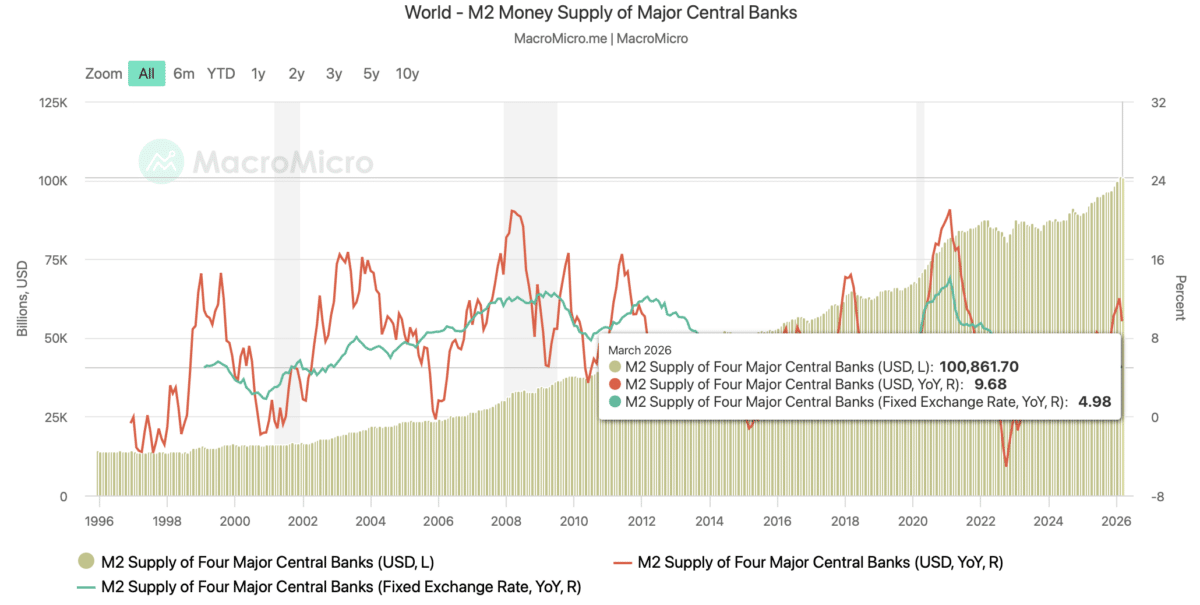
As of March 2026, global M2 supply has reached approximately $100.86 trillion, driven by monetary expansion across major economies including the United States, Europe, China, and Japan.
This suggests that liquidity conditions at the macro level remain supportive.
However, that liquidity has not yet translated into a sustained bid for risk assets such as Bitcoin. The disconnect largely reflects macro instability.
Geopolitical tensions involving the United States, Iran, and Israel, alongside earlier tariff escalations, introduced uncertainty that limited capital deployment into volatile markets.
Stablecoin liquidity diverges from price action
Stablecoin market capitalization has expanded despite persistent drawdowns across crypto markets.
While total cryptocurrency market cap has declined by 42.91% since October 2025, stablecoins have moved in the opposite direction, growing by 50% year-on-year and adding 4.67% over the same period, reaching $321.37 billion.
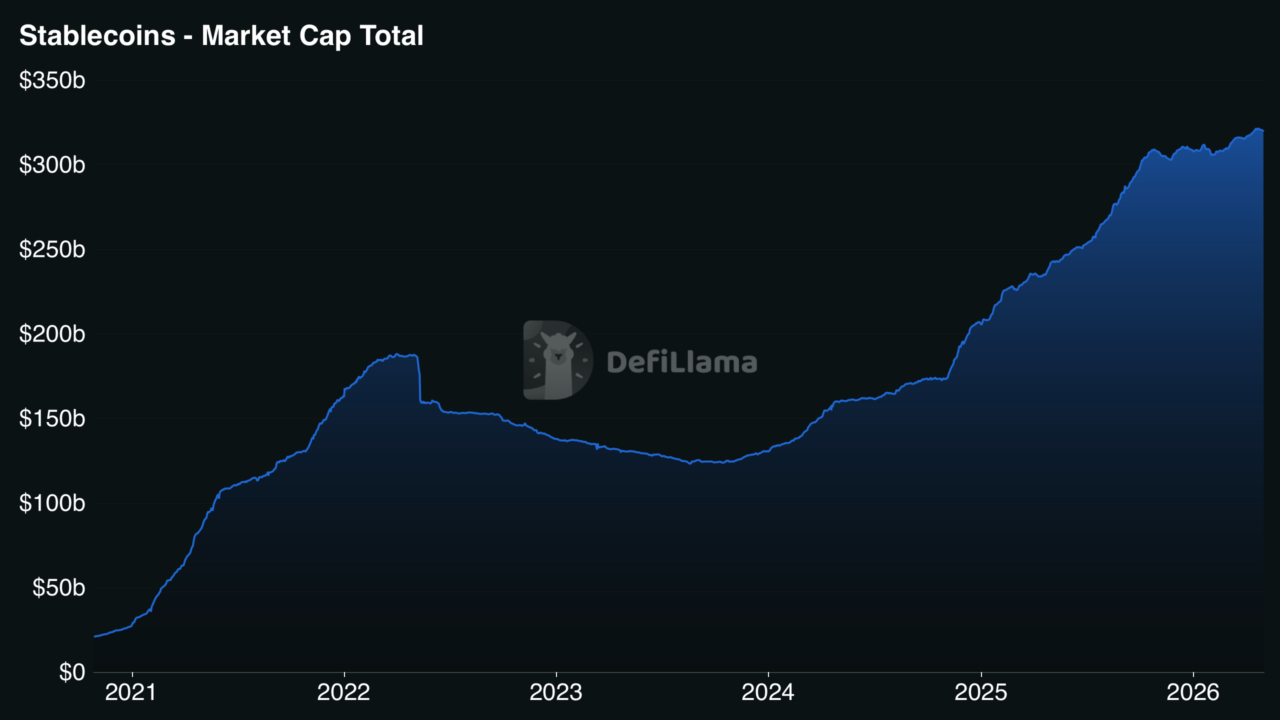
This divergence highlights a structural dynamic as capital remains within the ecosystem but has shifted into lower-volatility instruments. In previous cycles, this pattern has often preceded accumulation phases and eventual market expansion.
Between the 11th of September 2023 and the 12th of August 2024, stablecoin market capitalization rose from $124.31 billion to $145.09 billion, a $20.78 billion increase that aligned with a broader market uptrend.
A similar pattern emerged between September 2, 2024, and December 2024, when stablecoins expanded from $170.69 billion to $194.01 billion, adding roughly $23 billion as the crypto market posted a 110% gain.
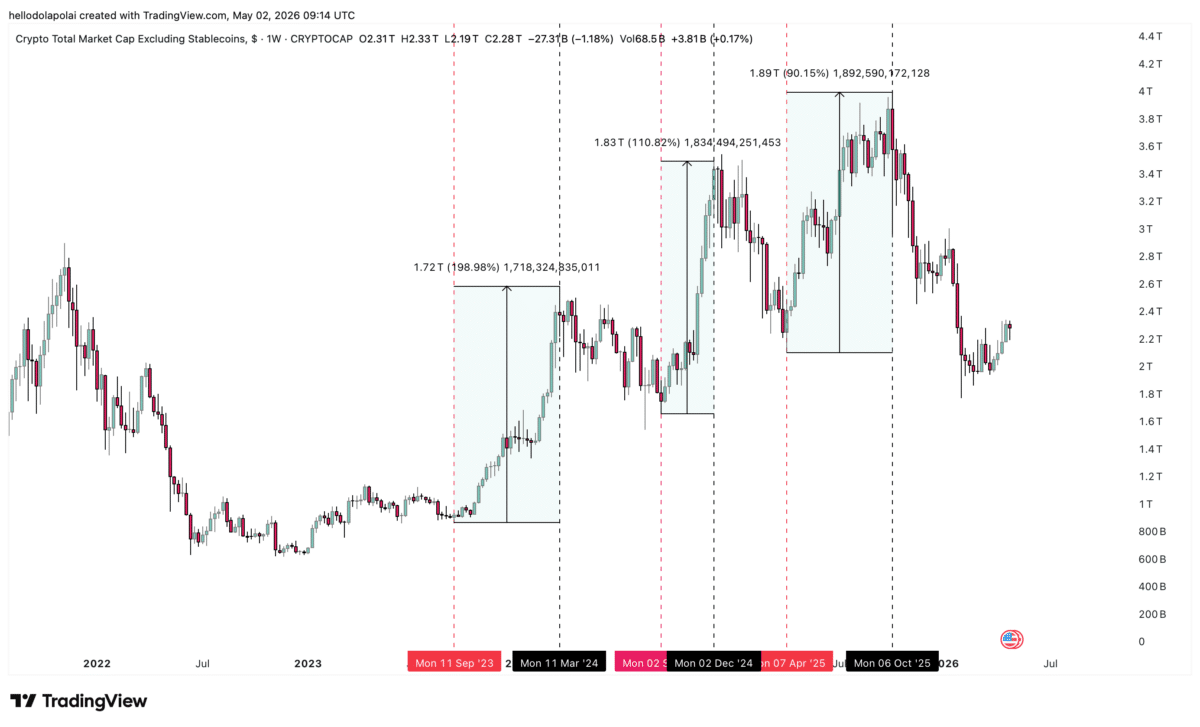
The most pronounced expansion occurred between the 6th of April to the 6th of October, 2025. During this period, stablecoin capitalization surged from $235.29 billion to $302.56 billion, a $67 billion increase, while the total crypto market cap grew by 90%.
Across these periods, one trend remains consistent. Stablecoin growth has tracked closely with, and in some cases anticipated, broader market expansion.
The current setup reflects early signs of a similar structure forming, particularly as April closed as the second consecutive bullish month for the crypto market.
If this trend holds, the current expansion in stablecoin supply may act as a precursor to broader market participation.
Final Summary
- Stablecoin market capitalization has climbed to $321 billion, even as the broader cryptocurrency market attempts to rebuild.
- Stablecoins now account for roughly 1.4% of global M2 supply, positioning liquidity conditions at a level that could support a risk-on transition if macro pressures ease.

 coinfomania.com
 u.today
 1
1

 blockchainreporter.net