


 4
4
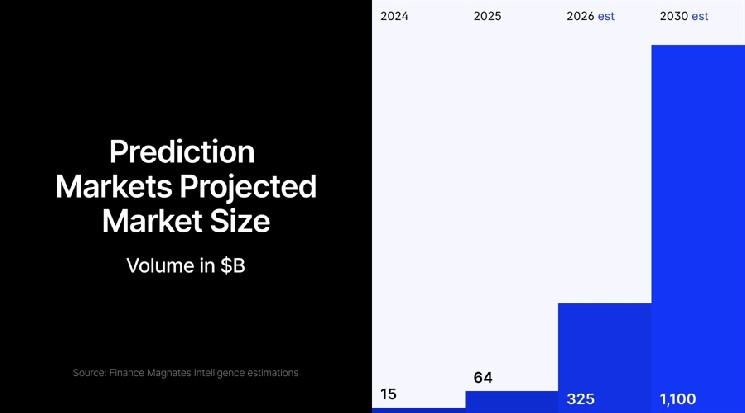
When looking back at 2025, it is hard to deny that one of the hottest trends was prediction markets. Few other developments captured the attention of investors, except perhaps gold trading. Certainly, nothing else attracted as much venture capital. There is a clear reason why investors believe in prediction markets, but there is also a less obvious reason why they are so appealing.
Growth of Prediction Market Popularity
The sudden rise in popularity of prediction markets began during the most recent U.S. presidential election, when global audiences tracked the shifting odds of Donald Trump and Joe Biden. A landmark court ruling in October 2024 allowed Kalshi to offer contracts on congressional and presidential elections, effectively opening election trading to retail participants.
By March 2026, the sector is dominated by two “decacorns”: Kalshi, valued at $22 billion, and Polymarket, targeting up to $20 billion. Growth has been rapid. Kalshi recorded a 1,100% increase in trading volume in 2025, reaching 97 million transactions and 5.1 million monthly users. Meanwhile, Polymarket generated $21.5 billion in annual volume from a smaller but higher-value user base.
| Prediction Markets Key Players | ||
| Polymarket | Kalshi | |
| Annual Volume (2025) | ~$21.5 Billion | ~$23.8 Billion |
| Growth (YoY) | 250% | 1100,00% |
| Total Transactions | 95 Million | 97 Million |
| Active Users | ~478,000 (Peak Monthly) | ~5.1 Million (MAU) |
| Avg. Transaction | ~$500 - $1,000+ | ~$10 - $50 |
| Volume Driver | High Velocity & Large Bets | Massive User Base (Reach) |
| Primary Markets | Politics, Crypto, Culture | Sports (85%), Economics |
| source: Finance Magnates Intelligence | ||
The Science Behind Behaviour
It all started with B.F. Skinner, an American psychologist and a leading figure in behaviourism. Born in 1904, he began his professional life as an aspiring writer before transitioning to academic research at Harvard.
He advanced the understanding of human behaviour by moving beyond simple reflexes to study “operant conditioning”, the process by which actions are shaped by their consequences rather than just prior stimuli. In professional settings, this work laid the foundation for organisational behaviour management, which focuses on how positive reinforcement can increase productivity more effectively than punishment.
From Science to Gambling and Prediction Markets
Key findings from Skinner’s work are widely applied in the gambling industry, and there is a strong likelihood that the same mechanisms are driving the popularity of prediction markets. Neuroscience shows that dopamine is not primarily about the reward itself, but about the anticipation of the reward.
Singapore Summit: Meet the largest APAC brokers you know (and those you still don't!)
When the probability of an outcome is uncertain, the brain releases significantly more dopamine than when the outcome is guaranteed. This creates a feedback loop that encourages repeated action. This is what both gambling and prediction markets rely on: simple, repetitive interactions that trigger dopamine responses.
These insights extend beyond these industries. Learn more about the experiment and how its findings are applied in the financial sector. The full article is available on the Finance Magnates Intelligence Portal.

 coindesk.com

 techgaged.com
 invezz.com