


 4
4
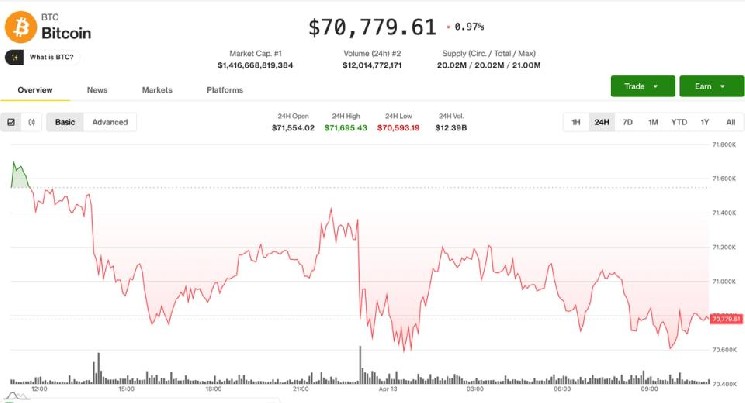
Bitcoin failed once more to break out of its monthslong trading range over the weekend, selling off below the key resistance level at $74,000 to trade recently at $70,600.
Ether ($ETH) and the altcoin market followed suit, as $ETH tumbled from April 11 high of $2,320 to $2,190. It remains little changed since midnight UTC.
The selloff came as Brent crude oil jumped back above $100 per barrel after U.S. President Donald Trump ordered a blockade at the Strait of Hormuz. The conflict with Iran has been a direct driver of risk asset price action over the past month, with U.S. equities and crypto being inversely correlated to oil and the U.S. dollar.
For now, bitcoin and the broader crypto market remain in a trading range that has persisted since early February, failing to break above $75,000 to the upside while holding firm above $63,000 to the downside.
Derivatives positioning
- Futures tied to most major tokens, including bitcoin and ether, have declined slightly over the past 24 hours. The move indicates traders are scaling back risk after President Trump ordered a blockade of the Strait of Hormuz, triggering a surge in oil prices.
- While oil prices have surged 5%, open interest (OI) in Binance's crude futures declined by more than 1%. Activity on the decentralized platform Hyperliquid picked up over the weekend, with combined OI in Brent and WTI futures topping $1 billion.
- Futures tied to saw strong capital inflows, with open interest jumping to the most since Feb. 26. This is not necessarily bullish, as both perpetual funding rates and the 24-hour cumulative volume delta remain negative, suggesting that the inflows are being driven largely by traders chasing downside positioning or actively building short exposure rather than accumulating long positions.
- Except for $HYPE, LINK, AVAX, TRX and ZEC, all top 25 coins have seen negative CVD, indicating that sell-side aggression is offsetting buy-side aggression across the market.
- A negative CVD indicates that more participants are selling by actively hitting bids than buying by lifting asks.
- Bitcoin and ether's options-based implied volatility metrics remain low across most time frames, suggesting the market is pricing in calmer, slower price movements. The volatility curve is also fairly flat, showing no strong expectation of sudden future spikes.
- Still, downside concerns persist. $BTC puts are currently trading at a 5-point or more premium across all time frames, indicating stronger demand for downside protection. $ETH puts are also elevated, though to a noticeably lesser degree than $BTC.
- Block flows featured call calendar spreads and straddles, with these two strategies accounting for over 50% of total activity over the past 24 hours, indicating investor preference for time decay and volatility over a clear directional bias.
Token talk
- The CoinDesk Memecoin Index (CDMEME) and the DeFi Select Index (DFX) were both in the black on Monday alongside the altcoin-dominant CoinDesk 100 (CD100), while the bitcoin and indexes dominated by the biggest tokens lost ground following oil's price increase to above $100 per barrel.
- DeFi token AAVE was one of the top performers, rising around 5%, followed by $HYPE and JUP, which added about 2%.
- But it was the memecoins that dominated Monday's gains: BROCCOLI, BAN and 币安人生 posted gains in excess of 10%, demonstrating investor appetite for highly speculative tokens in what is otherwise a very flat market.
- CoinMarketCap's "Altcoin Season" indicator is at 36/100, higher than February's sub-20 low, but beneath the 50/100 it hit last month.

 u.today
 thecryptobasic.com