



 4
4
The market is clearly shifting toward DeFi, and as a result, Layer 1s are rethinking how to stay ahead.
Consequently, it’s no surprise that most strategic partnerships are now centered around stablecoins. By acting as a bridge between TradFi and DeFi, they not only move capital on-chain more efficiently but also reduce friction and unlock access to key growth areas such as RWAs, AI, and NFTs.
In this context, Aster’s [$ASTER] partnership with WorldLibertyFinancial [$WLFI] fits perfectly. Under this deal, $WLFI’s native stablecoin, $USD1, becomes the base layer for $ASTER’s perpetual markets and RWA initiatives, further reinforcing the broader trend of connecting traditional finance more closely with DeFi via stablecoins.
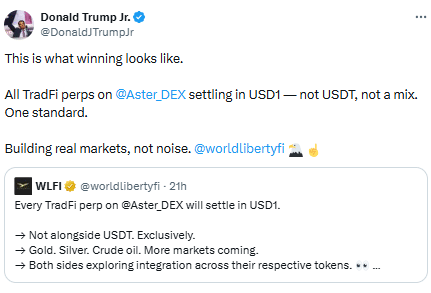
Unsurprisingly, the market reacted quickly. The most buzzed-about response came from Donald Trump Jr. on X, calling the partnership a major “win” for both networks. That said, when we look at the technical positioning, it’s clear this move is about more than just strengthening fundamentals.
On the charts, both $ASTER and $WLFI have been impacted by ongoing macro FUD, closing near critical support levels that could soon be tested. At the same time, on the longer timeframe, these assets still have a significant way to go before reclaiming early-October price levels.
Naturally, the key question becomes, can this partnership actually drive meaningful price gains? That’s especially relevant when you consider that other DEX tokens like Hyperliquid [$HYPE] have managed to stay relatively bullish despite the same macro headwinds.
$ASTER bets on $USD1 to reclaim ground
When you think of stablecoins, $USDT usually comes to mind first.
That said, its technical setup doesn’t always tell the full story. So far this year, $USDT’s market cap has only grown about 1.6%. Considering that this period overlaps with roughly a 20% correction across the broader crypto market, it’s clear that $USDT flows still influence wider price action.
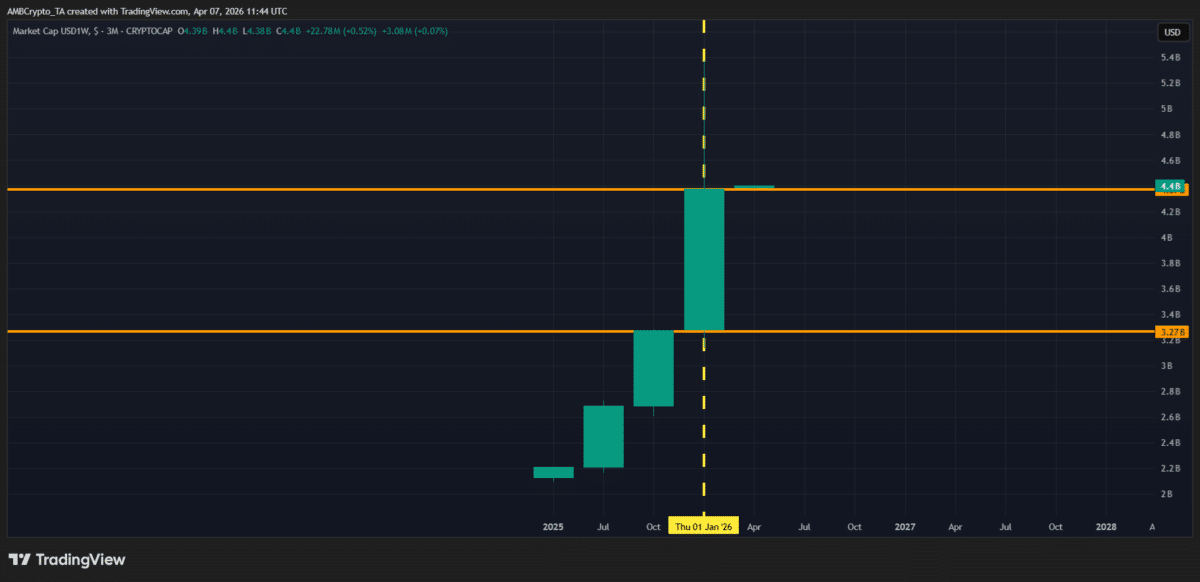
But capital isn’t just chasing speculation anymore. The RWA market, for example, has grown 35% this year, showing that money is moving into more structured, real-world assets. In this context, $USD1’s 34.3% jump in market cap highlights how well-positioned stablecoins are driving real growth, making the $ASTER-$WLFI partnership a clearly strategic play.
Meanwhile, a similar divergence is visible in perpetual volume, which has cooled overall. Yet, on a chain-by-chain basis, Hyperliquid still dominates, reporting $620 billion in perp volume in Q1. Oil trading, in particular, has been a key driver, keeping Hyperliquid firmly in the lead even as broader market activity slows.
By comparison, $ASTER posted $318 billion over the same period. Technically, that’s almost half of Hyperliquid’s volume. The impact shows in price action too, with $HYPE ending Q1 up 43%, while $ASTER slipped 3.32%. That said, the $WLFI partnership puts $ASTER in a position to strengthen its liquidity, potentially improving its competitiveness in the DEX perpetual market.
The main catalyst? $USD1. Serving as the base layer for $ASTER’s perpetual markets and RWA initiatives, it could be the lever that helps $ASTER close the gap with Hyperliquid, creating a stronger presence across both trading and real-world asset markets.
Final Summary
- $USD1 now serves as the base layer for $ASTER’s perpetual markets and RWA initiatives, strengthening liquidity.
- While $HYPE dominates perp volume, $ASTER’s $USD1 integration positions it to narrow the gap and expand its presence in both trading and real-world asset markets.

 coinpedia.org
 coindesk.com
 newsbtc.com
 coingape.com