


 1
1
Right now, Bitcoin is under constant pressure, and the price structure clearly favors a further decline rather than a significant bullish reversal. The asset is currently trading in the middle of the $60,000 range and is still trapped in a distinct declining channel, which has existed since the macro top at $120,000.
Shiba Inu's recovery under pressure
Price action indicates that Shiba Inu is nearing a turning point in its current market cycle, and the asset may not have enough room to support a significant recovery. $SHIB is currently consolidating close to local lows after months of consistent declining, creating a feeble ascending structure that is more likely to collapse.
The overall trend is still clearly negative. The 50, 100 and 200-day levels are among the major moving averages that $SHIB is still trading below. All of these levels are trending lower. This alignment is a result of persistent selling pressure and insufficient long-term accumulation.
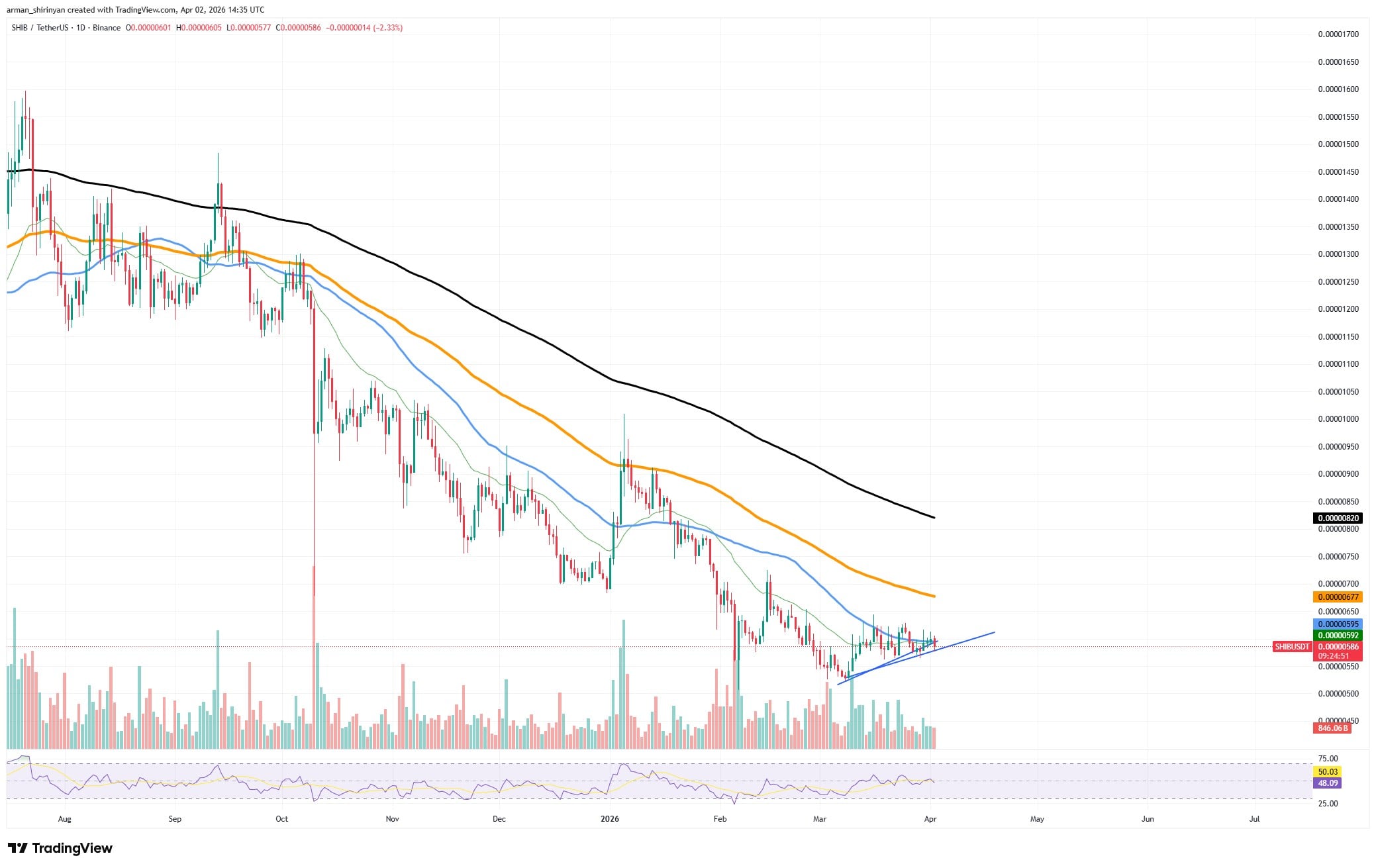
The price has consistently formed lower highs and been rejected from resistance zones in attempts to reclaim higher levels. A shallow ascending trendline represents $SHIB's attempt to construct a short-term recovery structure in recent sessions. This move lacks momentum, though. There is no obvious indication that significant buying interest is emerging, and volume is still comparatively low.
In a bearish trend, the asset is effectively compressing under resistance, which usually resolves to the downside. The main problem is that $SHIB has already been refused a legitimate breakout. The $0.0000065-$0.0000070 range, which currently serves as immediate resistance, was not regained.
The current structure is still unstable in the absence of a clear move above this threshold. Sellers in this area are still active and prepared to defend higher prices if they are rejected repeatedly. The $0.0000055-$0.0000057 area is serving as short-term support from a downside viewpoint. However, this level is weakened by repeated testing — just like other assets in extended downtrends. Should this support break, $SHIB may swiftly shift toward lower demand zones, which could prolong the wider decline.
Bitcoin's thick ceiling
Sellers are still in control, as evidenced by recent price action that repeatedly rejects lower highs. The $75,000-$80,000 range is now firmly functioning as a ceiling rather than a support, and every attempt to recover higher levels has been capped close to resistance zones. This change is structurally significant because it indicates that the prior bullish trend has already ended.
Bitcoin is forming a sequence of lower highs and roughly equal lows on the chart as it compresses inside a declining range. Until there is a significant breakout, this kind of structure usually resolves in a continuation rather than a reversal. The bearish bias is strengthened by the current moving averages, which are sitting above price and sloping downward.
In a corrective or early bear phase, short-term bounces are being sold into rather than expanded. The $65,000-$66,000 range is currently serving as immediate support from a level perspective, but it is undergoing frequent testing. Weak support is prone to breaking.
The next logical downside target that has already been recognized as a crucial demand zone during prior sell-offs is in the $60,000-$62,000 range — should this area fail to hold. Deeper retracement scenarios would be possible if a breakdown below that level were confirmed.
Momentum indicators lend credence to this perspective. RSI fails to create a persistent bullish divergence and stays neutral to weak. The market's overall circumstances, such as recent liquidations and options-driven volatility, are putting pressure on price stability, and volume does not exhibit aggressive accumulation.
$XRP downtrend aggravates
With price action continuing to show weak momentum and ongoing selling pressure, $XRP is currently in a prolonged downtrend. The asset is now consolidating in the $1.20-$1.30 range, well below important resistance zones, after failing to hold above the $2 level earlier in the cycle.
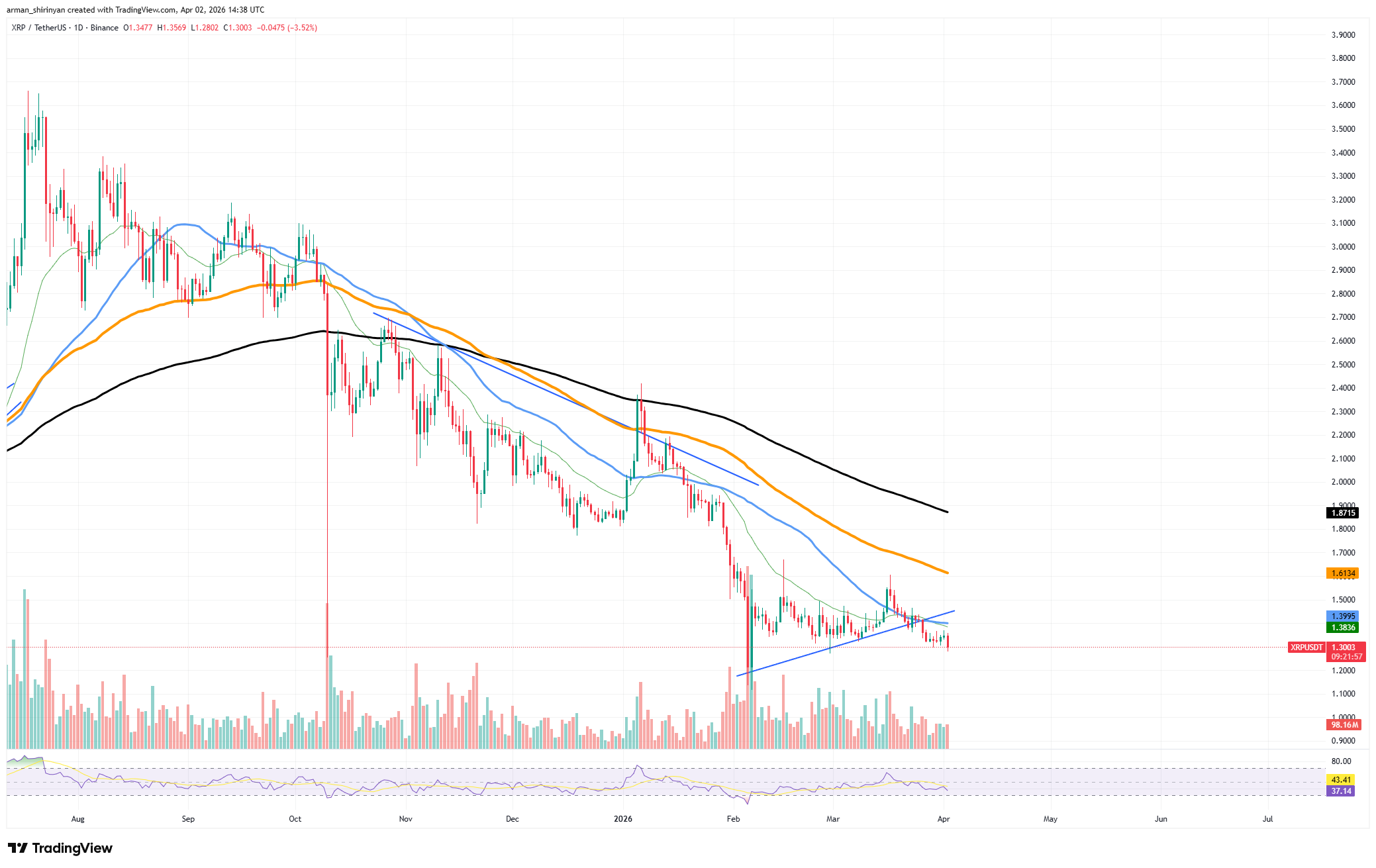
The chart structure confirms that the overall trend is still negative by displaying a traditional pattern of lower highs and lower lows. A short-term ascending support line was created by recent price action, but it has already collapsed, suggesting that even local attempts at recovery are failing. At the same time, $XRP is below fundamental moving averages, including the downward-sloping 50, 100 and 200-day levels.
Lack of bullish momentum on $XRP
This alignment supports the absence of bullish momentum. Technically speaking, the $1.35-$1.40 range is now immediate resistance. When the price failed to break through this area, it formed another lower high. Upside continuation is unlikely as long as $XRP stays below this range.
The $1.20 level is serving as short-term support on the downside, but repeated testing raises the likelihood of a breakdown. The subsequent logical support is located closer to the $1.00-$1.10 range if this level fails. A complete trend reversal would be necessary for $XRP to realistically aim for $2 once more.
This would entail establishing higher highs on rising volume, breaking the descending structure and recovering important moving averages. At the moment, none of these circumstances exist. Rather, the RSI is in a neutral-to-weak range, with no significant bullish divergence, and the volume is still comparatively muted.
Although it is not the most likely scenario given the current circumstances, a return to $2 is not impossible. In addition to a structural breakout above the $1.50-$1.60 range, it would probably necessitate a wider market recovery. Until then, instead of starting a long-term rally toward $2, $XRP is more likely to keep consolidating or drifting lower.

 cryptonewsz.com
 ambcrypto.com