


 2
2
$XRP price trades near $1.42, down roughly 8% on the week. What was previously shaping up as a breakout structure has now flipped into a standard head-and-shoulders breakdown pattern on the 12-hour chart, carrying a 16% downside risk. This happened after a sudden bounce from a local low, and when $XRP lost key support levels.
The spot market, institutional flows, and on-chain data are all aligning in the same bearish direction.
A Head-and-Shoulders Meets a Bearish EMA Crossover
The 12-hour chart on Binance shows a head-and-shoulders pattern that has formed since late February. The right shoulder has completed after $XRP bounced from the $1.36 zone. The pattern carries a measured move of approximately 16%, which would target $1.15 if the neckline breaks on a 12-hour close.
Want more token insights like this? Sign up for Editor Harsh Notariya’s Daily Crypto Newsletter here.
Compounding the risk, a bearish crossover has formed between the 20-period and 50-period Exponential Moving Averages (EMAs), indicators that smooth price data with more weight on recent activity. $XRP price has lost both these EMAs and now trades below them.
The last time both EMAs were lost, around March 21, $XRP corrected by approximately 4.2%. A similar 4% move from current levels would push $XRP directly to the neckline. If the neckline then breaks, the 16% measured move activates.
The EMA crossover is not causing the head-and-shoulders. It is accelerating the path toward it. Whether the on-chain data supports this bearish lean or pushes back against it reveals how deep the selling pressure actually runs.
ETF Flows and Exchange Reserves Paint the Same Picture
March 2026 has already become $XRP’s first net outflow month since the ETFs launched in late 2025. According to SoSoValue data, $XRP spot ETFs have recorded -$30.12 million in net outflows this month.
The trajectory tells the story. November 2025 (the launch month) brought $666 million in net inflows. December followed with $499 million. January collapsed to $15 million. February recovered slightly to $58 million. March has now turned negative entirely, to date, with only a few days left to flip things around.
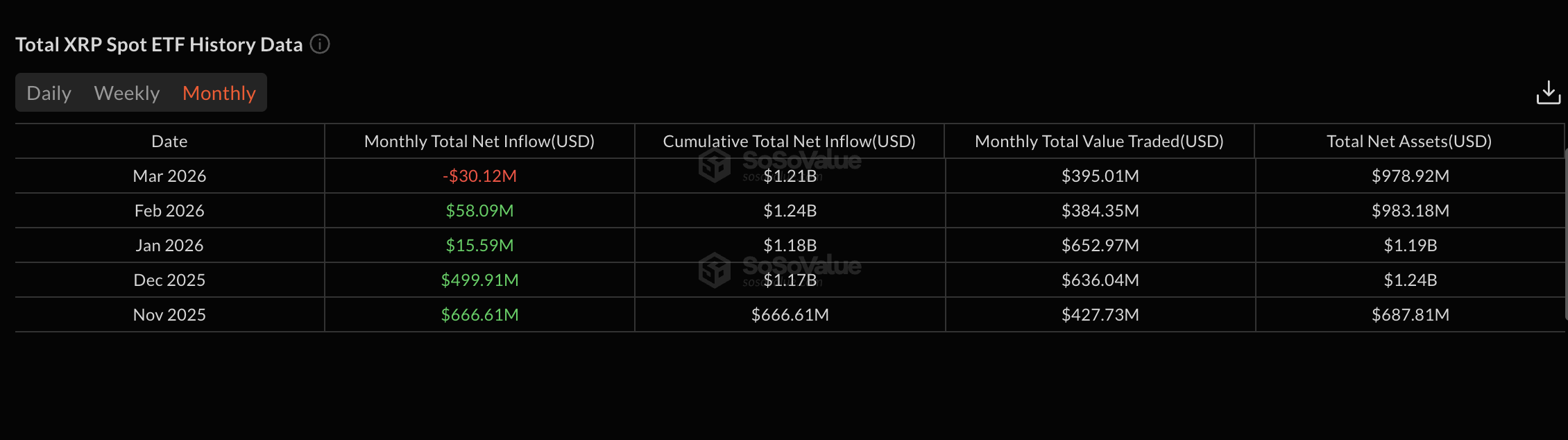
The funds initially went 35 consecutive trading days without a single outflow, a streak that neither Bitcoin nor Ethereum ETFs matched. That institutional confidence now seems broken.
The on-chain picture reinforces the institutional retreat. The exchange supply ratio on Binance (one of the biggest exchanges), which measures exchange reserves relative to total supply, has been climbing steadily since early February.
On February 9, it stood at 0.0255. It has now risen to approximately 0.0279, a year-to-date high. A rising exchange supply ratio means more $XRP is sitting on exchanges, suggesting holders are positioning to sell. Institutions are pulling capital out through ETFs. Spot holders are moving tokens to exchanges.
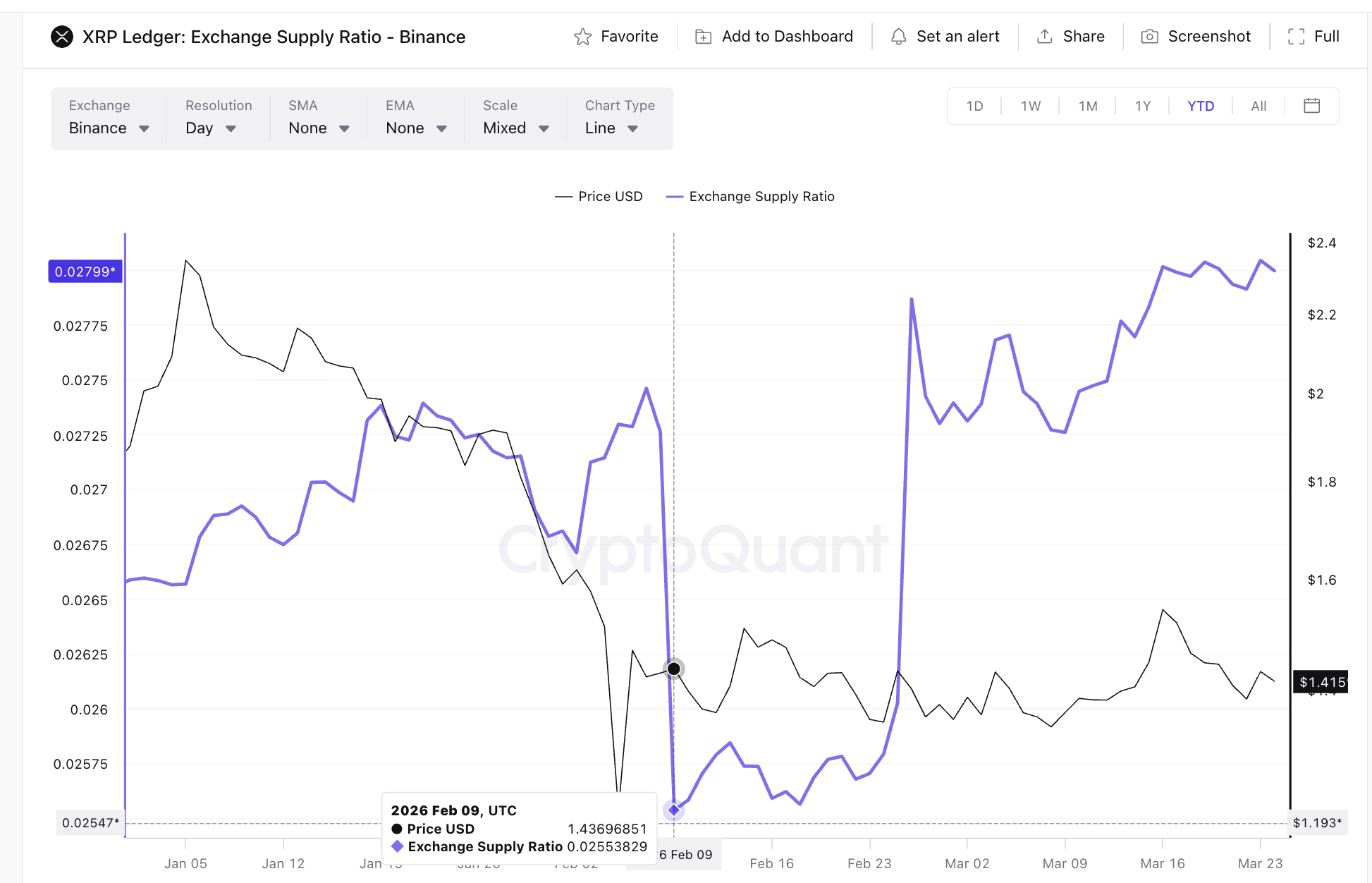
Both flows point in the same direction, and the weakness was building well before the bearish chart pattern formed.
$XRP Price Levels Where the Cost Basis Heatmap Aligns With Technical Support
The cost basis distribution heatmap reveals why the $1.37 to $1.40 zone is structurally critical. Two dense clusters sit in this range. The first (from the downside) sits between $1.38 and $1.39, holding approximately 442 million $XRP.
The second, between $1.39 and $1.40, holds roughly 475 million $XRP. Combined, nearly 917 million $XRP were acquired in this narrow band.
These clusters align with the technical support levels from the current $XRP price swing. The first support sits at $1.40, followed by one at $1.37. If $XRP price falls below $1.37, both cost basis clusters would flip underwater, potentially triggering panic selling from holders trying to minimize losses.
That breakdown would bring the neckline into play. A 12-hour close below it would activate the head-and-shoulders measured move, targeting $1.22 initially and $1.15 as the full projection.
To invalidate the bearish setup, $XRP needs a 12-hour close above $1.46, which would reclaim the right shoulder peak. A close above $1.60, the head of the pattern, would eliminate the head-and-shoulders entirely.
Currently, only a 3% drop separates $XRP from the neckline that could trigger the 16% correction the chart, the exchange data, and the ETF flows are all pointing toward.
The post Is This Unwanted $XRP ETF Record Building a 16% Price Breakdown Case? appeared first on BeInCrypto.

 coindesk.com
 cryptonewsz.com
 u.today