


 2
2
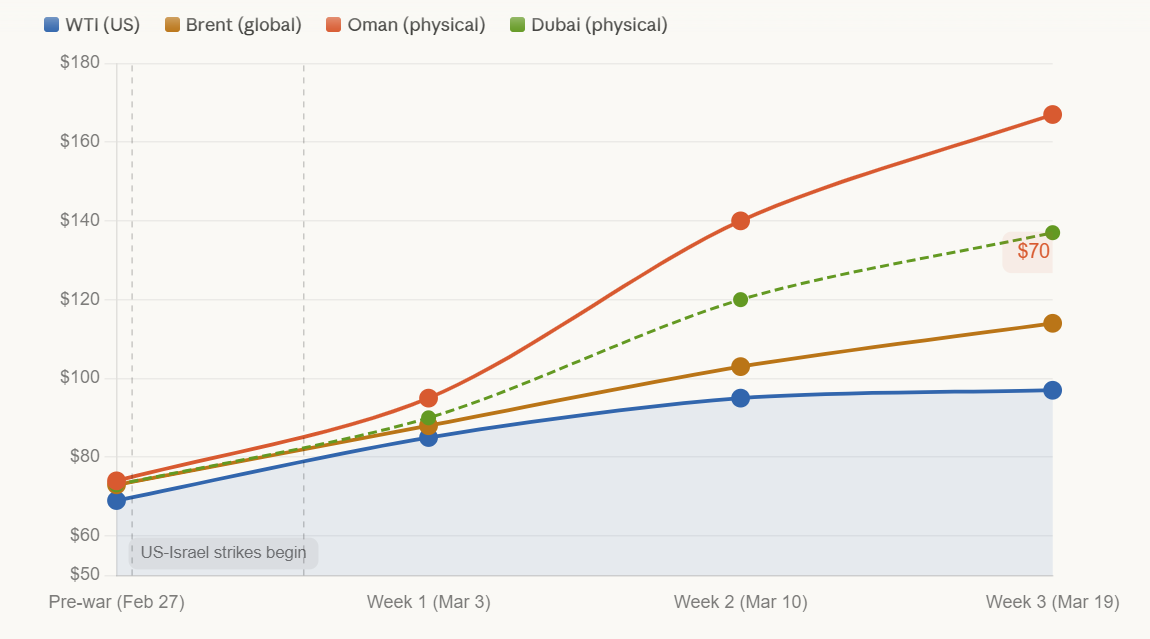
Three weeks into the Iran conflict, global oil markets have fractured along geographic lines. West Texas Intermediate (WTI) crude sits near $97 per barrel while physical crude in Oman trades at a record $167.
The gap between US and international benchmarks has widened to levels not seen in over a decade. The split reflects a deeper structural divide between a relatively self-sufficient American energy market and a world scrambling for supply.
A $70 Barrel Gap With No Precedent
The Brent-WTI spread blew out to roughly $18 per barrel on March 19, its widest level since the mid-2010s. But that figure understates the dislocation in physical markets. Oman crude trades near $167, Dubai at $137, and Brent at $113, while WTI remains below $100.
That divergence has no modern parallel. When the Iran conflict began on February 28, US oil initially surged toward $120 per barrel. However, as the Strait of Hormuz closed and roughly 18% of global crude supply went offline, international benchmarks broke away.
“This could increase tension between the U.S. and its European allies who are suffering a greater consequence when it comes to energy prices,” warned goldbug Peter Schiff.
The US gets less than 8% of its oil from the Persian Gulf, roughly 500,000 barrels per day. That figure has fallen sharply from 2 million barrels per day just 9 years ago.
Domestic production near 13.7 million barrels per day and a shift to net exporter status have created a buffer that no other major economy enjoys.
Europe Faces an Inflation Reversal
The energy shock has hit Europe and Asia far harder. European natural gas prices surged over 30% after Iran struck Qatar’s Ras Laffan facility, which handles roughly 20% of global liquefied natural gas (LNG) supply.
BREAKING: European natural gas prices surge over +30% after Iran strikes Qatar’s largest LNG facility, responsible for 20% of global supply.
— The Kobeissi Letter (@KobeissiLetter) March 19, 2026
Swap markets now fully price two European Central Bank (ECB) rate hikes in 2026, totaling 50 basis points. Just weeks ago, the consensus pointed toward further cuts.
ECB Governing Council member Madis Muller acknowledged that the probability of a rate hike has increased.
“This is not our war,” the Daily Star reported, citing European leaders to President Trump.
That message from European capitals highlights a growing rift. The situation is that the continent is facing a full energy crisis, with physical crude in some markets trading above $150 per barrel, and the EU is pivoting from rate cuts to potential hikes.
German Defence Minister explicitly stated: 'This is not our war, we have not started it'
— BeInCrypto (@beincrypto) March 19, 2026
Meanwhile, US rate cuts in 2026 have been almost entirely priced out. Core Producer Price Index (PPI) inflation on pre-war data rose to its highest level since February 2023.
A Shield With an Expiration Date
Washington has moved aggressively to protect its advantage. The US announced the release of 172 million barrels from the Strategic Petroleum Reserve (SPR), and International Energy Agency (IEA) member countries followed with a combined 400 million barrel drawdown, the largest coordinated release in history.
However, that move carries significant risk. US oil reserves are set to fall roughly 41% to their lowest since the 1980s, leaving stockpiles at about 34% of total capacity. Further releases would leave a minimal buffer.
US Treasury Secretary Scott Bessent signaled the administration may remove sanctions on Iranian oil currently at sea, a move that could ease Brent pressure slightly but would do little to address the physical bottleneck at Hormuz.
BREAKING: US Treasury Secretary Bessent says the US may remove sanctions on Iranian oil that is on water.
— The Kobeissi Letter (@KobeissiLetter) March 19, 2026
US oil prices are now trading at a near $20 DISCOUNT to Brent.
Six nations, including France, Germany, the UK, Italy, the Netherlands, and Japan, have reportedly said they are ready to join efforts to secure safe passage through the strait.
BREAKING:
— X Press (@X_Press24) March 19, 2026
France, Germany, the UK, Italy, the Netherlands, and Japan say they are ready to join efforts to ensure safe passage through the Strait of Hormuz. pic.twitter.com/rO77BNlLxU
Whether a naval escort mission materializes remains uncertain.
J.P. Morgan analysts warned this week that the apparent stability in WTI and Brent should not be mistaken for adequate global supply.
If the strait does not reopen, Atlantic basin benchmarks will eventually reprice higher as inventories drain.
Analysts at The Kobeissi Letter estimate that US inflation could reach 3.2% if current prices hold for another 2 months.
With strategic reserves depleting and no resolution in sight, the gap between America’s discount and the world’s crisis may not last much longer.
The post Oil’s Great Divide: Iran War Splits Global Energy Market Into 2 Worlds appeared first on BeInCrypto.

 en.bitcoinsistemi.com
 news.bitcoin.com

 u.today
 1
1