


 2
2
 4
4
Prediction markets and professional forecasters are pushing back ceasefire timelines for the US-Iran war. The shift comes as Federal Reserve Chair Jerome Powell flagged energy prices as a growing inflation risk.
The longer the war drags on, the deeper its reach into inflation, rate expectations, and risk assets like Bitcoin.
Bettors and Forecasters Agree: No Quick End
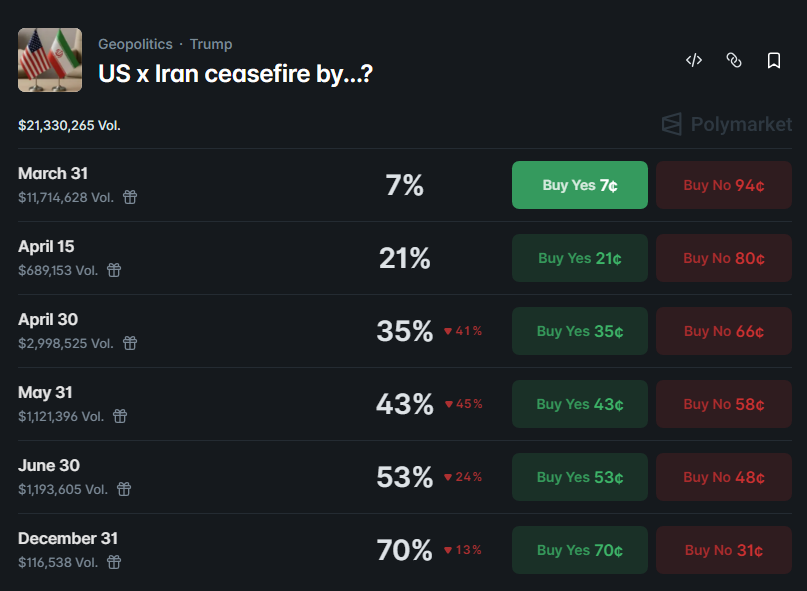
On Polymarket, the largest crypto-native prediction market, the probability of a US-Iran ceasefire by March 31 stands at just 7%. The April 30 contract has dropped to 35%, down 41 percentage points from its peak. Even the June 30 deadline carries only a 53% probability. The market has drawn $21.3 million in total trading volume since the war began on February 28.
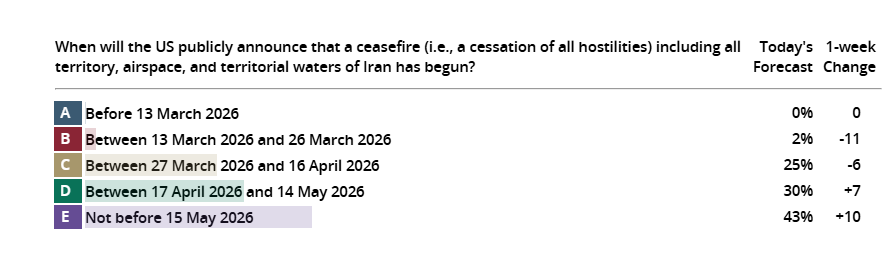
Good Judgment’s Superforecasters — a network rooted in the US intelligence community research — echo the trend. Their latest forecast gives a 43% chance that no ceasefire will come before May 15. That figure rose 10 points in one week. The April 17 to May 14 window rose 7 points to 30%. Meanwhile, the odds of a ceasefire before March 26 collapsed to just 2%.
The convergence of two methodologically distinct forecasting systems reinforces a single message. The White House projection of a four-to-six-week conflict is not what the market believes.
Powell: ‘Nobody Knows’
The Fed held rates at 3.50–3.75% on Wednesday and raised its 2026 inflation forecast to 2.7% from 2.4%. Powell said rising oil prices “for sure showed up” in policymakers’ updated projections. Core PCE inflation sits at 3.0%, with tariffs accounting for roughly half to three-quarters of a percentage point.
Powell repeatedly stressed uncertainty around the war’s economic impact. Several FOMC members suggested this would have been a good meeting to skip projections entirely. He dismissed comparisons to 1970s stagflation, calling current conditions far milder. But he acknowledged the Fed faces a real tension: inflation risk calls for higher rates while a weakening labor market calls for cuts.
On the critical question of whether the Fed would “look through” the energy shock, Powell was cautious. He said the standard approach depends on inflation expectations staying anchored. Five consecutive years above target make that less certain, he added.
Markets React
Brent crude surged to $108.78 per barrel on March 18, up roughly $38 from a year ago. The IEA reported that disruptions in the Middle East cut global oil supply by 8 million barrels per day in March.
Bitcoin dropped nearly 4% to $71,017, extending a consistent pattern of post-FOMC selloffs. The Nasdaq closed at its session low, down 1.5%. US Treasury two-year yields rose six basis points to 3.73%, while traders priced in less than one full rate cut for 2026.
Asian markets opening on Thursday reflected the divergence. Japan’s Nikkei 225 fell 2.80%, and South Korea’s KOSPI dropped 2.95% — both energy-import-dependent economies vulnerable to sustained high oil prices.
What Comes Next
The next FOMC meeting falls exactly six weeks from now. Powell said the committee will “learn a lot” in that window. For crypto markets, the calculus is straightforward. A prolonged war means elevated oil prices, stickier inflation, and fewer rate cuts — all headwinds for risk assets. Ceasefire signals, if they emerge, would rapidly reverse that chain.
Iran’s Foreign Minister Abbas Araghchi told CBS on March 15 that Tehran has “never asked for a ceasefire.” Until that posture changes, prediction markets suggest investors should prepare for the long game.

 ambcrypto.com
 cryptonewsz.com

 newsbtc.com

 u.today