

 1
1


 8
8
Polymarket, the crypto-native prediction market that conquered the 2024 election cycle, is doing something no one had on their bingo card: opening a bar in Washington, DC.
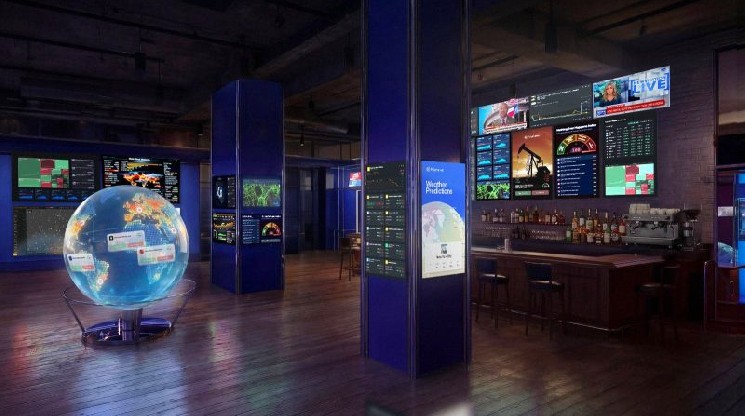
Called “The Situation Room,” the venue is scheduled to open its doors on March 21, 2026. It’s being billed as the world’s first bar dedicated to monitoring live events, outfitted with Bloomberg terminals, flight radar feeds, X streams, and — naturally — Polymarket screens displaying real-time odds on everything from geopolitics to interest rate decisions. Think sports bar, but for people who get their adrenaline from CPI prints and UN Security Council votes.
Here’s the thing. This isn’t just a quirky marketing stunt from a company with money to burn. It’s a calculated move by a platform valued at $9 billion, strategically planting a flag in the most politically wired city on Earth.
The numbers behind the novelty
Polymarket has earned the right to be a little audacious. The platform hit over $7 billion in monthly trading volume in February 2026 — a 7.5-fold increase from the same month a year earlier. That kind of growth trajectory makes a bar seem like a rounding error on the expense sheet.
The company’s momentum really ignited during the 2024 US presidential election, when its markets processed more than $3.6 billion in volume on election night alone. That single evening did more for prediction market awareness than years of academic papers ever could.
Then came the institutional validation. In October 2025, Intercontinental Exchange — the parent company of the New York Stock Exchange — led a $2 billion investment into Polymarket. That’s not venture capital money from a crypto fund with a meme-heavy Twitter account. That’s legacy finance saying “we think this is real.”
By late 2025, Polymarket’s valuation had soared to $9 billion. The platform and its closest competitor, Kalshi, now control a combined 97.5% of the prediction market space. As of March 2026, Polymarket was running more than 108 active markets spanning everything from Federal Reserve policy to celebrity scandals.
The platform has also been experimenting with faster-paced products. Its five-minute Bitcoin price betting markets have already generated over $60 million in trading volume — essentially turning short-term crypto speculation into something closer to a structured derivatives product.
Why DC, and why a bar
The choice of Washington is not subtle, and it’s not meant to be.
Prediction markets have had a complicated relationship with US regulators. Polymarket previously navigated governmental scrutiny — including a $1.4 million settlement with the CFTC in 2022 — and has since worked to position itself as a cooperative, transparent operator. Opening a physical venue in the nation’s capital is essentially Polymarket walking into the room where it happens and ordering a drink.
The venue concept is designed to attract exactly the people Polymarket needs in its corner: policymakers, journalists, lobbyists, and institutional traders. In a city where information is the primary currency, a bar that aggregates Bloomberg data, live flight tracking, social media feeds, and prediction market odds into one room is less a novelty and more a professional tool wrapped in a hospitality format.
In English: it’s a networking hub disguised as a cocktail lounge, and the cocktails are optional but the data feeds are not.
There’s a broader strategic logic here too. Polymarket has existed almost entirely in the digital realm since its founding. Moving into physical spaces signals a company transitioning from scrappy crypto startup to mainstream financial brand. The Situation Room isn’t just about selling overpriced old fashioneds next to a Bloomberg terminal. It’s about normalizing prediction markets in the one zip code that matters most for their regulatory future.
What this means for the prediction market landscape
Look, the prediction market space has gone from academic curiosity to genuine financial infrastructure in roughly 18 months. And that transformation has implications worth paying attention to.
First, the regulatory angle. The fact that Polymarket feels comfortable enough to open a physical venue in DC — where every move gets noticed by the people who write the rules — suggests the company believes its regulatory standing is solid. That confidence likely stems from the ICE investment, which effectively gave Polymarket the backing of one of the most established players in traditional finance. Regulators tend to treat companies differently when the NYSE’s parent company has skin in the game.
Second, the institutional pipeline. A venue like The Situation Room creates a physical touchpoint for the kind of high-net-worth individuals and institutional allocators who might use prediction markets but haven’t yet. It’s one thing to see Polymarket odds quoted on cable news. It’s another to sit in a room watching those odds shift in real time while a Bloomberg terminal confirms the underlying data. That experience has conversion potential that a website alone cannot replicate.
Third, there’s the competitive signal. Kalshi, Polymarket’s primary rival, has been pursuing its own mainstream legitimacy through regulatory approvals and traditional market listings. Polymarket’s bar is a different play — cultural integration rather than regulatory conquest. Both strategies aim at the same goal: making prediction markets feel as normal as checking a stock ticker. But Polymarket is betting that vibes and visibility matter just as much as compliance filings.
The risk, of course, is that the regulatory winds shift. Prediction markets still operate in a gray zone, and a high-profile physical venue could attract the wrong kind of attention if political sentiment turns against crypto-adjacent platforms. A bar full of Bloomberg terminals and betting odds is a regulator’s dream subpoena target if things go sideways.
There’s also the question of whether this concept scales. A single bar in DC is a statement. A chain of Situation Rooms in New York, London, and Singapore would be a business model. Polymarket hasn’t indicated plans for expansion, but the concept is clearly designed to be replicable if the first location proves the thesis.
For investors watching the prediction market space, the key metric to track isn’t whether The Situation Room makes money on overpriced drinks. It’s whether the venue accelerates Polymarket’s institutional adoption and helps the platform push beyond its current $7 billion monthly volume ceiling. Some analysts have projected that prediction markets could eventually process trillions in annual volume. Getting there requires exactly the kind of mainstream visibility that a DC bar provides.
Bottom line: Polymarket opening a bar in Washington might sound like a punchline, but it’s actually one of the shrewder moves a crypto company has made in recent memory. It puts prediction markets directly in front of the people who regulate them, fund them, and trade on them — all in a setting designed to make the experience feel inevitable rather than exotic. Whether The Situation Room becomes a lasting institution or a well-funded experiment, it marks the moment prediction markets stopped being a niche crypto product and started trying to become infrastructure.

 thecryptobasic.com
 en.cryptonomist.ch