


 1
1
 2
2
The crypto market is gripped by extreme fear. Geopolitical and macroeconomic concerns have pushed investor sentiment deep into risk-off territory.
Against this backdrop, one critical question stands out: where is institutional capital positioning itself? In the latest BeInCrypto Expert Council discussion, leaders from Standard Chartered and Bitwise revealed that institutional focus is narrowing, with smart money concentrating around a handful of select crypto assets.
Crypto Market Stuck in Extreme Fear as War Rages On
The Crypto Fear & Greed Index, which measures the overall emotional state of the cryptocurrency market, places the market firmly in Extreme Fear territory at press time.
While today’s 18 is a slight improvement from yesterday’s lower reading, it still reflects a market dominated by fear.
The sentiment is hardly surprising given current market conditions. The US-Israeli war on Iran is now in its 13th day, and geopolitical risk is escalating rather than cooling.
President Trump’s earlier suggestion that the conflict could end soon briefly lifted stocks and crypto while dragging oil prices lower. That optimism has since evaporated.
Trump says the war with Iran will end soon.
— BeInCrypto (@beincrypto) March 11, 2026
The president told Axios the conflict concludes whenever he wants because there is practically nothing left to target.
‘Little this and that … any time I want it to end it will end’ pic.twitter.com/sS2ZM0S9Nf
BeInCrypto reported that Iran has laid out ceasefire conditions that are fundamentally at odds with Washington’s stance. More critically, the Islamic Revolutionary Guard Corps (IRGC) has vowed not to allow “a litre of oil” through the Strait of Hormuz.
The chokehold on the Gulf’s most vital waterway is negatively impacting global energy markets, oil prices are surging again, and crypto is sliding in tandem.
BREAKING: US crude oil prices surge above $95/barrel. pic.twitter.com/b4OC8io8F7
— The Kobeissi Letter (@KobeissiLetter) March 12, 2026
The knock-on effects are compounding. Spiking energy costs are stoking recession fears, while stress signals from labor and credit markets add to the unease.
Across equities and credit, hedging activity is climbing sharply, a clear sign that institutional investors are bracing for further turbulence.
“Hedge fund short positions in US macro products, including index futures and ETFs, are up to 11% of total US exposure, the highest since the 2022 bear market. This percentage has risen by +4 points since September 2024. Over the last 5 years, short exposure has been higher only 7% of the time,” The Kobeissi Letter reported.
The Case For Bitcoin
In this current climate, investors are more likely to tread with caution. The Expert Council discussion suggests institutions are positioning around Bitcoin, Ethereum, and a small group of established decentralized finance (DeFi) protocols, rather than the broader altcoin market.
Michael Walsh, Chair at Zodia Markets (a Standard Chartered subsidiary) and a Kraken entity, stated that the market is heading toward “a consolidation around the main coins, the main assets.”
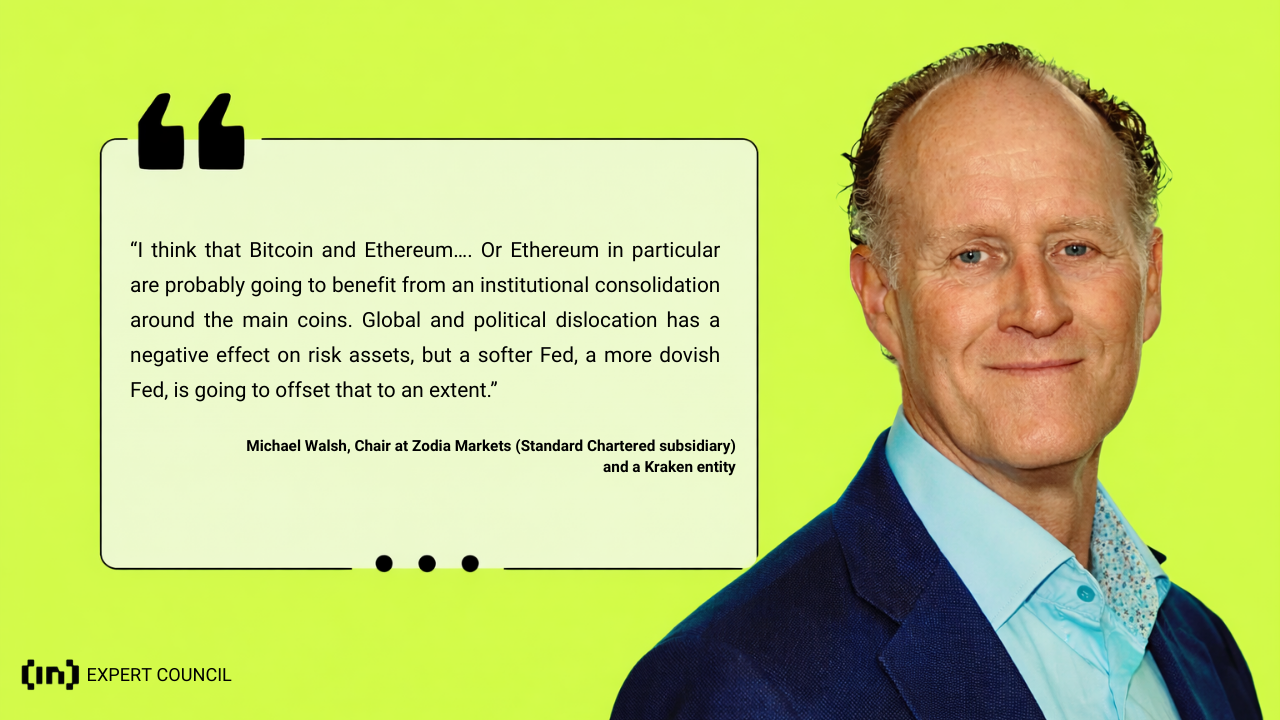
In his view, the reason it’s going to be the major coins is that institutional adoption demands commitment. The numbers back this up. Institutional exposure to Bitcoin remains substantial.
In 2025, from businesses, governments, funds, and ETFs collectively added roughly 829,000 $BTC.
Meanwhile, registered investment advisors (RIAs) have poured approximately $1.5 billion per quarter into Bitcoin ETFs over the past two years, without a single net-selling quarter on record.
Despite the demand slowdown amid the bear market, institutional capital has not entirely left the crypto market. Bitcoin ETFs have already attracted over $1 billion in inflows so far in March 2026, snapping a streak of four consecutive red months.
Bloomberg’s senior ETF analyst Eric Balchunas highlighted that ETFs now collectively hold 1.28 million $BTC, making them the world’s single largest holder of Bitcoin as a group.
In addition, BitcoinTreasuries data showed that 194 public companies currently hold 1.156 million Bitcoin.

Why Ethereum Attracts Institutional Capital
Ethereum has also drawn significant institutional interest, with 29 publicly traded companies already holding the asset on their balance sheets, according to CoinGecko data. As of December 31, spot ETH ETFs had 938 institutional holders filing 13F forms.
Notably, Bitcoin and Ethereum appeal to institutions for fundamentally different reasons. Bitcoin is widely regarded as a store of value.
Meanwhile, Ethereum’s draw lies in its dominance across DeFi, its yield through staking, and its role as the primary platform for tokenizing real-world assets (RWAs). Ethereum commands over 57% of the distributed RWA market share.
Geoff Kendrick, Global Head of Digital Asset Research at Standard Chartered, argued that over the next couple of years, much of the TradFi blockchain activity is likely to occur on Ethereum.
“I think Ethereum probably wins for the next little while on the back of TradFi getting involved,” he said.
Thus, it’s clear that Bitcoin and Ethereum remain the clearest large-cap crypto beneficiaries of institutional allocation, offering the deepest liquidity, the strongest infrastructure, and the most familiar entry points for capital.
Subscribe to our YouTube channel to watch leaders and journalists provide expert insights
Institutional Capital Flows Into DeFi Layer With Aave, Morpho, Uniswap
That said, Bitwise Asset Management’s Chief Investment Officer Matt Hougan also named a few other protocols.
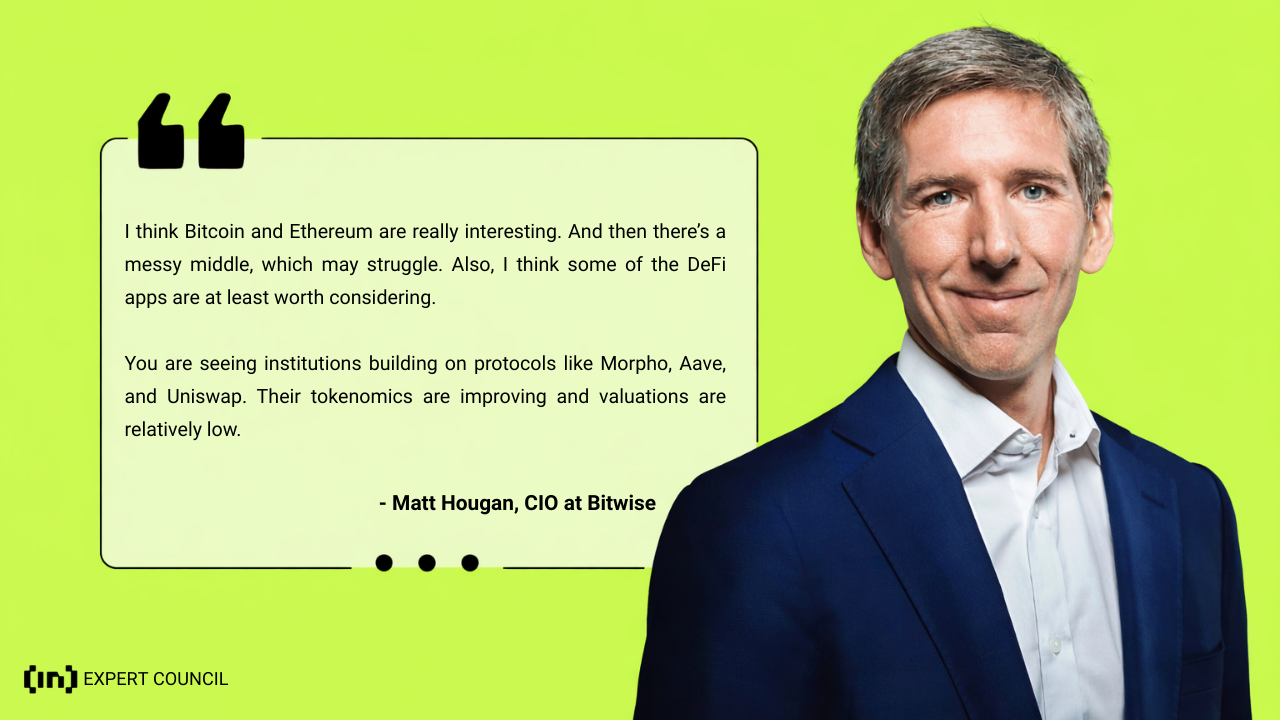
The interest is evidenced by recent initiatives. Last month, Anchorage Digital added support for Morpho, allowing institutional clients to access a suite of Morpho Vaults directly through its platform.
In late February, Resolv and Centrifuge channeled a $100 million JAAA strategy through Aave Horizon. Notably, it has become the largest market for RWA-backed loans on Ethereum, signaling growing institutional confidence.
Meanwhile, asset management giant BlackRock also brought its tokenized Treasury fund, BUIDL, to UniswapX through a partnership with Securitize. The firm also disclosed it had purchased UNI tokens.
Taken together, these moves highlight a clear pattern: institutional capital is not just sitting in Bitcoin and Ethereum. It is actively flowing into the DeFi infrastructure layer, though this cycle looks more like selective institutional consolidation than a speculative rush across all crypto tokens.
The post Institutional Crypto Bets Are Narrowing to Bitcoin, Ethereum, and Select DeFi Names appeared first on BeInCrypto.

 cryptonewsz.com
 finbold.com
 news.bitcoin.com