


 7
7
Oil markets have abruptly returned to the center of crypto’s risk matrix as tensions over the Strait of Hormuz intensify.
Against this backdrop, the prospect of a four-week disruption, as estimated by President Trump, could ripple far beyond energy.
Strait of Hormuz Oil Shock Threatens to Tighten Liquidity and Rattle Crypto Markets
On Sunday, President Trump said that the conflict with Iran could last four weeks, noting that this timeline reflects planning and acknowledges the strength of Iran, while remaining open to future talks.
Meanwhile, Polymarket reports that shipping giant Maersk has suspended all transit through the Strait, one of the world’s most critical oil corridors.
BREAKING: Maersk, one of the world's largest shipping companies, suspends all transit through the Strait of Hormuz.
— Polymarket (@Polymarket) March 1, 2026
Roughly 20% of global crude supply flows through the narrow passage between Iran and Oman. Even without a confirmed full blockade, tanker insurance premiums have surged, and traders are pricing in potential supply shocks.
According to estimates from Goldman Sachs, oil’s “fair value” could range from $1 to $15 per barrel depending on the severity of a one-month disruption.
Goldman estimates the following effects on the fair value of oil prices in scenarios for one-month disruptions to oil flows through the Strait:
— zerohedge (@zerohedge) March 1, 2026
+$15 for a full one-month closure if there are no offsets (e.g. utilization of spare pipeline capacity, SPR release)
+$12 for a full… https://t.co/yD07qFkNk4 pic.twitter.com/o8IUkBSxT5
A full closure without offsets could add $15, while partial disruptions would have more muted effects. In extreme cases, some analysts have floated crude spiking toward $120–$150.
If the Middle East WAR ESCALATE market will collapse 💥
— Mr hunter (@TrueGemHunter) March 1, 2026
I am expecting 👇
Oil → $120 to $150
Gold → $7,000 to $7,500
Silver → $150
Nasdaq → 30 to 45% drop from recent highs
Bitcoin → below $30K
ETH → below $800
SOL → below $30
The world is not ready for this. pic.twitter.com/7Z97wvDumw
Yet markets remain divided. The Kobeissi Letter noted that oil briefly erased nearly 70% of its initial spike, dropping back below $70 per barrel. That volatility highlights how fragile sentiment has become.
“This is NOT World War 3. Ignore the noise,” wrote analysts at the Kobeissi Letter.
For crypto, the implications are less about oil itself and more about liquidity.
From Oil Spike to Liquidity Shock: Why Bitcoin Faces a 4-Week Macro Stress Test
As Reuters reported, oil surged while equities slid, with investors rotating into the dollar, gold, and bonds as Middle East conflict appeared set to stretch for weeks.
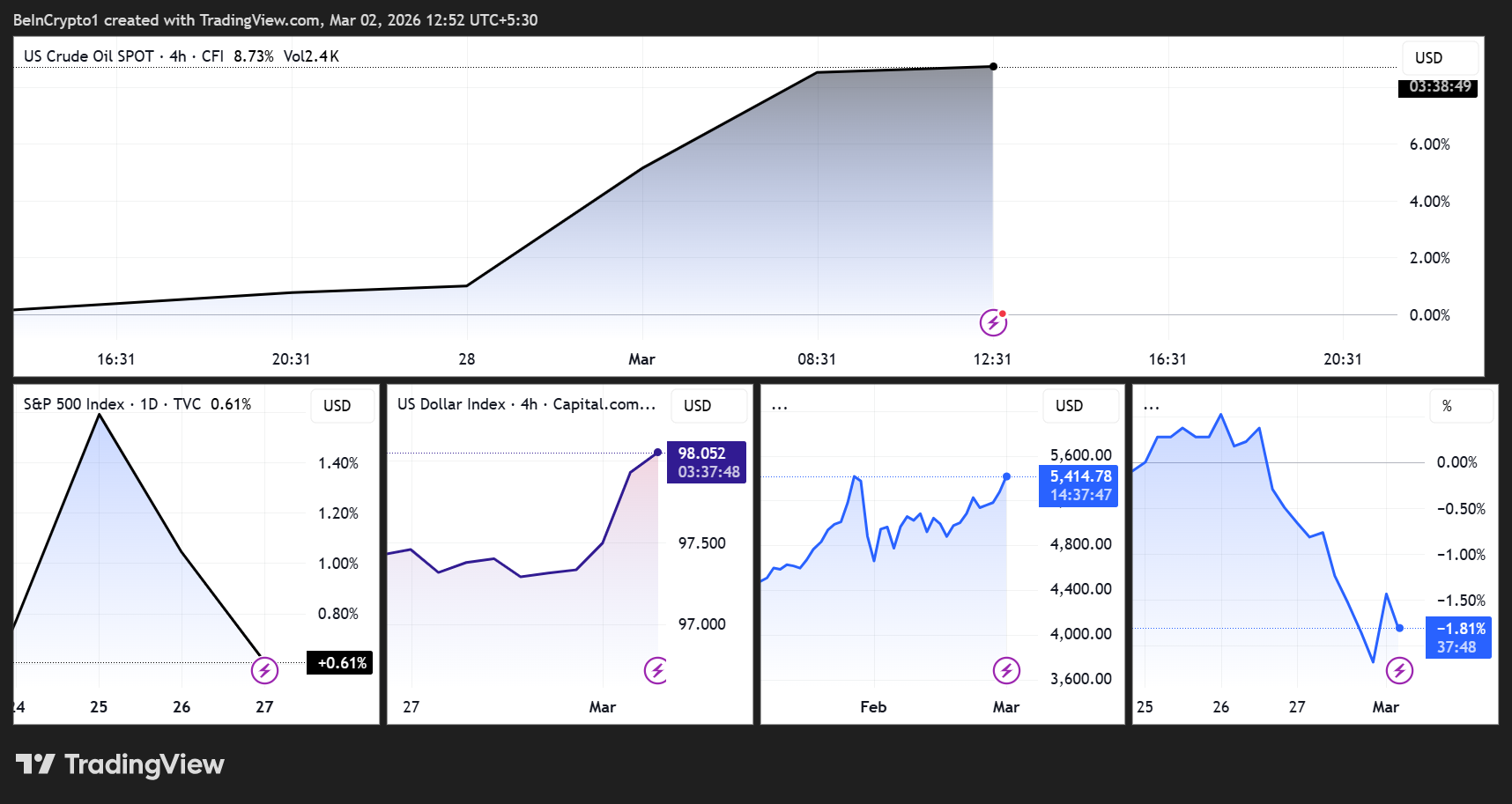
Red across the board: US stock futures are tumbling, as 'fear gauges' spike. The primary catalyst is a massive 15% explosion in crude oil prices over the weekend, over fears of a total closure of the Strait of Hormuz, leaving investors scrambling to price in a new inflationary… pic.twitter.com/wUc2lDjFUE
— BeInCrypto (@beincrypto) March 1, 2026
If crude remains elevated over the next month, inflation expectations could rebound just as markets were positioning for rate cuts.
That is where crypto becomes vulnerable.
Higher oil feeds directly into transportation and manufacturing costs, lifting CPI prints and potentially forcing central banks to delay easing.
Rising inflation expectations typically push Treasury yields higher. And when real yields rise, liquidity tightens.
Bitcoin has repeatedly traded as a high-beta liquidity asset. During prior tightening cycles, higher yields have drawn capital toward bonds and away from speculative markets.
A sustained oil shock could therefore reprice trillions in rate-sensitive capital, pressuring equities and digital assets simultaneously.
“With 24/7 crypto markets having already digested US-Iran tensions over the weekend, digital-asset traders are on the defensive as they assess potential contagion risks from crude oil prices when US markets open on Monday,” Bloomberg analysts observed.
This means deleveraging can happen instantly. If bond yields spike alongside crude, leveraged positions across Bitcoin and altcoins could unwind quickly.
BeInCrypto previously warned that an oil shock could trigger a liquidity selloff without requiring a geopolitical catastrophe.
The transmission mechanism is mechanical: higher oil → higher inflation → fewer rate cuts → rising yields → tighter liquidity.
There is also a secondary geopolitical layer. BeInCrypto highlighted fears of a broader domino effect, including potential spillovers toward the Taiwan Strait. This could compound global trade risk and deepen macro stress.
The Middle East is in a state of high-intensity conflict.
— BeInCrypto (@beincrypto) March 2, 2026
While the Strait of Hormuz faces immediate disruption, an additional fear is a "domino effect" reaching the Taiwan Strait.
Join @steve_hanke and @BMcGleenon as we discuss:
– The immediate economic shock of $100+ oil… pic.twitter.com/BW5V6UFLXl
Over the next four weeks, oil may act as crypto’s leading indicator. A de-escalation that stabilizes crude prices could quickly restore risk appetite.
However, a sustained disruption through Hormuz would likely shift the narrative from geopolitical noise to a full-scale liquidity event, one where digital assets, as always, are among the first to feel the pressure.
The post How Could Oil Prices Over the Next 4 Weeks Pressure Bitcoin? appeared first on BeInCrypto.

 ambcrypto.com
 crypto.news