

 1
1


 5
5
SAN FRANCISCO, CA - As artificial intelligence dominates venture funding and headlines alike, some in crypto have begun to wonder whether the industry has missed its “ChatGPT moment” — or worse, whether capital is permanently rotating away.
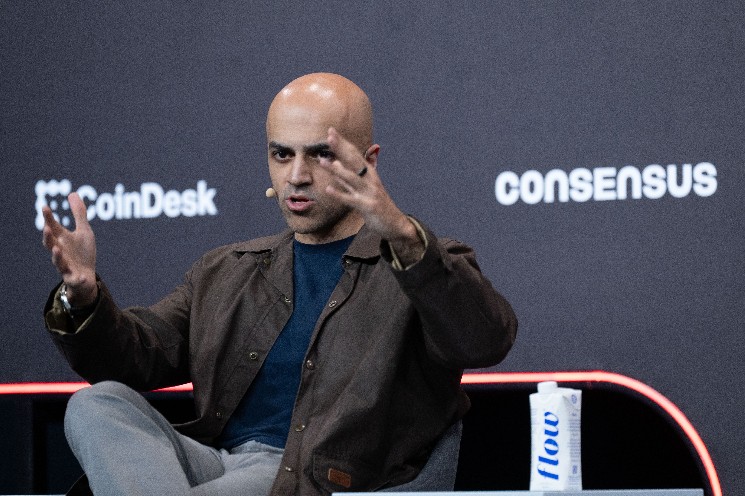
Haseeb Qureshi, managing partner at crypto venture firm Dragonfly, rejects that framing outright.
“I would completely dispute this framing,” Qureshi said in an interview with CoinDesk at NEARCON 2026. “Less than 1% of AI users are paying. That means 99% are using the free tier. Crypto doesn’t have a free tier.”
Comparisons between AI’s explosive consumer adoption and crypto’s trajectory misunderstand the nature of the products, he argued. “There is no free Bitcoin. There’s no free Ethereum,” he said, noting that while roughly 80% of Americans have tried some form of AI tool, about 15% have owned crypto — a figure he calls “a mass-market phenomenon.”
To Qureshi, the better lens is global utility, particularly in payments. Stablecoins, he noted, have grown steadily regardless of price swings. “Stablecoin supply has been growing 50% year over year,” he said. “That’s exponential growth.”
Qureshi said the underlying fundamentals of crypto remain intact even if sentiment has cooled.
Following the money
Venture dollars have undeniably shifted toward AI. But Qureshi views that less as an indictment of crypto and more as the market doing what markets do.
“Money is a leading indicator,” he said. “Human beings respond to money — they don’t respond to the reality on the ground.”
Crypto, even after multiple drawdowns, remains a $2 trillion asset class. And unlike AI giants such as OpenAI, which employ thousands, crypto projects often scale with lean teams.
“We don’t have any 9,000-person companies like OpenAI — and that’s a good thing,” Qureshi said. “Crypto is incredibly high leverage as a technology. You don’t need very many people to build things that are world scale.”
He sees the recent contraction as a correction after years of overfunding. “To the extent that there were too many people building too many things in crypto, the market’s correcting that. That’s capitalism doing its job.”
In fact, Dragonfly recently announced a $650 million fund — a move some observers characterized as bold given the current market malaise.
“That’s the best time to double down,” Qureshi said. “Why would you want to double down when prices are high? If you’re raising money and deploying into all-time high prices, that’s when you should be nervous.”
Asked whether something more existential had changed in crypto over the past four months, he was blunt: “Did the fundamentals of the industry change that much? No.”
Crypto and AI: convergence or mirage?
While Dragonfly is exploring investments at the intersection of crypto and AI, Qureshi cautioned against assuming AI will revive crypto’s momentum.
“Is AI going to save crypto? F*** no,” he said. “AI agents using crypto are so far away — it’s going to take years.”
He sees a familiar pattern of crypto attaching itself to whatever technological trend is ascendant. “Chatbots are exciting? Great — we have chatbots with tokens. Agents are exciting? Great — you can buy the layer one for agents,” he said. “As an investor, you just have to slow down.”
That doesn’t mean crypto’s identity is shifting away from its roots. Recent narratives suggesting that the industry has capitulated to Wall Street miss the point, Qureshi said.
“There’s a lot of people saying crypto capitulated and became a tool of Wall Street. I think that’s stupid,” he said. “The whole point of bitcoin is that it encompasses everybody’s usage of the same technology. Nobody’s usage impinges on anybody else’s.”
Cycles, not collapse
Qureshi attributes much of today’s gloom to short time horizons and simple fatigue.
“People in crypto are pathologically short-time horizon,” he said. “Prices were down a lot of times.”
From ETF-driven rallies to tariff-induced pullbacks, volatility has defined the industry for over a decade. The pattern, he suggests, is neither new nor fatal.
“This idea that because prices are down, nobody’s going to use stablecoins anymore? Absurd,” he said.
For Qureshi, the story isn’t about AI replacing crypto, nor about crypto’s decline. It’s about cycles — and patience.
“Chill out,” he said. “It’s not a catastrophe.”
Read more: Kraken’s co-CEO could trust AI with 100% of his crypto — Dragonfly’s Haseeb Qureshi isn’t convinced

 en.bitcoinsistemi.com
 beincrypto.com
 coingape.com
