


 1
1
 10
10
$XRP staged a sharp rebound on Friday, rising about 18% over 24 hours to trade near $1.49 after a deep selloff a day earlier made it the worst performer among major tokens.
The move came as bitcoin briefly rose over $70,000 in U.S. morning hours, reversing Thursday's sharp declines ahead of the weekend.
The bounce came after $XRP collapsed to roughly $1.14 in the prior session, a move that triggered heavy liquidations and flushed out traders who had been leaning too hard on leverage.
Data shows short liquidations of roughly $26 million in the past 24 hours, compared with around $30 million in longs from earlier Thursday.
That imbalance matters. It suggests the market wasn’t reacting to fresh bad news as much as it was mechanically clearing out bullish bets as prices slid. Once those positions were forced shut, selling pressure eased and $XRP was able to rebound quickly.
The recovery also comes at an awkward time for $XRP’s broader narrative. Ripple and its ecosystem have spent the past week pitching a more institutional future for the $XRP Ledger, including plans for permissioned markets, lending and privacy tools.
Flare, a closely watched project trying to bring DeFi-style utility to $XRP through FXRP, also expanded institutional access through custody firm Hex Trust.
But none of that helped $XRP sentiment when the market cracked.
Friday’s rally, then, looks less like investors suddenly buying into the “institutional DeFi” pitch and more like a classic crypto snapback: a steep fall, a leverage wipeout, then a fast rebound once forced sellers are gone.
Meanwhile, a ratio of bullish versus bearish bets on futures tracking $XRP shows retail longs got rinsed, but big traders were leaning the other way.
On Binance, the overall account-based long/short ratio is 2.13 as of Friday, meaning there were about 2x more accounts positioned long than short. That’s usually a sign of crowded bullish positioning — lots of smaller traders expecting a bounce.
But at the same time, Binance’s top trader long/short (positions) is ~0.73, which means the biggest traders on Binance were net short.
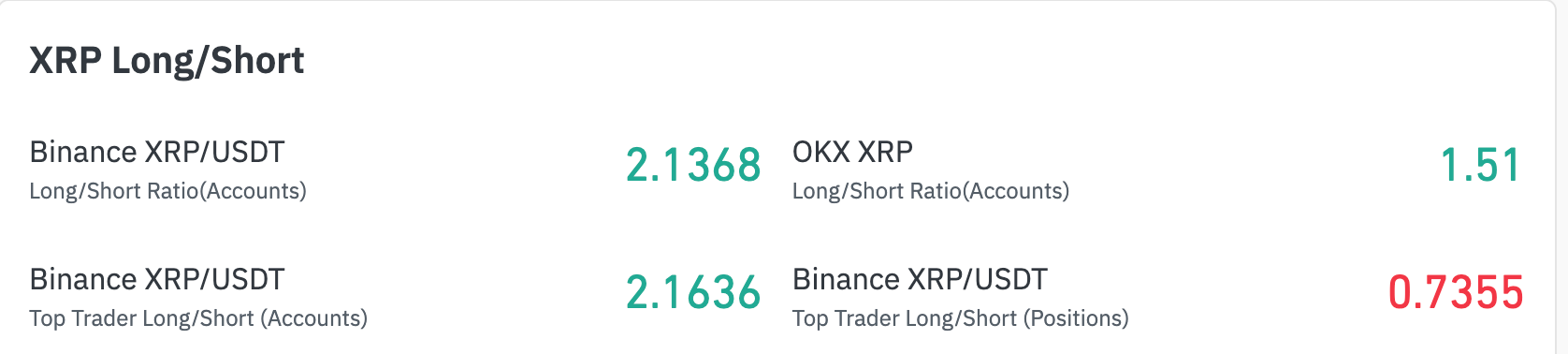
That split suggests $XRP’s dump wasn’t random: it likely ran into a market where smaller traders were stubbornly long, while larger players were positioned to profit from a flush.
And once those longs were cleared, $XRP did what it usually does after a wipeout: it snapped back violently, because there wasn’t much selling left.

 cointelegraph.com
 en.bitcoinsistemi.com
 finbold.com
