


 3
3
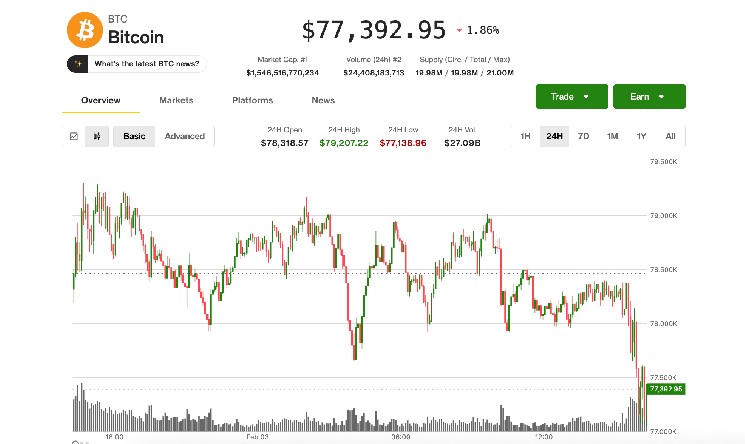
After having climbed roughly 7% to above $79,000 from its panickly weekend lows near the $74,000 mark, bitcoin BTC$77,961.94 is again giving ground during morning U.S. trade.
Bitcoin was recently changing hands at $77,100, lower by 2% over the past 24 hours. Ether ETH$2,325.24 was faring worse, down to $2,260, or 4.7% lower.
The selloff is occurring as gold and silver are both posting strong gains in what appears to be a real rebound from their own panicky price action last Friday.
Alongside, U.S. stocks — particularly, a sizable group of AI-related names — are declining. Nvidia (NVDA), Oracle (ORCL), Broadcom (AVGO), Micron (MU) and Microsoft (MSTR) are all lower by 3%-5%, leading the Nasdaq's 1% drop.
The largest publicly traded bitcoin holder Strategy (MSTR) continues to make fresh lows and is down more than 2%. Coinbase (COIN) and Bullish (BLSH) are off similar amounts.
Galaxy Digital (GLXY) shares are down more than 12% following disappointing fourth-quarter results. Stablecoin issuer Circle (CRCL) is down another 3.5%.
Bitcoin miners turned AI infrastructure providers are posting gains, led by TeraWulf (WULF), which advanced 12% after acquiring two industrial sites in the U.S. that could more than double the firm's power capacity to 2.8 gigawatts. Cipher Mining (CIFR) shares are up 4% after announcing plans to raise $2 billion in the junk bond market to fund its Black Pearl data center in Texas, which will deliver 300 megawatts of capacity under a long-term lease with Amazon Web Services.
Dead-cat bounce
Options flows suggest traders are bracing for a short-lived bounce off of the weekend lows below the $75,000 level, according to Jake Ostrovskis, head of OTC at crypto trading firm Wintermute.
The absence of demand for upside exposure mirrors conditions seen in April 2025, he added.
Heavy demand for near-term downside protection has distorted the options market, pushing short-dated volatility higher than longer-dated contracts, a setup known as backwardation, Ostrovskis noted. The analyst said he's watching when volatility cools and the options curve normalizes back into contango as bottom signals.
"At that point I'd be more comfortable calling local lows," he said.


 bitcoinworld.co.in

 crypto.news
 coingape.com