



 9
9
The crypto market is flashing a rare signal for XRP, suggesting the asset may be undervalued and presenting a potential buying opportunity for investors.
Data from blockchain analytical firm Santiment shows that XRP’s 30-day Market Value to Realized Value (MVRV) is at -5.7%, a level the analytics firm characterizes as a potential “buy zone.”
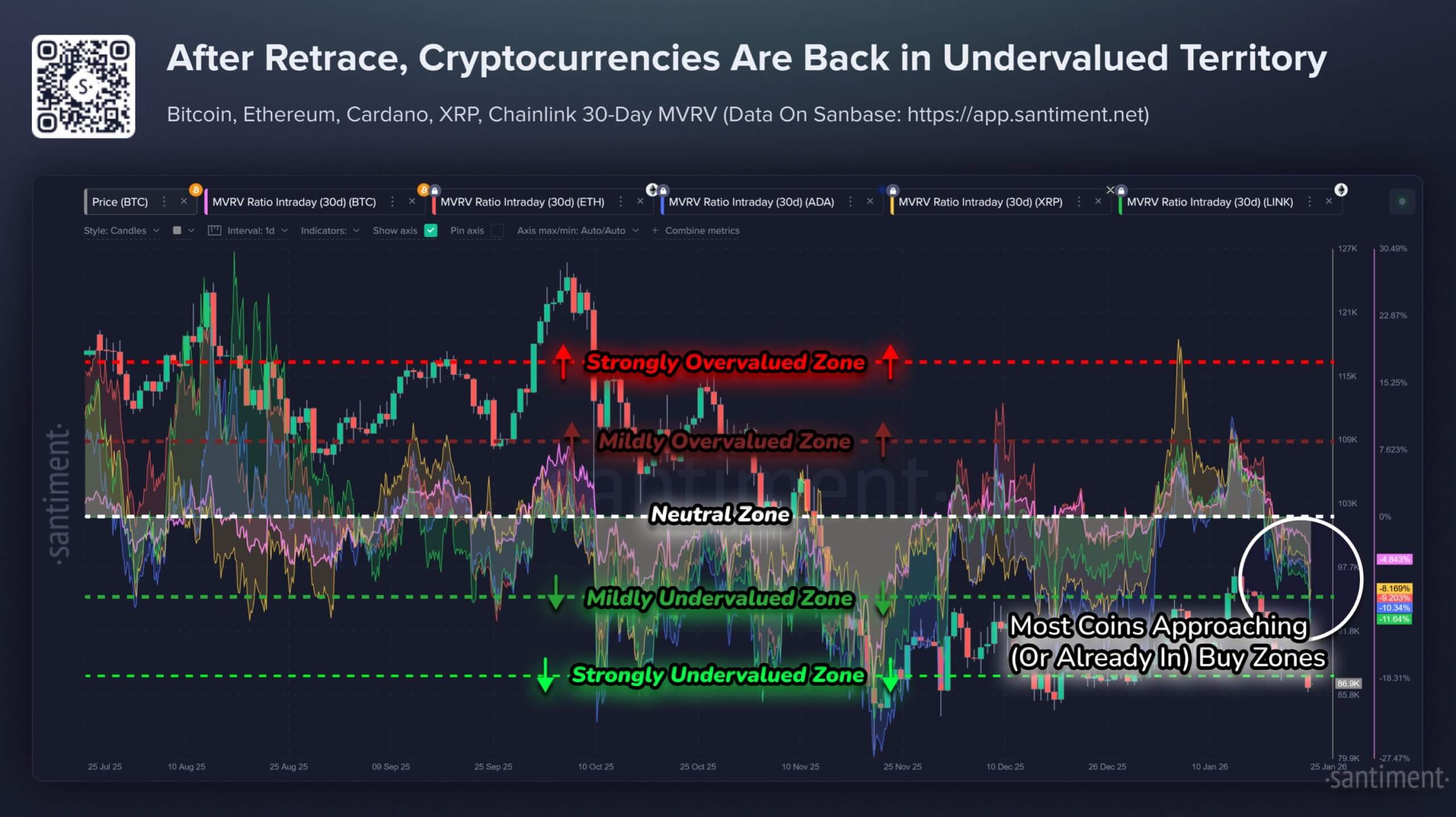
This metric indicates that the average recent buyer is currently underwater, a condition that historically precedes price rebounds as selling pressure from profit-taking evaporates.
With XRP trading near $1.88 at the time of writing, the data implies a distinct positioning reset rather than a mere dip.
However, the narrative is deeper than a simple discount. While the negative MVRV reading suggests a “spring-loaded” market where the 30-day cohort’s breakeven point sits near $1.99, the broader context involves a collision of record liquidity, surging institutional flows, and a fundamental reshaping of Ripple’s corporate footprint.
Liquidity signals and XRP derivatives risks
The dominant backdrop to this on-chain valuation signal is not price action but liquidity, which remains resilient even as XRP has struggled to build momentum.
Stablecoins function as the crypto market’s working capital, and their presence at record levels suggests dry powder is accumulating. Notably, DeFiLlama data shows that the total stablecoin market capitalization recently reached a new high of over $311 billion.
That cash build supports two competing interpretations. It can be read as capital positioning to rotate back into large, liquid assets such as XRP. Or it can be read as investors choosing to sit in cash, preserving optionality rather than taking immediate directional exposure.
Meanwhile, that tension is the point. A negative 30-day MVRV is not a guarantee of safety. It is a signal that the trade is less crowded than it would be if recent buyers were sitting on broad, mark-to-market profits.
Over that liquidity, however, sits a derivatives market that looks more fragile than the on-chain “value” framing implies.
CoinGlass data puts XRP futures open interest at roughly $3.3 billion. That is large enough for forced liquidations to steer price action over short windows, particularly if a move gains speed.
The result is a market where spot and on-chain signals can argue for value, while leverage argues that any break in either direction can be mechanically amplified.
Santiment flagged another volatility marker in XRP earlier this month, pointing to a three-month high in transactions above $100,000. It recorded 2,802 such transfers in a single day.
That level of whale activity indicates large players are active within the market. In practice, that tends to accelerate volatility, regardless of whether the next impulse is up or down.
Institutional inflows remain strong
A primary differentiator in this cycle compared to previous XRP downturns is the presence of regulated access points and verified institutional demand.
Data from CoinShares shows that XRP has seen institutional inflows of approximately $90 million this year, placing it among the top three assets by inflows.
This institutional appetite is corroborated by the performance of spot exchange-traded funds. XRP ETFs have recorded $68 million in inflows this month alone, pushing their total flows to $1.23 billion since their launch last November.
The emergence of these products has changed the composition of the marginal buyer as XRP demand has shifted from crypto-native reflexes, where traders buy dips because indicators are oversold, to flows-based allocation driven by mandates and rebalancing.
This transition supports the thesis that the current undervaluation may be a prelude to a more sustained recovery driven by sticky institutional capital rather than fleeting retail speculation.
XRP exchange reserves and market depth
Under the hood of the spot market, XRP is flashing an early liquidity signal on the world’s largest venue.
CryptoQuant data shows Binance’s XRP reserve has climbed to about 2.74 billion tokens, the highest level since last November.
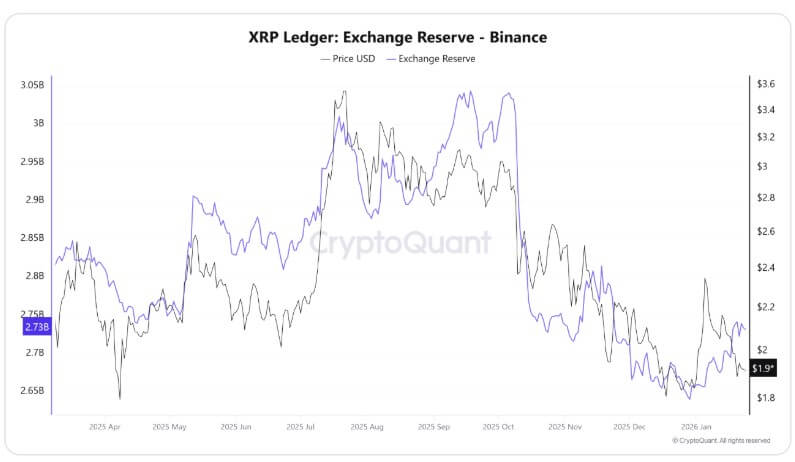
This move reverses a long stretch of drawdowns that pushed reserves to roughly 2.63 billion XRP in December, marking a pivot away from the late-2025 pattern of steady depletion.
That earlier decline fit a familiar repositioning phase, with investors moving inventory off-exchange into external wallets.
However, the recent rise points the other way, suggesting liquidity is gradually migrating back onto the exchange.
In most cycles, rising reserves can be read as a potential supply returning to the market. But the framing here is more nuanced.
In this case, the reserve rebuild looks less like a blunt distribution signal and more like a market transitioning out of a liquidity-scarce regime, into one defined by measured reinvestment and readiness for higher activity.
Meanwhile, that shift is also showing up in XRP's microstructure.
CryptoQuant’s data indicates that the asset's 30-day Price–Cumulative Volume Delta (CVD) correlation on Binance is around 0.61, a moderate-to-strong positive relationship between price action and net volume flows.
In plain terms, recent price moves are being accompanied by supportive flow behavior rather than drifting independently of it, which is often read as a form of structural confirmation.
Essentially, this positive correlation argues that the market is building a base, with flows and price increasingly moving in the same direction.
Ripple's corporate expansion
Beyond market mechanics, XRP’s valuation is no longer just a function of spot flows and derivatives positioning.
Instead, it is increasingly being framed through Ripple’s corporate buildup, a campaign that looks less like a payments company scaling a product suite and more like a crypto-native investment firm assembling distribution, custody, and prime-brokerage plumbing.
Over the years, that strategy has produced a long shopping list, including the acquisitions of Palisade, Metaco, GTreasury, Rail, and Hidden Road, which has since been rebranded as Ripple Prime.
Alongside the acquisition push, the firm has also pursued a licensing strategy to expand its addressable market.
Ripple has aggressively targeted regulatory footholds in the UK and Liechtenstein, positioning those approvals as a framework it can use to passport services across the European region and extend into additional jurisdictions over time.
This corporate trajectory means Ripple’s enterprise push can be read as a bullish signal for the broader platform. Yet, XRP remains the liquid proxy most exposed to retail sentiment and reflexive positioning.
For value-focused investors, that gap is increasingly the point. With XRP trading at $1.88, the divergence between Ripple’s expanding footprint and the token’s distressed pricing is being used to reinforce an “undervalued” narrative.
The near-term question is whether leverage allows the market to clear this “undervalued” tag cleanly.
If traders can absorb $3.3 billion in open interest without triggering a liquidation cascade, the next move looks less like a breakout and more like a reset completing itself.
In that scenario, the path of least resistance becomes a mean reversion toward the $1.99 breakeven zone.
Beyond that, proponents argue that record stablecoin dry powder and steady ETF inflows could make the current repricing more durable.

 coindesk.com
 coinspeaker.com
 u.today
 finbold.com
