
 u.today

The market might take another recovery attempt sooner than anticipated. Unfortunately though, there are not many upside possibilities for XRP, SHIB or even BTC. On Monday we will see a spike in institutional and retail presence, which should give us a heads-up for the upcoming week.
Shiba Inu goes back in time
In a sense, Shiba Inu is trading backward. Following several unsuccessful attempts at recovery in 2024 and 2025, SHIB has returned to levels last observed in 2023, erasing a full year of speculative gains. That alone is a warning sign, but the structure beneath it exacerbates the problem.
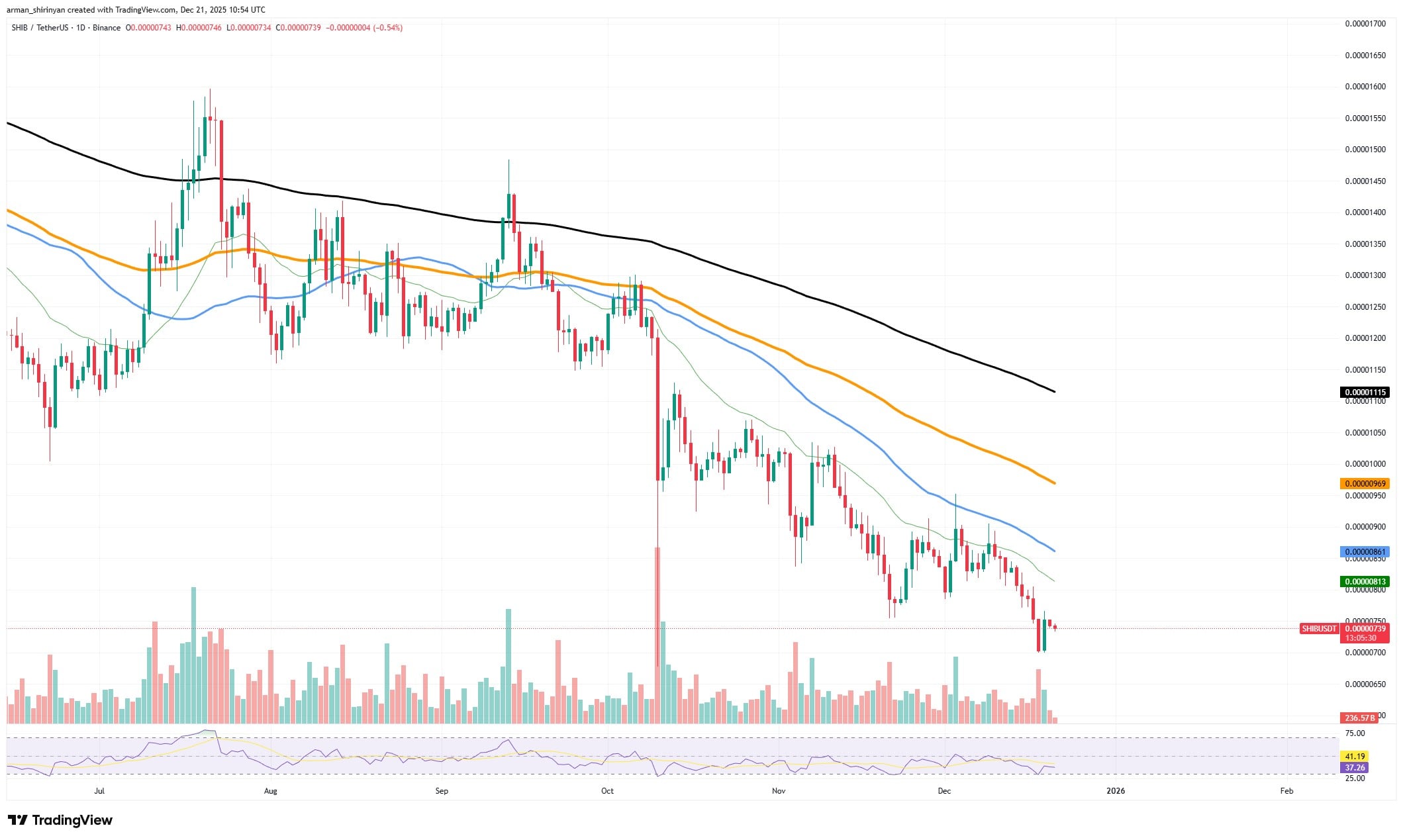
From the perspective of pure price action, SHIB is stuck in a long-term decline. On the daily chart, every significant moving average is sloping downward, and the price remains well below all of them. Attempts to recover short-term resistance have been feeble and fleeting, consistently encountering sell pressure. There is a steady, gradual distribution with no indication of accumulation.
Volume confirms this. Upside candles lack follow-through, while spikes almost always occur on downward movements. Returning to 2023 levels matters because it alters market perception. Anyone who bought dips in 2024 or 2025 is now underwater, creating overhead supply across the entire range above the current price. Any bounce is more likely to be sold into than chased.
Practically speaking, for SHIB to absorb that supply would require a structural catalyst rather than a tweet or a burn headline. None are apparent. This is further supported by the RSI holding in the low 40s. That is not an oversold panic bottom, but a weak market slowly declining. Without capitulation to signal an end, these trends are the hardest to reverse.
The recovery narrative is effectively invalidated by a return to 2023 pricing, which is the larger issue. The speculative moment for SHIB has already occurred. Since then, the token has failed to establish a higher low on a macro time frame, liquidity has declined and relative performance against majors has declined. That is erosion, not consolidation. Demand would need to be strong enough to overcome years of stagnant supply for any recovery to be sustainable.
XRP's chance to stabilize
It appears that XRP has finally stopped bleeding. The price has begun to stabilize and push back above $1.90 after weeks of declining inside a descending channel, printing a significant green daily candle. This is not an isolated bounce; it is occurring at the point where downward momentum has run out.
Since October, XRP has adhered to a distinct bearish channel. Sellers are no longer driving prices lower, which is the key change. The most recent push higher was accompanied by cleaner participation, while volume on down candles has diminished. That is typically the first indication that short-term positioning is crowded on the wrong side and that distribution is coming to an end.
The $2 level now serves as the pivot. It is more than a round number. During the most recent sell-off, XRP repeatedly faltered here, flipping from support to resistance. A reclaim of $2 would place the price back above the lower bound of the broken structure and pose a threat to the mid-range of the broader consolidation. Put simply, rallies are sold below $2, and sellers become uneasy above it.
There is also a psychological element. Earlier in the cycle, XRP spent significant time above $2. When it fell below that level, forced exits and momentum unwinds followed. If the price returns there, those same participants are more likely to reenter rather than exit. That reflexive behavior can create upside pressure, particularly if shorts lean into resistance too early.
Momentum indicators support this view. RSI has moved out of weak territory without entering overbought conditions, which is exactly what you want to see in the early stages of a potential reversal. This is stabilization, not euphoria.
None of this guarantees a straight move higher. Follow-through is required to confirm the move, as XRP still faces notable overhead supply between $2.10 and $2.40. That said, sellers are no longer able to extract easy profits from the market, which materially changes the dynamic.
Bitcoin is not sleeping
Following a steep decline that destroyed weeks of upward momentum, Bitcoin is attempting to regain its footing. Price is currently well below the psychological $100,000 level that dominated narratives earlier in the cycle, hovering in the high $80,000s. From a structural perspective, this market is in repair mode rather than a clear uptrend.
The daily chart tells the story clearly. BTC broke through former support near $100,000, lost its short- and midterm moving averages and accelerated lower on rising volume. As late longs were forced out and leverage was flushed, the price stabilized instead of continuing to cascade. That said, stabilization is not the same thing as a confirmed reversal.
Bitcoin is still trading below key resistance between $93,000 and $100,000. A rally into that zone will not be a free pass higher. It will be a test of conviction. Bulls must reclaim and hold those levels, otherwise upside attempts are simply relief bounces within a broader corrective structure.
Momentum indicators reflect the same uncertainty. RSI has rebounded from oversold conditions but remains muted, signaling that selling pressure has eased while genuine bullish strength has yet to return. This aligns with a market either waiting for a trigger or setting up for another leg lower.
Sentiment data reinforces this caution. On the regulated prediction market Kalshi, traders are not pricing in a rapid return to $100,000. Current odds imply that a move back to six figures is unlikely in the near term. That does not mean $100K is off the table indefinitely, but expectations have shifted from inevitability to conditionality.
 ambcrypto.com
 0
0
 beincrypto.com
 cryptopolitan.com